SIEM vs XDR: What Is the Difference and Do You Need Both?
 Cybergen InsightsCREST-certified security team
|
|
11 min read
Picture two security teams on the same Monday morning. The first opens a dashboard with four thousand overnight alerts from firewalls, servers, cloud services and applications, and starts working out which ones matter. The second opens a single incident: a laptop that ran a suspicious script, an account that then signed in from an unusual location and a mailbox rule that started forwarding invoices. The laptop was isolated and the account disabled at two in the morning.
Both teams are doing threat detection. The first is mostly working in a SIEM. The second is mostly working in XDR. Neither picture is the whole truth, and many organisations end up needing elements of both. This guide explains what each one does, where they overlap, what each costs to run and how to decide what your organisation actually needs.
What a SIEM Does
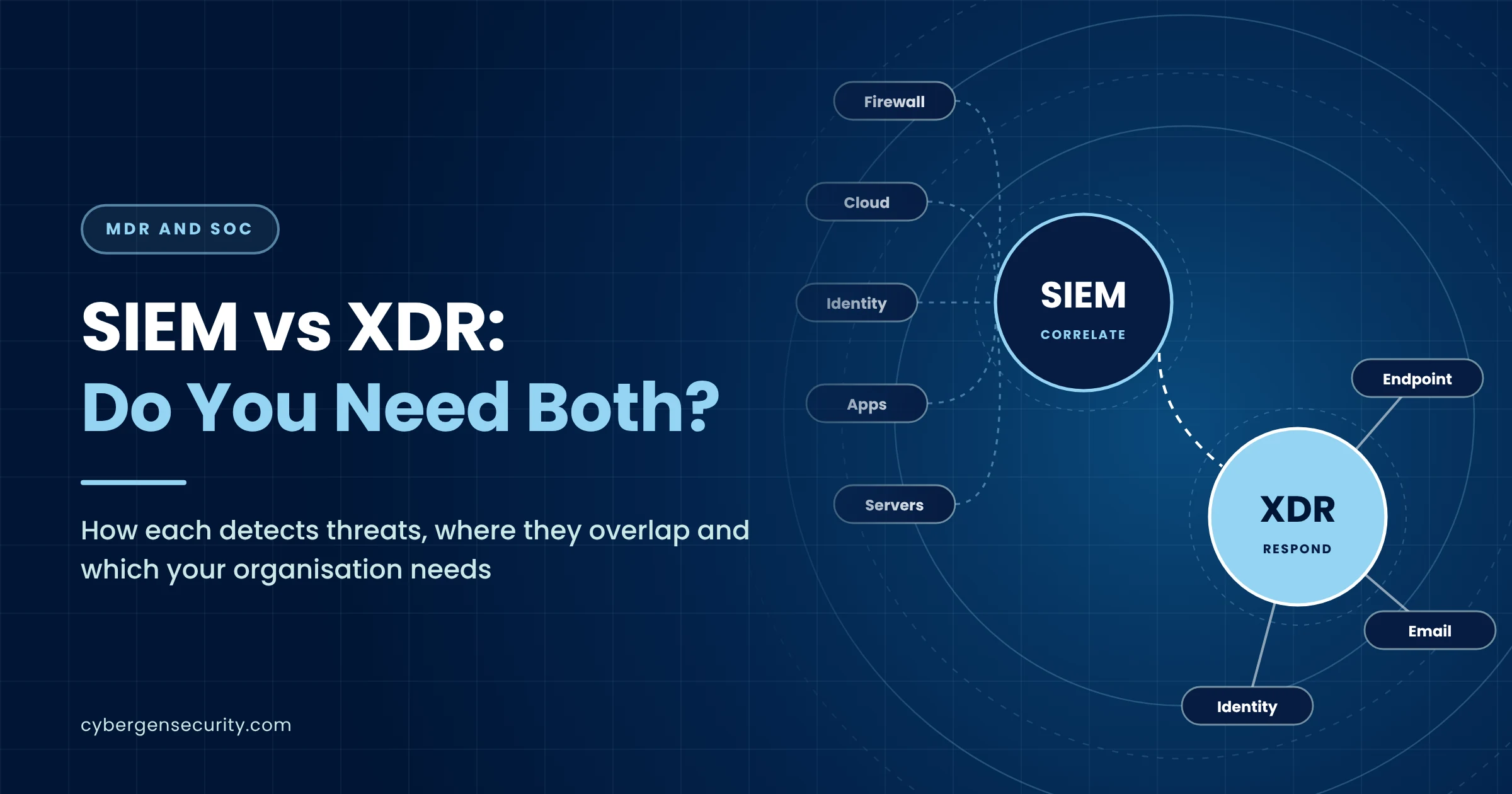
A security information and event management platform, or SIEM, is a central place to collect, store and analyse logs. It pulls in events from firewalls, servers, cloud services, identity systems, applications and network devices, converts them into a common format and runs rules across them to spot suspicious patterns.
The strength of a SIEM is breadth. It can see almost anything that produces a log, which makes it good at spotting attacks that cross boundaries. Think of a login from a new country, followed by a large download from a file server, followed by a firewall connection to an unfamiliar destination. Individually, none of those raises an eyebrow. Correlated, they tell a story.
The NCSC's guidance on logging for security purposes makes the case for collecting and keeping logs well before you think you need them, because investigations so often depend on events from weeks or months earlier. A SIEM is built for exactly that: long retention, fast search and audit-ready evidence.
The catch is effort. A SIEM is a platform, not a finished service. Someone has to connect each data source, write and maintain parsers, build detection rules, tune out noise and, crucially, watch the alerts and act on them. A SIEM that nobody looks at overnight is an expensive record of what went wrong.
Same goal, very different plumbing
- Collect and store
- Normalise
- Correlate with rules
- Search and report
Breadth first: a SIEM takes logs from almost anything and keeps them, but your team writes, tunes and acts on the detections.
- Deep native telemetry
- Built-in detections
- Correlated incidents
- Automated response
Depth first: XDR watches fewer layers in much more detail, ships with detections maintained by the provider and can act on what it finds.
What XDR Does
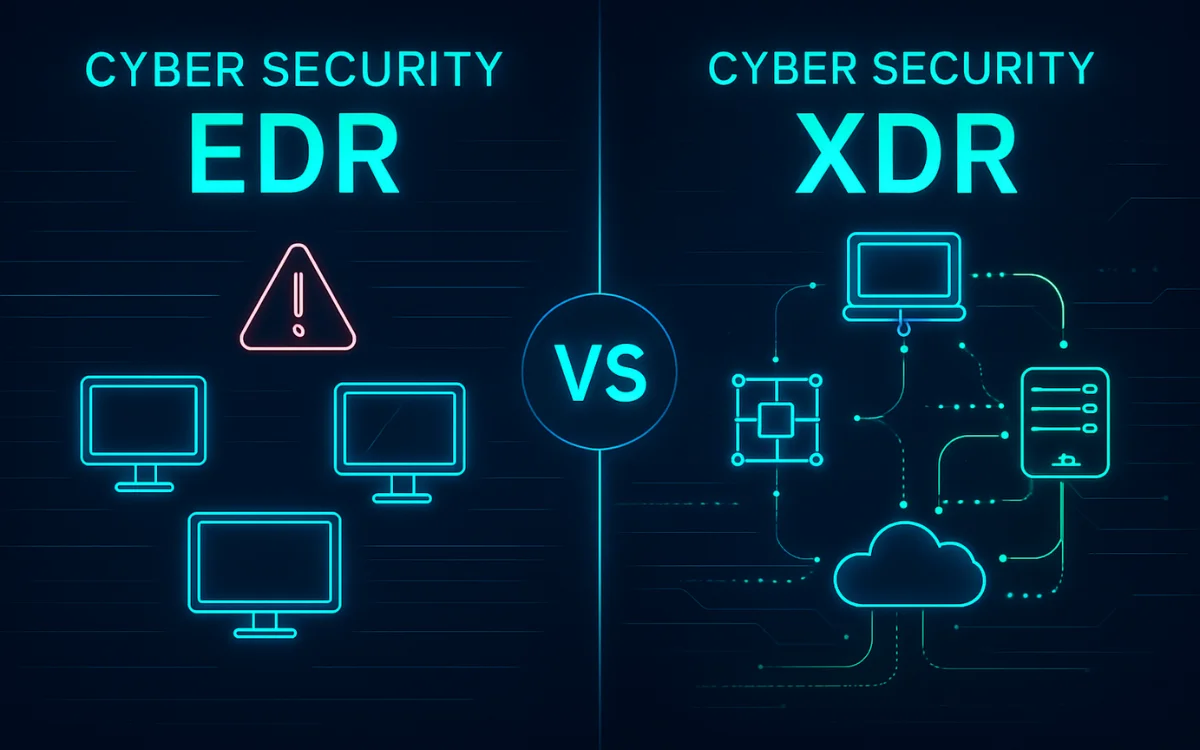
Extended detection and response, or XDR, grew out of endpoint detection and response. EDR watches laptops and servers in fine detail, recording processes, file changes and network connections, and can stop malicious activity on the device. XDR extends that approach to other security layers, typically identity, email and cloud workloads, and joins the signals together into a single incident.
Where a SIEM is broad, XDR is deep. It sees fewer types of data but understands them much better, because the telemetry is designed for detection rather than just logging. Detections are usually built and maintained by the provider and mapped to known attacker techniques, such as those in the MITRE ATT&CK knowledge base, so you get value quickly without writing your own rules.
The other big difference is response. XDR does not just tell you something is wrong; it can act. Isolating a laptop from the network, disabling a compromised account, removing a phishing email from every inbox and stopping a malicious process are typically built in, either automatically or with a single approval. In ransomware, where minutes matter, that is a decisive advantage.
The trade-off is coverage and choice. XDR works best within one provider's ecosystem, and it is not designed to ingest every log source or keep data for years. If your firewall, operational technology or bespoke application is where an attack would show up, XDR alone may not see it.
Comparison Table: Data Sources, Detection, Response, Effort
Here is how the two compare across the points that usually decide the question. Select each one to see the difference side by side.
Almost any source that produces logs: firewalls, cloud, identity, servers, applications, operational technology and more.
A smaller set of security layers, typically endpoints, identity, email and cloud workloads, with much richer detail from each.
Notice that cost is not just the licence. For a SIEM, the biggest variables are how much data you send it and how long you keep it, plus the engineering time to keep detections useful. For XDR, pricing is usually tied to the number of endpoints or users, which is easier to forecast, but you still need people to investigate incidents and make decisions about response. In both cases, the people are often the largest cost of all.
The Same Attack Through Both Lenses
Take a common business email compromise. An attacker phishes a finance user, signs in with their password from an unfamiliar location, sets up a mailbox rule to hide replies and then asks a supplier to change their bank details.
An XDR platform watching identity and email would likely connect the risky sign-in, the new forwarding rule and the suspicious messages into one incident, and could revoke the session and disable the account within minutes. A SIEM would see the same sign-in in the identity logs and the rule creation in the mail audit logs, but only if those sources are connected, a rule exists to correlate them and someone is watching when it fires.
Now change the scenario. The attacker instead exploits an unpatched firewall and moves into an operational technology network with no endpoint agents. Here the SIEM, collecting firewall and network logs, is the one with a chance of spotting it, while XDR may see nothing at all. Most organisations face both kinds of risk, which is why the answer is so often a combination.
When You Need Both
For many mid-sized and larger organisations, the answer is not either or. SIEM and XDR are increasingly used together, with each doing what it is best at.
- You have strict log retention duties. Regulated sectors, public sector suppliers and organisations working towards frameworks that expect long-term log retention usually need SIEM-grade storage and search, even if XDR handles front-line detection.
- Your risk lives beyond the endpoint. If critical systems include operational technology, legacy platforms, bespoke applications or network devices that XDR cannot see, a SIEM fills that gap.
- You want correlation across everything. Feeding XDR incidents into a SIEM lets analysts see an endpoint alert alongside firewall, cloud and application events, which speeds up investigations.
- You need evidence after the event. When an incident turns into an insurance claim, a regulatory report or a legal matter, the long memory of a SIEM is invaluable.
Equally, there are plenty of organisations for whom XDR alone, properly monitored, covers most of the realistic risk. If most of your exposure sits in laptops, servers, user accounts and email, and you have no heavy retention requirement, starting with XDR and adding SIEM capability later is a sensible path.
SIEM, XDR, both or a managed service?
Four questions for a starting recommendation.
Do regulators, auditors or contracts require you to retain security logs for a long period?
Do you need to monitor important systems beyond endpoints, identity and email, such as firewalls, operational technology or bespoke applications?
Do you have security people available to build detections and respond to alerts every hour of every day?
Is most of your risk concentrated in laptops, servers, user accounts and email?
Whichever way the helper points, check two things before buying. First, map your top attack scenarios to data sources and confirm the tool you choose can actually see them. Second, be honest about who will respond at three in the morning. A brilliant platform with nobody watching it is no better than no platform at all.
Where Managed Detection and Response Fits
Managed detection and response, or MDR, answers that last question. It is a service rather than a tool: a team of analysts who monitor your environment around the clock, investigate what the tools find and take action to contain threats. Good MDR services run on SIEM, XDR or both, either your own or theirs.
Tools find the signals. People turn them into outcomes.
For many organisations, MDR is what makes either technology worth having. It removes the need to build a round-the-clock security operations team, brings detection content and threat intelligence that keeps pace with attackers and ensures that alerts lead to action. If you are weighing up providers, our guide on how to choose an MDR provider sets out the questions to ask, and our comparison of MDR and EDR explains how the service and the technology differ.
How Cybergen Can Help
Our advice starts with your risks and obligations rather than a product list. We can help you:
- Review your current detection coverage and map your most likely attack scenarios to the data you actually collect
- Design, deploy and tune SIEM and log management where breadth and retention matter
- Deploy and manage endpoint detection and response as the foundation for XDR
- Monitor and respond around the clock through our 24/7/365 managed detection and response service
- Strengthen detections with threat intelligence focused on your sector
If you are trying to decide between SIEM, XDR or both, speak to our team. We will give you a clear recommendation and explain why.
Frequently Asked Questions
Is XDR replacing SIEM?
Not for most organisations. XDR is taking over a lot of day-to-day threat detection and response, especially across endpoints, identity and email, which used to be done inside the SIEM. But SIEM still does things XDR is not built for: collecting logs from almost any source, keeping them for long periods, supporting investigations that span years and producing compliance evidence. The two are converging, and many platforms now offer elements of both.
Do we need a SIEM for compliance?
Many frameworks and contracts expect you to collect, protect, retain and review security logs, and a SIEM is the most common way to do that across a whole estate. Whether you need a full SIEM depends on your obligations and data sources. Some organisations meet the requirement with the log retention built into an XDR or managed service; others, particularly in regulated sectors, need the breadth and retention a SIEM provides.
What does XDR stand for?
Extended detection and response. It extends the idea behind endpoint detection and response (EDR) beyond the laptop and server to other security layers, typically identity, email, cloud workloads and network, and correlates them into a single view of an attack with built-in response actions.
Is SIEM or XDR better for a small business?
For most smaller organisations, XDR delivered as part of a managed detection and response service is the more practical starting point. It focuses on the places attacks usually start, needs far less tuning and comes with people to act on alerts. A SIEM tends to make sense when log retention requirements, a wide range of data sources or a dedicated security team justify it.
Can MDR use our existing SIEM or XDR?
Often, yes. Good managed detection and response providers can work with the tools you already own, or bring their own platform if you have nothing suitable. What matters most is that the service covers your key data sources, responds rather than just alerts and is clear about who does what during an incident.
Sources
CREST-certified consultants with over 100 years of combined experience in threat intelligence, penetration testing, MDR and compliance.