How to Build a Cyber Threat Intelligence Program Your SOC Will Actually Use
October 2, 2026

Why Most CTI Programs Stall
Most cyber threat intelligence programs do not fail because the analysts are weak. They fail because they were built backwards. A team buys three commercial feeds, stands up a threat intelligence platform, pipes millions of indicators into the SIEM and waits for value to appear. Six months later the SOC is drowning in low-fidelity alerts, leadership is asking what the budget bought, and the CTI analysts spend their days deduplicating IP addresses.
Intelligence is not data. Data is an IP address. Information is the knowledge that the IP address hosted a phishing kit last week. Intelligence is the assessment that a financially motivated actor is targeting your sector's payroll staff with that kit, that your mail filtering will not catch the current lure, and that the detection team should prioritise a specific rule before Friday.
Intelligence answers a question someone actually asked, in time for them to act on it.
This guide is written for SOC analysts, detection engineers and CTI practitioners who are building a program from scratch or rebuilding one that has lost its way. It follows the intelligence lifecycle, but it focuses on the decisions that separate programs that change outcomes from programs that produce PDFs nobody reads: requirements, collection, analysis, dissemination, SOC integration, tooling, metrics and a phased roadmap.
Start With Intelligence Requirements, Not Feeds
Every mature CTI program is anchored in intelligence requirements. Without them, collection is random, analysis is unfocused and nobody can tell whether the team is succeeding. Requirements define what the organisation needs to know, who needs to know it and what decision it supports.
Start by identifying your stakeholders. For a SOC-aligned program they usually include the SOC manager, detection engineering, incident response, vulnerability management, the CISO and, increasingly, fraud and identity teams. Interview each of them with the same few questions: What decisions do you make weekly? What threat information would change those decisions?
What do you currently receive that you ignore?
Turn those conversations into Priority Intelligence Requirements (PIRs). A good PIR is specific, answerable and tied to a decision. Compare these two examples:
- Weak: "What are the latest threats?"
- Strong: "Which ransomware affiliates are actively exploiting internet-facing edge devices we run, and what initial access techniques are they using this quarter?"
Break each PIR into specific intelligence requirements, then into essential elements of information your analysts can actually collect against. The ransomware PIR above might break down into questions about exploited CVEs in your VPN and firewall vendors, affiliate tooling seen after initial access, and leak site postings naming peers in your sector.
Keep the list short. Five to eight PIRs is plenty for a small team. Review them quarterly with stakeholders and retire the ones nobody uses. Written requirements are the single most useful artefact a CTI team can own, because they turn "we do threat intel" into a service with a defined scope and a way to say no.
Build a Collection Strategy Around Your Own Telemetry
The richest intelligence source you have is your own environment. Incident reports, phishing submissions, EDR detections, proxy and DNS logs, blocked authentication attempts and past breach investigations all show which adversaries are actually interacting with you. External feeds tell you what is happening to everyone. Internal telemetry tells you what is happening to you.
Map each PIR to the sources that can answer it using a simple collection plan. For every requirement, record the source, its access method, its expected value and any gaps. That plan quickly exposes blind spots, such as having no visibility into cloud control plane logs while one of your PIRs concerns identity-based intrusions.
Once internal collection is working, layer in external sources deliberately:
- Open source: vendor threat reports, government advisories (CISA, NCSC, ACSC), security researcher blogs, malware repositories and code sharing sites.
- Communities: sector ISACs and ISAOs, trusted peer groups and closed Slack or Signal channels, where the best tactical intelligence is often shared first.
- Commercial: premium intelligence vendors, attack surface monitoring and dark web or underground forum coverage.
- Technical enrichment: passive DNS, certificate transparency logs, WHOIS history, internet scan data and sandbox services.
Evaluate every source against your requirements before you pay for it. Ask for a trial and measure how many of its reports or indicators map to a PIR, how many were new to you and how early they arrived. Grade sources over time using a consistent scheme such as the Admiralty Code, which rates source reliability (A to F) separately from information credibility (1 to 6). A source that is fast but frequently wrong should carry less weight than one that is slower but consistently accurate.
Turn Information Into Analysis With Proven Frameworks
Processing is where raw collection becomes usable: normalising formats, deduplicating indicators, enriching them with context and expiring stale data. Automate as much of this as possible. Analysts should spend their time thinking, not copying hashes between browser tabs.
Analysis is where a CTI program earns its keep. Three frameworks do most of the heavy lifting for SOC-aligned teams:
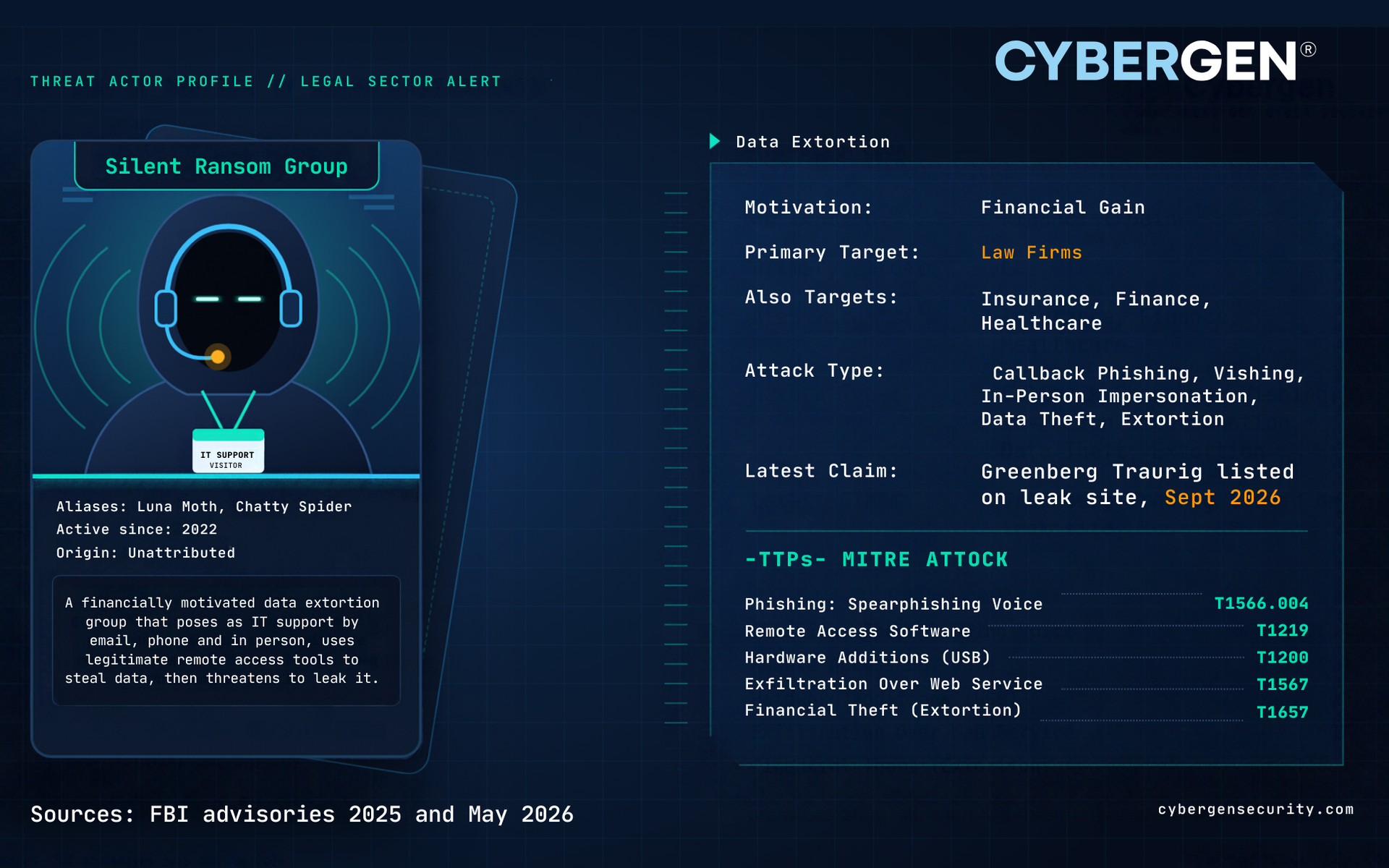
- MITRE ATT&CK gives you a shared language for adversary behaviour. Mapping reports and incidents to techniques lets you compare actors, spot the techniques that recur across your threat landscape and measure detection coverage against them.
- The Diamond Model of Intrusion Analysis links adversary, capability, infrastructure and victim. It is ideal for pivoting: a single domain from a phishing email can lead to shared hosting, related certificates, other victims and eventually a clustered activity group.
- The Cyber Kill Chain remains useful for explaining where in an intrusion a control failed or succeeded, particularly when briefing non-specialists.
Keep David Bianco's Pyramid of Pain in mind when prioritising. Hashes and IP addresses are trivial for an adversary to change, while tools and TTPs are expensive to replace. Intelligence that describes behaviour lasts longer and drives better detections than intelligence that lists indicators.
Finally, guard against bias. Analysts anchor on the first attribution they hear, and vendor naming conventions blur the picture further. Techniques such as Analysis of Competing Hypotheses (ACH), developed by Richards Heuer, force you to weigh evidence against several explanations instead of confirming one. Always state confidence explicitly using standard estimative language ("likely", "almost certainly") and separate what you observed from what you assess. A clearly labelled low-confidence judgement is far more useful than a confident one that turns out to be wrong.
Match Intelligence Products to Their Audience
The best analysis in the world is worthless if it arrives in the wrong format, at the wrong time or to the wrong person. Design a small catalogue of products and match each one to a stakeholder and a PIR.
| Level | Audience | Example products | Cadence |
|---|---|---|---|
| Tactical | SOC analysts, detection engineers | Indicator packages, Sigma and YARA rules, hunt packages | Continuous or daily |
| Operational | IR leads, SOC managers, vulnerability management | Actor and campaign profiles, flash alerts on active exploitation | Weekly or event-driven |
| Strategic | CISO, risk committee, executives | Threat landscape assessments, quarterly briefings | Monthly or quarterly |
Lead every product with the "so what". A flash alert should open with the action required and the deadline, then the supporting evidence. Executives rarely read past the first paragraph, and SOC analysts want the detection logic, not the geopolitical backstory.
Label sharing restrictions consistently using the Traffic Light Protocol (TLP 2.0: CLEAR, GREEN, AMBER, AMBER+STRICT and RED) so recipients know what they can pass on. Then close the loop: every product should invite feedback, and that feedback should flow back into your requirements.
Follow a Phased Maturity Roadmap
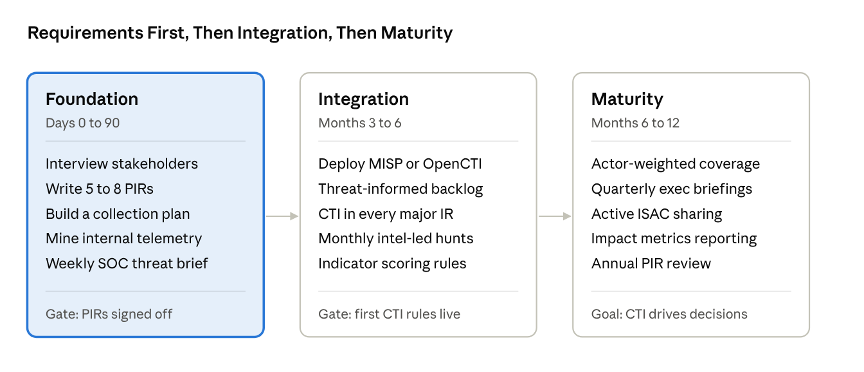
You do not need a ten-person team to deliver value. A single dedicated analyst with clear requirements can transform a SOC's effectiveness within a quarter. The key is sequencing: prove value on a narrow scope, then expand.

CTI program roadmap · 3 phases over 12 months
Each phase ends with a gate. Do not deploy a platform before your PIRs are agreed, and do not chase strategic briefings before the SOC trusts your tactical output. Programs that skip the foundation almost always end up rebuilding it later.
Common Pitfalls to Avoid
- Feed hoarding. More sources do not mean better intelligence. Every feed you add costs analyst time to evaluate and maintain.
- Attribution obsession. Knowing the exact actor name matters less than knowing the behaviour and how to detect it. Attribute when it changes a decision, not for its own sake.
- Report factories. If your products are not read, stop producing them and ask stakeholders what they need instead.
- Isolation from the SOC. CTI teams that sit apart from operations lose context quickly. Sit together, share tickets and attend each other's stand-ups.
- No feedback loop. Without feedback, requirements go stale and the program drifts away from what the organisation needs.
- Ignoring the business. Understand your organisation's crown jewels, suppliers and strategic plans. A merger, a new market or a cloud migration all reshape your threat landscape.
Measure CTI Value With Metrics That Matter
"Number of indicators ingested" is the most common CTI metric and one of the least meaningful. Volume measures activity, not impact. Good metrics show that intelligence changed a decision or an outcome.
| Metric | What it shows |
|---|---|
| Detections created or tuned from CTI | Direct influence on defensive coverage |
| Coverage of prioritised actor techniques | How well you defend against the threats that matter to you |
| Incidents where CTI shortened scoping or containment | Operational value during response |
| Hunts initiated from intelligence, and their outcomes | Proactive discovery driven by threat knowledge |
| Lead time on exploited vulnerabilities | How early CTI flagged a CVE before exploitation in your environment |
| PIR coverage and stakeholder feedback scores | Whether you are answering the questions people asked |
| True positive rate of CTI-sourced alerts | Quality and trustworthiness of what you push to the SOC |
Pair the numbers with short impact stories. "CTI flagged active exploitation of our VPN vendor's CVE nine days before our patch window, and the emergency patch closed the gap before any scanning reached us" will do more for your budget than any dashboard. Collect these stories as they happen, because they are hard to reconstruct at year end.
Summary: Intelligence Is a Service, Not a Feed
Building a cyber threat intelligence program is less about technology and more about discipline. Anchor everything in intelligence requirements. Collect from your own environment first. Analyse with structured frameworks and honest confidence levels. Deliver products shaped for the people who will use them. Above all, wire intelligence directly into detection engineering, threat hunting and incident response so it changes what the SOC does every day.
If you take one action this week, schedule thirty-minute interviews with your top five stakeholders and ask what decisions they need help with. Their answers are the first draft of your PIRs, and your PIRs are the foundation of everything that follows. Start small, prove value, measure impact and scale deliberately. That is how a CTI function becomes one of the most trusted teams in security.
Ready to strengthen your security posture? Contact us today for more information on protecting your business.
Let's get protecting your business
Thank you for contacting us.
We will get back to you as soon as possible.
By submitting this form, you acknowledge that the information you provide will be processed in accordance with our Privacy Policy.
Please try again later.
Cybergen News
Sign up to get industry insights, trends, and more in your inbox.
Contact Us
Thank you for subscribing. It's great to have you in our community.
Please try again later.
SHARE THIS
Latest Posts