Does NIS2 Apply to UK Companies?
 Cybergen InsightsCREST-certified security team
|
|
12 min read
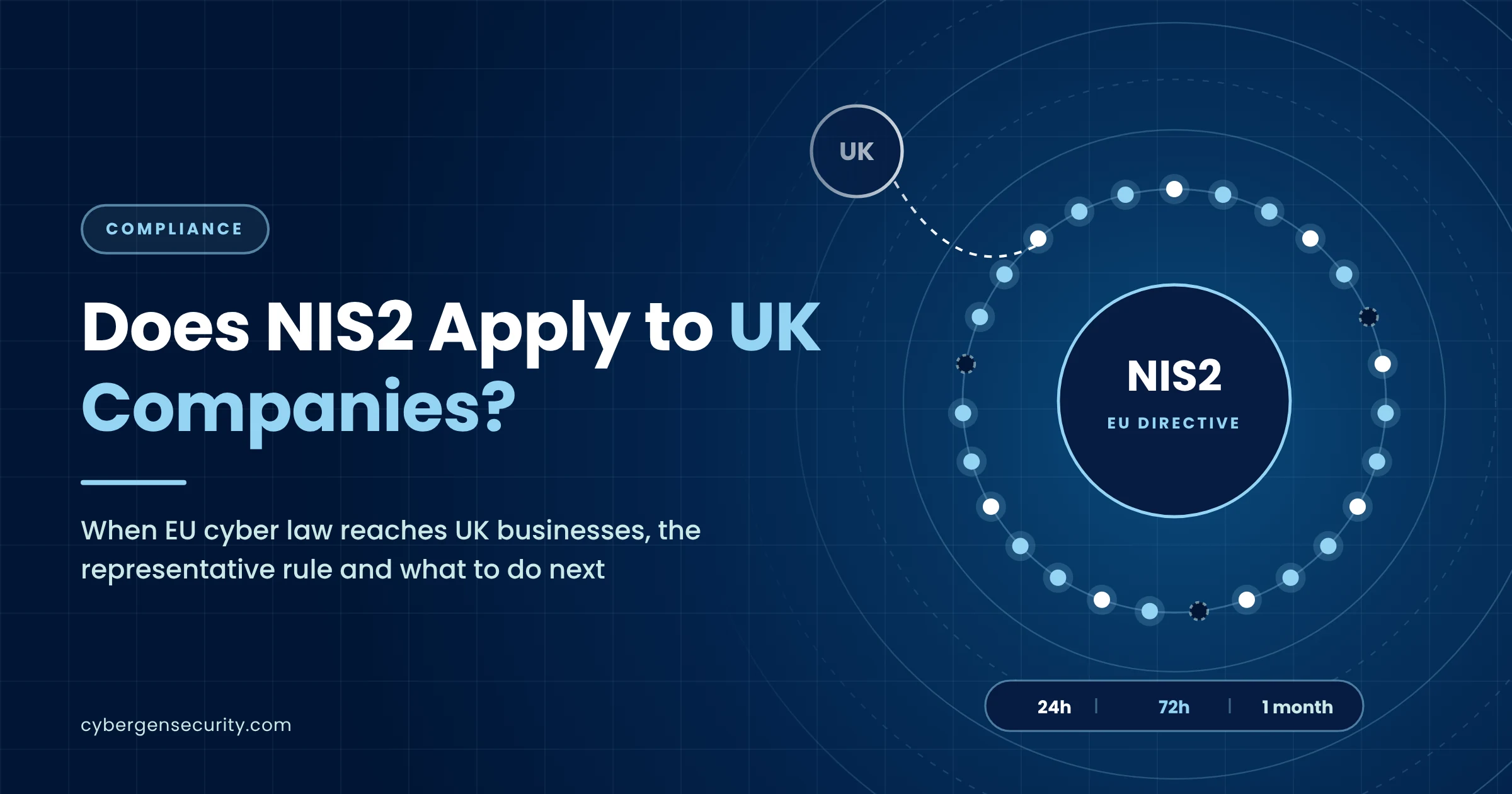
Brexit took the UK out of EU law, but it did not take UK businesses out of the EU market. That is why a question we hear often from boards is a reasonable one: if NIS2 is an EU directive, why are our European customers asking whether we comply with it?
The short answer is that NIS2 can reach a UK company in three ways. It can apply directly to an EU subsidiary or office. It can apply to a UK provider of certain digital services into the EU, which must then appoint an EU representative. And it can apply indirectly, because EU organisations in scope must manage the security of their suppliers. This guide explains each route, how the rules decide who is responsible and how NIS2 compares with the UK's own Cyber Security and Resilience Bill.
This article is guidance, not legal advice. Scope depends on your exact services, structure and the national law in each member state, so take specialist advice before relying on it.
Why a UK Company Can Be in Scope
NIS2, formally Directive (EU) 2022/2555, replaced the original NIS Directive and applies to organisations that provide their services or carry out their activities within the EU. Member states were due to bring it into national law by 17 October 2024. Most have now done so.
24 of 27 member states, with three still to finish
France's National Assembly passed its law on 17 November 2026, but it still needs final agreement with the Senate, and Ireland and Spain were still finalising theirs, when this article was updated.
Source: NIS2 EU tracker, reviewed 26 October 2026. Being "in force" does not mean every national law is complete or identical.
Where you sit depends on your footprint in Europe, not your headquarters. Try the quick check below, then read on for what each answer means.
Could NIS2 reach your company?
Answer five questions for a quick indication. It is a starting point for a proper scoping exercise, not legal advice.
Do you have an office, subsidiary or other establishment in an EU member state?
Does that EU business work in a NIS2 sector, such as energy, transport, health, digital infrastructure, ICT services, manufacturing, food, waste or post?
Is that EU business medium-sized or larger: 50 or more staff, or annual turnover and balance sheet both above 10 million euros?
Do you provide cloud, data centre, content delivery, DNS, managed IT or managed security services, an online marketplace, search engine or social network to customers in the EU?
Do EU organisations rely on you as a supplier of IT, software or other services that touch their systems or data?
Route One: Your EU Entities
If your group has a subsidiary, branch or office in a member state, that entity is assessed under the national law of that state like any local business. If it works in a NIS2 sector and is medium-sized or larger, it is very likely in scope, regardless of the fact that the parent company sits in the UK. Expect the regulator to look at group-wide controls too, because the EU entity's security usually depends on shared systems, identities and IT teams run from the UK.
Route Two: Digital Services Into the EU
NIS2 gives special treatment to a list of digital services that cross borders easily: cloud computing, data centres, content delivery networks, DNS, top-level domain registries, managed IT services, managed security services, online marketplaces, search engines and social networks. A UK provider of these services to EU customers can be in scope even with no office in the EU. That is where the representative rule, covered below, comes in.
Route Three: Your Customers' Supply Chains
This is the route that affects the most UK businesses. NIS2 requires organisations in scope to manage security risks from their direct suppliers and service providers. In practice that means security questionnaires, contract clauses, audit rights and incident notification duties flowing down to suppliers, including UK ones. You may not be regulated, but your contracts increasingly will be. Our supply chain risk management work sees this from both sides.
Essential and Important Entities
NIS2 sorts organisations in scope into two groups. The difference matters, because it changes how closely you are supervised and the size of the potential fine.
Mostly large organisations in the highest criticality sectors, such as energy, transport, banking, health, drinking water, digital infrastructure and ICT service management.
- Audits and inspections at any time
- Fines up to at least 10 million euros or 2% of worldwide turnover
Medium-sized organisations in those sectors, plus medium and large organisations in other critical sectors, such as manufacturing, food, waste, post, chemicals and digital providers.
- Checked when there is evidence of a problem
- Fines up to at least 7 million euros or 1.4% of worldwide turnover
The size test is the usual starting point. Medium-sized means at least 50 staff, or annual turnover and balance sheet both above 10 million euros. Some services are covered whatever their size, including DNS providers, top-level domain registries, trust service providers and public electronic communications networks. Member states can also add smaller organisations that are critical in their own country.
Whichever group you fall into, the obligations are similar. Article 21 sets out ten areas of risk management, from incident handling and business continuity to supply chain security, encryption, access control and multi-factor authentication. Article 20 makes leadership answerable: management bodies must approve the measures, oversee their delivery and take training, and they can be held liable if they fail to do so. This is not a compliance task that can sit with the IT team alone.
Two regimes, two very similar stopwatches
Clocks start when you become aware of a significant incident. Timeline not to scale. UK figures reflect the Cyber Security and Resilience Bill as introduced and may change before it becomes law.
The reporting duty is where many organisations discover gaps. A significant incident starts a 24 hour clock for an early warning, a 72 hour clock for a fuller notification and a one month deadline for a final report. Knowing who decides that an incident is significant, who drafts the report and who sends it, at three in the morning on a bank holiday, is something to rehearse in advance. An incident response retainer and a tabletop exercise built around the reporting timeline are two of the fastest ways to close that gap.
Appointing an EU Representative
Article 26 decides which member state is responsible for an organisation. For most sectors it is simply the member state where you are established. For the cross-border digital services listed above, it is the member state of your main establishment in the EU, usually where decisions on cyber security risk management are taken.
If you provide those digital services into the EU but have no establishment there, NIS2 requires you to designate a representative established in one of the member states where you offer services. You are then treated as falling under the jurisdiction of that member state. The representative acts as a contact point for the authorities, and you must register your details with that member state's competent authority, which passes them to ENISA's registry of these providers.
Two points are worth stressing. First, appointing a representative does not move your legal responsibility onto them. You remain accountable for meeting the obligations. Second, if you do not appoint one, the directive allows any member state where you provide services to take action against you. Choosing deliberately, with advice on which country's approach suits your services, is better than being chosen.
NIS2 and the UK Cyber Security and Resilience Bill Side by Side
The UK is updating its own regime at the same time. The Cyber Security and Resilience Bill amends the NIS Regulations 2018, bringing managed service providers, larger data centres and designated critical suppliers into scope, tightening incident reporting and giving regulators stronger powers. The Bill completed its House of Lords stages on 2 November 2026 and has returned to the Commons, where MPs are due to consider the Lords amendments on 24 November 2026. It becomes law only once both Houses agree the final text and it receives Royal Assent. Most of its duties will be switched on later through secondary legislation.
For a UK group with EU operations, the overlap is good news. The controls that satisfy NIS2 will go most of the way towards the UK Bill, and vice versa. Running one programme with one set of evidence, mapped to both, is far cheaper than two parallel projects. Our earlier guide to the UK Bill covers the domestic side in more detail.
Financial services firms have a third framework to consider. The EU's Digital Operational Resilience Act takes precedence over NIS2 for financial entities and brings its own testing and third-party requirements. Our DORA compliance service and our article on threat-led penetration testing for DORA and NIS2 cover where they meet.
A Readiness Checklist
Whether NIS2 applies to you directly or through your customers, the same practical steps will put you in a strong position. Work through them in order: scope first, then ownership, then the controls and evidence.
NIS2 readiness for UK organisations
Tick each step you have completed.
Nothing you tick is sent or stored.
If you only do three things this quarter, make them these. Confirm your scope in writing, so you know which entities and member states are involved. Rehearse the reporting timeline end to end. And prepare a short, evidence-backed answer to the supplier questionnaires your EU customers will keep sending. Those three steps reduce regulatory risk and protect revenue at the same time.
How Cybergen Can Help
Our NIS2 compliance service helps UK organisations understand where they stand and get ready in the right order:
- Scoping across your EU entities, digital services and customer contracts, including whether you need an EU representative
- A gap assessment against the Article 21 measures, mapped to the UK Bill and ISO 27001
- Board briefings and ongoing leadership support through our virtual CISO service
- Incident response planning and exercises built around the 24 hour, 72 hour and one month deadlines
- CREST penetration testing to prove your controls work
If your EU customers are asking about NIS2, or you are not sure whether it reaches you, speak to our team. We will give you a clear answer and a practical plan.
NIS2 transposition across EU member states and the progress of the UK Cyber Security and Resilience Bill are subject to change. This guidance reflects the position as at 24 November 2026 and is not legal advice.
Frequently Asked Questions
What are the NIS2 reporting deadlines?
For a significant incident, NIS2 sets three stages: an early warning to the national CSIRT or competent authority within 24 hours of becoming aware of it, a fuller incident notification within 72 hours, and a final report within one month of that notification. Authorities can also ask for interim updates along the way.
Which EU country regulates us?
As a general rule, the member state where your entity is established. For certain digital services, such as cloud, data centre, managed and managed security services, it is the member state of your main establishment in the EU. If you provide those digital services into the EU with no establishment there, you must designate a representative, and the member state where the representative is based takes jurisdiction.
Does NIS2 apply to a UK company with no EU office?
Usually not directly, unless it provides one of the digital services listed in Article 26 to customers in the EU, such as cloud, data centre, content delivery, DNS, managed IT or managed security services, or runs an online marketplace, search engine or social network. In that case it must appoint an EU representative. Many other UK suppliers feel NIS2 indirectly, because their EU customers must manage supply chain risk.
What are the fines under NIS2?
Member states must be able to fine essential entities at least up to 10 million euros or 2% of total worldwide annual turnover, whichever is higher, and important entities up to 7 million euros or 1.4%. Senior managers can also be held accountable for failing to oversee cyber risk measures.
Does the UK have its own version of NIS2?
The UK still uses the NIS Regulations 2018, which came from the original EU NIS Directive. The Cyber Security and Resilience Bill will update them, adding managed service providers and data centres, tighter incident reporting and stronger regulator powers. It overlaps with NIS2 but is a separate law with its own scope.
Sources
- Directive (EU) 2022/2555 (NIS2), Official Journal of the EU
- NIS2 tracker: transposition status in all 27 EU countries (reviewed 26 October 2026)
- NIS2 Article 26: entities headquartered outside the EU
- Cyber Security and Resilience (Network and Information Systems) Bill: stages (accessed October 2026)
- Foot Anstey: Cyber Security and Resilience Bill, broader scope and tougher obligations
CREST-certified consultants with over 100 years of combined experience in threat intelligence, penetration testing, MDR and compliance.