Closing the Detection Gap: How SMEs Can Access Enterprise-Grade SOC Protection Without an Enterprise Budget


August 26, 2026

Introduction

Every CISO at a mid-market organisation knows the feeling: the board wants "enterprise-grade" security, the insurer wants evidence of 24/7 monitoring, and the budget looks nothing like the one enjoyed by the FTSE 350 companies being used as the benchmark. It is not a failure of planning. It is a structural mismatch between the way cyber risk is now distributed and the way security budgets have traditionally been allocated. Attackers stopped treating company size as a proxy for value a long time ago. Security budgets, in far too many mid-market and SME businesses, have not caught up.


That mismatch is the real story behind almost every ransomware headline involving a business nobody expected to be a target. It is also the reason a growing number of CISOs and heads of IT are re-examining a decision they may have made years ago: build detection and response capability in-house, or find a way to operate at enterprise standard without carrying an enterprise cost base. This is not a theoretical debate. The numbers make the case on their own.


It is also, increasingly, a board-level conversation rather than a purely technical one. Directors who once treated cybersecurity as an IT line item now ask pointed questions after every high-profile breach they read about: are we exposed the same way, and how would we know if we were compromised right now? A CISO who cannot answer that second question with confidence, who has to describe monitoring in terms of tools deployed rather than eyes actually watching them, is in a difficult position, regardless of how much has already been spent on the security stack. Closing that gap between "we have the tools" and "someone is genuinely watching them, all the time" is the single most consequential decision many mid-market security leaders will make this year.

The Uncomfortable Numbers Every CISO Already Knows

Small and mid-sized businesses are not the soft, ignorable end of the threat landscape anymore — they are the primary target. Verizon's 2025 Data Breach Investigations Report found that small businesses are attacked at nearly four times the rate of larger enterprises, and organisations with smaller headcounts now account for the majority of tracked breaches industry-wide. Proton's February 2026 research found that one in four SMBs were breached in the past year, despite 92% of them already having security tools in place. That last figure is the one worth sitting with: this is not, in the main, a story about businesses with no defences. It is a story about businesses with tools deployed but nobody watching them closely enough, quickly enough, around the clock.


The financial exposure has grown to match. SonicWall's 2026 Cyber Protect Report put the average cost of an SMB breach, accounting for downtime, recovery and reputational damage, at $4.91 million once the full picture is considered, with breaches going undetected for a median of 181 days before discovery. VikingCloud's 2026 research found that 40% of SMBs say a cyberattack costing as little as $100,000 would be enough to put them out of business, and Proton's SMB-specific data shows 67% of breached small businesses reported losses between $10,000 and $100,000. Ransomware sits at the centre of this picture: Verizon found that 88% of confirmed SMB breaches involved ransomware, compared with 39% in large enterprises, and Sophos put average ransomware recovery costs at $638,000 for organisations with 100–250 employees, before any ransom payment is factored in.


Layer on the fact that 79% of attacks now involve no malware at all, relying instead on stolen credentials and abuse of legitimate tools, according to CrowdStrike's 2025 research — and that AI-generated phishing is achieving a 54% click-through rate compared with 12% for human-written lures, and the picture for a CISO trying to defend a mid-market business with a lean team becomes clear. The threat has industrialised. The defence, in most SMEs, has not.

Why "Just Build a SOC" Isn't Realistic Advice for Most Mid-Market Businesses

The instinctive response from a board hearing these numbers is often "so build a SOC." It is the right instinct pointed at the wrong solution for the vast majority of organisations outside the enterprise bracket. Industry cost modelling puts the fully loaded cost of a genuinely 24/7, in-house security operations centre, staffing, SIEM licensing, cloud monitoring, threat intelligence feeds and vulnerability scanning combined, at anywhere between $2 million and $7 million annually, with a bare-minimum round-the-clock team costing north of $1 million a year even before tooling is added. The average security analyst commands roughly $90,000 in salary alone, and covering three shifts, 365 days a year, without gaps during annual leave, sickness or attrition, typically requires eight to twelve analysts minimum, not the two or three that most mid-market security budgets can realistically stretch to.


That cost is only half the problem. Building a SOC also takes time — realistically months, sometimes years, to recruit, train and embed a team while procuring and tuning the toolset. During that build-out window, the organisation is exactly as exposed as it was before the project started, except now it is also carrying the cost and distraction of the build. And once the SOC exists, retention becomes its own ongoing risk: Tier 1 analyst roles have some of the highest burnout and turnover rates in the entire security profession, driven by exactly the kind of relentless, repetitive alert triage that grinds down even motivated people. A CISO who builds an in-house SOC has not solved the staffing problem, they have taken permanent ownership of it.


For the overwhelming majority of SMEs and mid-market organisations, this is simply not a viable path, and pretending otherwise wastes time the security team doesn't have. There is also an opportunity cost that rarely makes it into the board paper: every hour a CISO or a senior engineer spends interviewing analyst candidates, evaluating SIEM vendors, or writing shift rotas is an hour not spent on architecture, risk reduction, or the strategic work that justified hiring a CISO in the first place. The more useful question is not "how do we build this" but "how do we access equivalent capability without owning all of its overhead and risk."

What Enterprise-Grade Detection Actually Requires

It is worth being precise about what "enterprise-grade" means in practice, because it is not a marketing phrase, it describes a specific operational capability. It means continuous, human-led monitoring, not just tooling that generates alerts and hopes someone is watching. It means every alert going through a disciplined triage and qualification process, so that genuine threats are separated from noise before they ever reach an already-stretched internal team. It means an incident response function that is embedded and ready to activate the moment a threat is confirmed, rather than a phone number to call once the damage is already spreading.


It means the ability to isolate and contain a compromised host automatically, at machine speed, rather than waiting for a human to notice and react. And increasingly, it means all of this being independently verified, ISO 27001 certification, in particular, has become the baseline evidence that a provider's processes, not just its technology, can be trusted with sensitive detection and response data.


None of this requires an SME to rip out its existing security stack and start again, a fact that matters enormously to a CISO who has already invested in Microsoft Defender, SentinelOne or another EDR platform and has no appetite for a disruptive re-platforming exercise. What it requires is bringing genuinely enterprise-calibre monitoring, triage and response capability to bear on the tools that are already in place, and filling the gaps where they don't yet exist.

How Cybergen Delivers This Without the Overhead

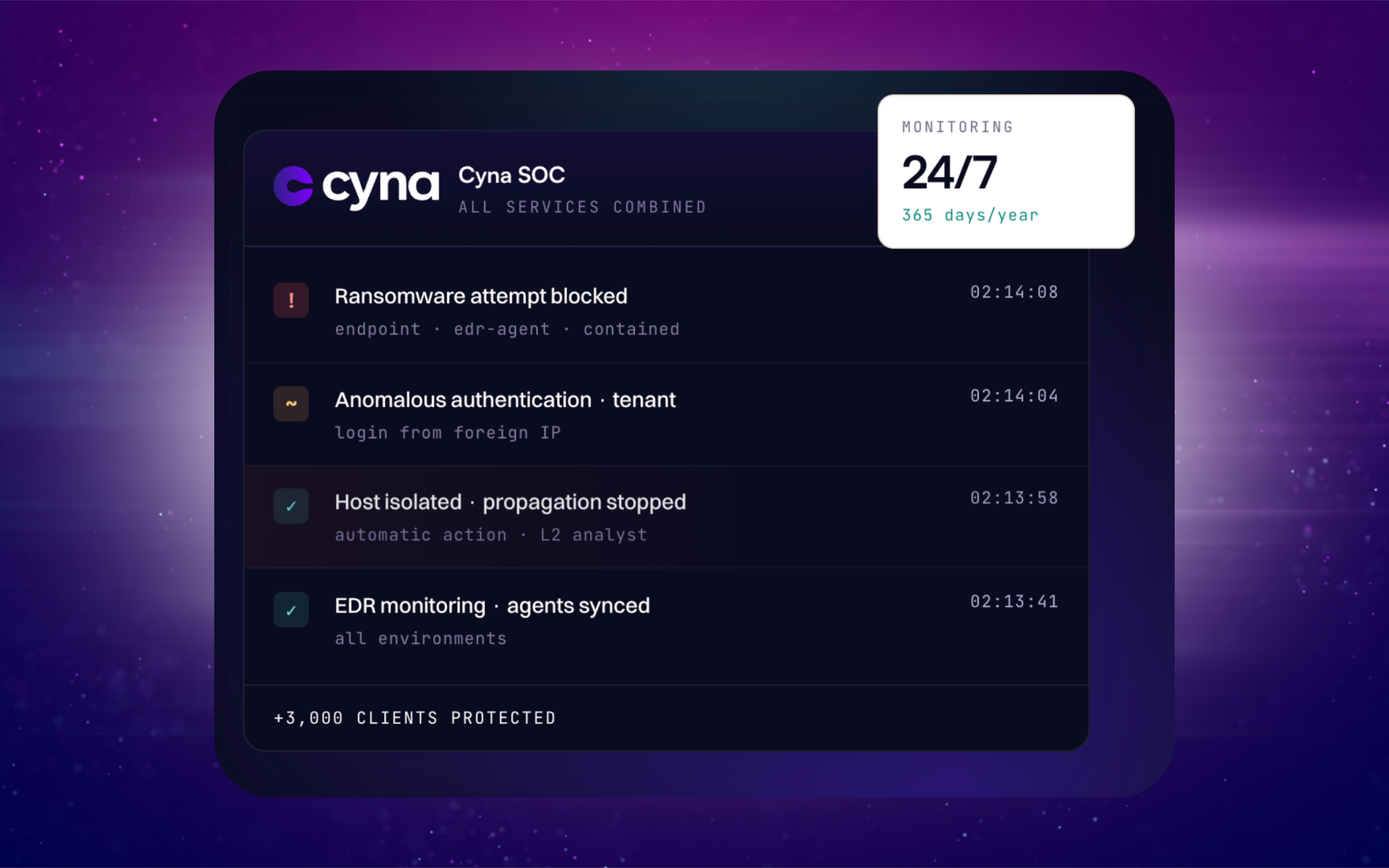
This is precisely the capability Cybergen brings into its own security services, built on a specialist detection and response platform that already protects more than 3,000 businesses and operates through 400-plus partner organisations across Europe. Rather than asking clients to build a monitoring function from nothing, Cybergen wraps this always-on capability around the client's existing environment as a natural extension of the wider prevention, detection and compliance services Cybergen already provides.


In practice, that means continuous monitoring performed by in-house analysts — not an offshore, subcontracted queue — working a genuine 24/7/365 rotation across Tier 1 and Tier 2 response. Every alert generated by the client's tools is triaged and qualified by a human analyst before it goes anywhere near the client's team, which is precisely the layer most stretched internal SOCs and IT departments cannot sustain on their own. Where a confirmed incident is identified, a dedicated incident response team activates immediately as part of the standard service — not as an emergency call-out that gets quoted and billed separately once the crisis is already underway.


That distinction matters more than it might first appear: a huge proportion of the anxiety CISOs carry around incident response is uncertainty about cost and response speed at the exact moment those things matter most. Removing that uncertainty, by including CERT-level response by default rather than as a chargeable extra, changes the entire risk conversation a CISO can have with their board.


The platform is built to work with the endpoint detection tools organisations already run — natively supporting Microsoft Defender and SentinelOne — and where a client doesn't yet have EDR in place, the appropriate licensing is bundled in rather than left as another procurement hurdle. Automatic containment and host isolation capability sits behind the monitoring layer, so that a confirmed compromise on one machine doesn't become a lateral-movement problem while a human is still being paged. The whole operation runs on an ISO 27001-certified platform, giving CISOs the audit trail and assurance they need when this capability shows up in a board pack, an insurance renewal, or a customer security questionnaire.


For a CISO evaluating this, the practical shift is significant: the organisation gains a genuinely staffed, 24/7 detection and response function without adding a single headcount, without a multi-year build programme, and without owning the recruitment and retention risk that comes with running Tier 1 analysts internally. It is enterprise-calibre operational security, delivered as a natural extension of the security programme the CISO is already running — not a bolt-on vendor relationship to manage separately.

The Economics: Enterprise Capability at a Fraction of the Cost

Set the numbers side by side and the case becomes straightforward. Building an equivalent in-house capability costs somewhere between $1 million and $7 million a year once staffing, tooling, training and the shift-coverage overhead needed for genuine round-the-clock resilience are all accounted for, and that figure assumes the organisation can actually recruit and retain eight-plus analysts in a market where experienced SOC talent is scarce and expensive. Accessing that same calibre of monitoring, triage, containment and incident response through Cybergen's service instead converts that entire capital and staffing problem into a predictable, scalable operating cost, with no recruitment risk, no tooling procurement cycle, and no exposure to the eighteen-month gap while an internal team is built and trained.


This is what genuinely levels the playing field for SMEs and mid-market businesses. The 40% of SMBs who say a $100,000 breach would put them out of business, and the 66% who cite cost as the primary barrier to stronger security, are not being offered a cut-down, watered-down version of enterprise protection here, they are being given access to the same triage discipline, the same in-house analyst standard, the same included incident response, and the same certification baseline that a large enterprise SOC would deliver, sized and priced for a business that could never have justified building it themselves. That is the real impact of this model: it does not make security cheaper by making it worse, it makes genuinely enterprise-grade protection accessible to organisations that were previously priced out of it entirely.

What This Means for the CISO's Day-to-Day

Beyond the economics, the operational relief for a CISO and their team is substantial. Alert fatigue is one of the most consistent, least glamorous drivers of security team burnout, and offloading first-line triage and qualification to a dedicated, always-on analyst function frees an internal team to focus on the things a vendor cannot do for them: architecture decisions, vendor risk, security awareness culture, and the strategic conversations the board actually needs from a CISO. Incident response readiness stops being a slide in a tabletop exercise and becomes an operational reality that can be pointed to directly in board reporting, cyber insurance renewals and customer due-diligence questionnaires.


It also strengthens the compliance narrative that increasingly sits alongside technical security work. With NIS2, DORA and Cyber Essentials all raising the bar on demonstrable, continuous monitoring and documented incident response capability, having a 24/7, ISO 27001-certified detection and response function in place is no longer a nice-to-have differentiator — it is fast becoming the expected baseline that regulators, auditors and enterprise customers ask about directly. A CISO who can answer "who is watching this at 3 am on a Sunday, and what happens the moment something is confirmed" with a specific, credible answer is in a materially stronger position than one relying on tooling alone.

Closing the Gap Starts With an Honest Conversation

None of this requires a CISO to admit defeat on building internal capability, and it doesn't mean handing over control of the security programme. It means recognising that continuous, human-led monitoring and incident response is a specialist, expensive, round-the-clock discipline in its own right, one that very few mid-market organisations can justify building from scratch, and one that doesn't need to be built from scratch when the right capability can be brought in as a genuine extension of the existing security function instead.


For any CISO or head of security currently weighing that build-versus-access decision, the most useful next step is usually a straightforward one: an honest look at where the current detection and response posture actually has gaps, and what closing them would really cost either way. That conversation is more valuable before an incident than after one, the CISOs who come out of a breach looking well-prepared, rather than exposed, are almost always the ones who had already asked these questions while things were quiet, not the ones scrambling to answer them for the first time during a live incident.


Cybergen's team is available for exactly that conversation, no obligation, no assumption about which answer is right for your organisation, just a clear-eyed look at what enterprise-grade protection would take to build versus what it takes to access. For a growing number of mid-market CISOs, that conversation has turned out to be the fastest, most cost-effective security improvement they made all year.

Ready to strengthen your security posture? Contact us today for more information on protecting your business.


Let's get protecting your business

Disaster Recovery

Keep your data secure and protected at all times.


Cybergen News

Sign up to get industry insights, trends, and more in your inbox.

Contact Us

SHARE THIS

Latest Posts

Turquoise shield emblem with a white crowned castle on a dark blue background
September 2, 2026
What UK boards need to know about the Cyber Security and Resilience Bill, including its scope, 24-hour reporting rule, penalties and compliance steps.
Aerial view of a city freeway interchange with glowing blue traffic lines overlayed
August 15, 2026
Critical infrastructure organisations face increasing cyber threats. Discover how Thales security solutions help improve resilience and protect essential services.
August 11, 2026
Modern web applications are a primary attack target. Discover how CREST web application penetration testing identifies exploitable vulnerabilities before attackers do.
Glowing blue AI letters inside a neon circular digital interface
August 3, 2026
AI adoption is accelerating across organisations, increasing the need for stronger data protection, visibility, and access control strategies.
Blue digital tunnel of binary code spiraling toward a bright center
July 28, 2026
Discover why modern organisations are prioritising data security, encryption and access control to strengthen cyber resilience against evolving threats.
Glitched computer screen with pink warning triangle and static noise on a dark background
June 21, 2026
Learn how Cyber Threat Intelligence helps organisations reduce cyber risk, prioritise vulnerabilities, improve incident response and strengthen security in 2026.
Person interacting with futuristic holographic icons and touchscreen in a blue digital interface
June 11, 2026
Discover how Shadow AI, unmanaged AI usage and poor governance are creating compliance, security and data protection risks. Learn how to close the AI compliance gap and protect sensitive information.
Neon AI letters with a glowing purple orbit on a dark tech-style background
June 3, 2026
Discover how Shadow AI is creating hidden security, compliance and data risks. Learn how to regain visibility, govern AI usage and reduce exposure.
Two professionals in a tech office with a laptop showing code and a digital globe display
May 19, 2026
Traditional threat intelligence is no longer enough. Discover how intelligence-led cybersecurity helps organisations predict, prioritise, and prevent cyber threats before they escalate.
Technician in a data center using a tablet beside server racks and digital displays
May 15, 2026
Discover the top network security priorities for CISOs in 2026, from modern firewalling and exposure management to Zero Trust, SASE, AI security, and cyber resilience.