ISO 27001 vs Cyber Essentials: Which Do You Need?
 Cybergen InsightsCREST-certified security team
|
|
10 min read
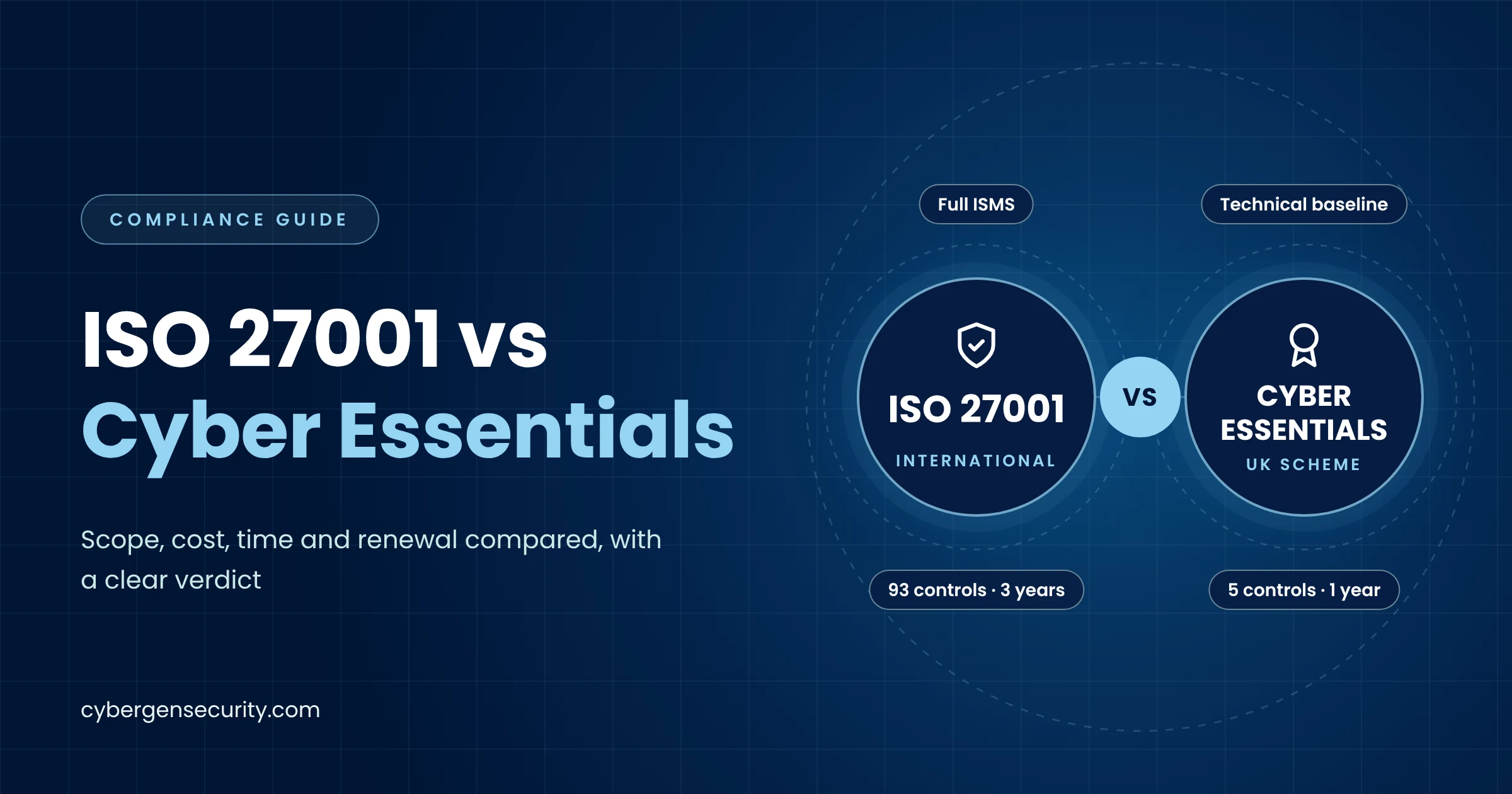
The short answer: Cyber Essentials proves you have five basic technical controls in place to stop common internet attacks, and is often required for UK public sector work. ISO 27001 proves you run a complete, risk-based information security management system, and is what larger and international customers ask for. Most UK organisations need Cyber Essentials first, then ISO 27001.
If you have been asked for "Cyber Essentials or ISO 27001" in a tender, a customer questionnaire or a board meeting, you are not alone. The two are often mentioned in the same breath, but they answer very different questions. This guide compares them side by side, explains who asks for each and helps you decide which to start with. If you already know you need ISO 27001, our ISO 27001 certification and consultancy page explains how we get you there. If Cyber Essentials comes first, see our Cyber Essentials Plus service.
ISO 27001 vs Cyber Essentials: Side by Side
| Cyber Essentials | ISO 27001 | |
|---|---|---|
| What it is | UK government-backed certification of five technical controls | International standard for an information security management system (ISMS) |
| Scope | Devices, networks and cloud services that connect to the internet | Information risk across people, processes, suppliers, premises and technology |
| Cost | IASME fee £320 to £600 + VAT by size; Plus audits typically a few thousand pounds | Audit fees typically £6,000 to £12,000 for a small business, plus preparation |
| Time | Days to a few weeks if your IT is in good order | Three to twelve months, including running the ISMS before audit |
| Assessment | Verified self-assessment; Plus adds a hands-on technical audit | Stage 1 and Stage 2 audits by an accredited certification body |
| Renewal | Every 12 months | Three-year certificate with annual surveillance audits |
| Who asks for it | UK government departments, the MoD supply chain, councils, the NHS, insurers | Enterprise customers, international buyers, regulated sectors, SaaS procurement |
| Recognition | Mainly the UK | Worldwide |
What Cyber Essentials Covers
Cyber Essentials is run by the UK's National Cyber Security Centre (NCSC) with IASME as the delivery partner. It focuses on five technical controls that, together, stop the large majority of common, untargeted internet attacks:
- Firewalls: boundary and device firewalls that control what can reach your systems
- Secure configuration: removing default passwords, unused accounts and unnecessary software
- Security update management: applying critical and high-risk updates within 14 days
- User access control: the right access for the right people, with multi-factor authentication on cloud services
- Malware protection: anti-malware or application allow-listing on every in-scope device
There are two levels. Cyber Essentials is a verified self-assessment: you answer a question set and an assessor reviews it. Cyber Essentials Plus covers the same controls but adds a hands-on technical audit, including vulnerability scans and checks on a sample of your devices. Our guide to Cyber Essentials vs Cyber Essentials Plus explains the difference in detail.
What Changed in 2026
From 27 April 2026, all new assessments use the Danzell question set and version 3.3 of the NCSC's requirements. The five controls are unchanged, but marking is stricter. Multi-factor authentication on cloud services and the 14-day patching rule are now treated far more strictly, and Cyber Essentials Plus assessors take a further sample if devices fail on missing updates. In November 2026 the government also announced a Cyber Essentials First Step Fund offering eligible small businesses a 75% discount on a new certification. If your last certificate was a while ago, check your set-up against the new requirements before you apply.
What ISO 27001 Covers
ISO/IEC 27001 is the international standard for an information security management system. Instead of prescribing a fixed set of controls, it asks you to build a system that identifies your information risks, decides how to treat them and proves, year after year, that the treatment works.
That system has two halves. Clauses 4 to 10 set out the management requirements: scope, leadership, risk assessment, objectives, competence, document control, internal audit, management review and continual improvement. Annex A then lists 93 controls across organisational, people, physical and technological themes, from supplier security to secure coding. You choose the controls that treat your risks and justify your choices in a Statement of Applicability.
If you are new to the standard, start with what an ISMS is, then read how to get ISO 27001 certification for the full step-by-step route.
How They Overlap
The good news is that the two fit together neatly. Every one of the five Cyber Essentials controls maps to ISO 27001 Annex A controls, so work done for one counts towards the other.
| Cyber Essentials control | Related ISO 27001 Annex A controls |
|---|---|
| Firewalls | 8.20 Networks security, 8.21 Security of network services, 8.22 Segregation of networks |
| Secure configuration | 8.9 Configuration management, 8.19 Installation of software on operational systems |
| Security update management | 8.8 Management of technical vulnerabilities |
| User access control | 5.15 Access control, 5.17 Authentication information, 8.2 Privileged access rights, 8.5 Secure authentication |
| Malware protection | 8.7 Protection against malware |
What Cyber Essentials does not cover is everything around the technology: risk assessment, policies, supplier management, incident management, business continuity, training records, physical security, internal audit and leadership review. That is the gap between the two, and it is why ISO 27001 takes longer.
Which Do You Need?
Start with who is asking and why. The right answer depends on your customers, your contracts and your risks, not on which certificate looks more impressive.
Choose Cyber Essentials first if
- You bid for UK public sector or MoD supply chain work
- You are a small business with limited budget
- Your insurer or a UK customer has asked for it
- You want a quick, visible improvement
Choose ISO 27001 if
- Enterprise or international customers require it
- You sell software or services that hold customer data
- Tenders score a full ISMS, not just controls
- Regulators expect risk-based governance
Plan for both if
- You sell to UK government and to large private buyers
- You are growing quickly into new markets
- You want Cyber Essentials as a stepping stone
- You want one programme, not two
For many organisations, the best route is sequential: achieve Cyber Essentials Plus in a few weeks, then use that technical baseline as the foundation of an ISO 27001 programme. The controls you fixed for Cyber Essentials become evidence for Annex A, and the habits you built, such as 14-day patching and MFA everywhere, are exactly what an ISO 27001 auditor wants to see running.
Cost and Time in Practice
Headline fees only tell part of the story. The real cost of either certificate depends on how much needs fixing first and how much of your own team's time it takes.
Cyber Essentials
The IASME assessment fee is set by organisation size, from £320 plus VAT for a micro organisation of up to nine employees to £600 plus VAT for organisations of 250 or more. Cyber Essentials Plus is priced by the certification body because it involves an assessor testing your devices, and typically costs a few thousand pounds for a small or mid-sized organisation. The hidden costs are remediation: replacing unsupported operating systems, switching on MFA for every cloud service and getting patching inside 14 days. For a business with tidy, modern IT, that can be close to nothing. For one with old laptops and shared admin accounts, it is where most of the budget goes.
A well-prepared small business can complete Cyber Essentials in a week or two. Cyber Essentials Plus must be completed within three months of the basic certificate, and most organisations allow four to eight weeks to fix findings from a pre-assessment scan.
ISO 27001
ISO 27001 costs more because there is more to build and an external auditor spends days, not hours, with you. Certification body fees are driven by the number of people in scope: a small business typically pays £6,000 to £12,000 for the Stage 1 and Stage 2 audits, then roughly a third of that each year for surveillance. Preparation ranges from a few thousand pounds for a small, well-organised business to £40,000 or more for complex scopes. Our ISO 27001 cost guide breaks this down by company size.
Most organisations need three to twelve months, because the auditor wants to see the ISMS running, including at least one internal audit and a management review, before Stage 2. Our guide to how long ISO 27001 takes sets out a realistic timeline.
What Buyers Actually Check
Whichever certificate you hold, procurement teams increasingly look beyond the logo. Expect to be asked:
- Is it current? Cyber Essentials certificates can be checked on the IASME register. ISO 27001 certificates should come from a UKAS-accredited, or equivalent, certification body.
- What is in scope? A Cyber Essentials certificate covering head office only, or an ISO 27001 scope that excludes the service being bought, will not satisfy a careful buyer.
- Is it the right level? Many public sector contracts now ask for Cyber Essentials Plus rather than the basic certificate, and some private buyers ask for ISO 27001 and Cyber Essentials Plus together.
- Can you show the controls working? Security questionnaires increasingly ask for evidence such as penetration test summaries, patching metrics and incident response plans.
Common Mistakes When Choosing
- Assuming ISO 27001 includes Cyber Essentials. It does not. A tender that requires Cyber Essentials will still require the certificate, even if you hold ISO 27001.
- Treating Cyber Essentials as a full security programme. It is an excellent baseline, but it does not cover suppliers, incidents, continuity or governance.
- Drawing the scope too narrowly. Both schemes let you limit scope. Customers increasingly check that the certificate covers the service they are buying.
- Leaving it until the tender deadline. Cyber Essentials Plus needs time to fix findings, and ISO 27001 needs months of evidence. Start before you are asked.
- Running them as separate projects. Plan them together so evidence is gathered once and reused.
How Cybergen Can Help
Cybergen delivers both, and we will tell you honestly which you need first. Our team can:
- Review your customers, tenders and risks and recommend the right route and order
- Prepare you for Cyber Essentials and Cyber Essentials Plus against the 2026 requirements
- Run an ISO 27001 gap analysis and build a proportionate ISMS, with CREST penetration testing for technical evidence
- Plan both together so the work is done once and counted twice
- Give you a fixed quote before you commit
For costs, see our ISO 27001 certification cost guide, or if you are a smaller organisation, our guide to ISO 27001 for small businesses. When you are ready, get my quote or book a free call with our compliance team.
This guide reflects ISO/IEC 27001:2022 and the Cyber Essentials Danzell question set (v3.3 requirements), as at November 2026.
Frequently Asked Questions
Is Cyber Essentials the same as ISO 27001?
No. Cyber Essentials is a UK government-backed certification covering five technical controls that stop common internet attacks. ISO 27001 is an international standard for a full information security management system, covering risk, governance, people, suppliers and 93 possible controls.
Is ISO 27001 harder than Cyber Essentials?
Yes. Cyber Essentials can be achieved in days or weeks by a well-run small business. ISO 27001 usually takes three to twelve months because you must build, run and evidence a management system before the certification audit.
Does ISO 27001 replace Cyber Essentials?
No. Holding ISO 27001 does not give you Cyber Essentials, and UK government contracts that require Cyber Essentials still require it. Many organisations hold both, and the work overlaps heavily.
How much does Cyber Essentials cost compared with ISO 27001?
The IASME fee for Cyber Essentials ranges from £320 to £600 plus VAT depending on organisation size, and Cyber Essentials Plus audits typically cost a few thousand pounds. ISO 27001 audit fees for a small business typically run £6,000 to £12,000, plus preparation.
Which should a small business get first?
Most UK small businesses should start with Cyber Essentials, ideally Cyber Essentials Plus, because it is quick, affordable and often required. Move to ISO 27001 when customers, international tenders or regulators ask for a full management system.
How often do you renew Cyber Essentials and ISO 27001?
Cyber Essentials certificates are valid for 12 months, so you renew every year. ISO 27001 certificates last three years, with surveillance audits in years two and three and a recertification audit before expiry.
Sources
CREST-certified consultants specialising in threat intelligence, penetration testing, MDR and compliance.