What Is an ISMS? A Practical Guide to Building One That Lasts
 Cybergen InsightsCREST-certified security team
|
|
10 min read
Ask ten people what an ISMS is and you will get ten answers. A folder of policies. A compliance platform. "The ISO 27001 thing." None of those is wrong, exactly, but none of them is the point.
An information security management system is simpler and more useful than any of those descriptions. It is how your organisation decides what information matters, what could go wrong with it, what to do about that and how to prove it is working. This guide explains what goes into an ISMS, how it runs day to day and how to build one that lasts. If you would rather have experienced hands do it with you, our ISO 27001 certification and consultancy team builds and runs them every week.
What an ISMS Actually Is
ISMS stands for information security management system. The word that matters most is "management". An ISMS is not a piece of software or a set of documents. It is the way an organisation governs information security: who decides, on what basis, what gets done and how anyone knows it is working.
Every ISMS answers four questions:
- What information matters? Customer data, intellectual property, financial records, the systems that hold them and the people who use them.
- What could go wrong? The threats and weaknesses that could affect the confidentiality, integrity or availability of that information.
- What are we doing about it? The controls you choose, the risks you accept and the owners responsible for each.
- How do we know it works? Measurement, audit, review and a record of what you changed as a result.
Policies, tools and platforms all support those answers. They are not the answers themselves. An organisation can have a beautifully written policy set and no ISMS at all, because nobody reviews risk, nobody measures anything and nothing ever changes. Equally, a small firm with a short risk register, a handful of clear policies and a quarterly review meeting can have a genuinely effective one.
ISMS, ISO 27001 and Certification
The three terms are often used as if they mean the same thing. They do not, and the difference is useful.
| Term | What it is | Think of it as |
|---|---|---|
| ISMS | The system you build and run to manage information security risk | The engine |
| ISO/IEC 27001 | The international standard that sets out the requirements an ISMS must meet | The yardstick |
| Certification | An independent audit by an accredited body confirming the ISMS meets the standard | The proof |
ISO 27001 is the yardstick. The ISMS is what you build and run. The certificate is independent proof that the two match. You can run an ISMS without ever certifying it, and many organisations start that way. You cannot be certified without a working ISMS, because the auditor tests the system, not the paperwork.
For a clause by clause breakdown of what the standard asks for, read our ISO 27001 requirements guide.
The Building Blocks of an ISMS
A working ISMS has the same building blocks whether or not you certify. They map directly to clauses 4 to 10 of ISO 27001, which is no coincidence: the standard was written to describe what good looks like.
Set direction
Decide what the ISMS covers and who is accountableManage risk
Find what could go wrong and decide what to do about itRun and prove it
Make it part of normal work and check it is working1. Context and Scope
Start by understanding your organisation: what it does, the issues that affect it inside and out, and what customers, regulators and partners expect. From that comes the scope, a clear statement of which parts of the business, which locations, which systems and which information the ISMS covers. A good scope matches what your customers actually need assurance about. A scope drawn too narrowly to make certification easy tends to disappoint the very buyers who asked for it.
2. Leadership and an Information Security Policy
Information security is a business risk, so it needs business ownership. Top management sets the information security policy, assigns roles and makes sure the ISMS has the time and budget it needs. The policy itself should be short and readable. It states your commitment and your objectives, and it points to the more detailed policies beneath it. Our virtual CISO service often fills the leadership gap in organisations that do not have a full time security lead.
3. Risk Assessment and Treatment
This is the engine of the whole system. You need a repeatable method for identifying risks to your information, analysing how likely and how damaging each one is, and deciding what to do: reduce it with controls, avoid it, transfer it, or accept it with the risk owner's sign off. The output is a risk register and a risk treatment plan. Everything else in the ISMS should trace back to them.
4. Controls That Trace Back to Real Risks
Controls are the measures that reduce risk: access control, encryption, backups, supplier checks, vulnerability management, incident response and many more. ISO 27001 Annex A lists 93 of them, and you record in your Statement of Applicability which apply, why and whether they are in place. The test of a good control set is traceability. For every control, you should be able to name the risk it treats. Our guide to ISO 27001 Annex A controls explains each one in plain English.
5. Training, Awareness and Document Control
People make or break an ISMS. Staff need to know the policies that affect them, why they matter and how to report a problem. That means induction training, regular security awareness and phishing simulations and records to show it happened. Document control keeps the policies and procedures current: version numbers, owners, review dates and a single place where everyone finds the latest copy.
6. Internal Audit and Management Review
An internal audit checks, independently, whether the ISMS meets the standard and your own rules, and whether it works in practice. A management review puts the results in front of leadership: audit findings, incidents, risk changes, metrics and progress against objectives. Leadership then decides what changes. Together they are how the system checks itself.
7. Continual Improvement
When something goes wrong, whether an audit finding, an incident or a missed objective, you record it, find the root cause and fix the cause rather than the symptom. Over time the ISMS gets sharper. An ISMS that looks exactly the same after two years is usually one that nobody is using.
How an ISMS Runs Day to Day
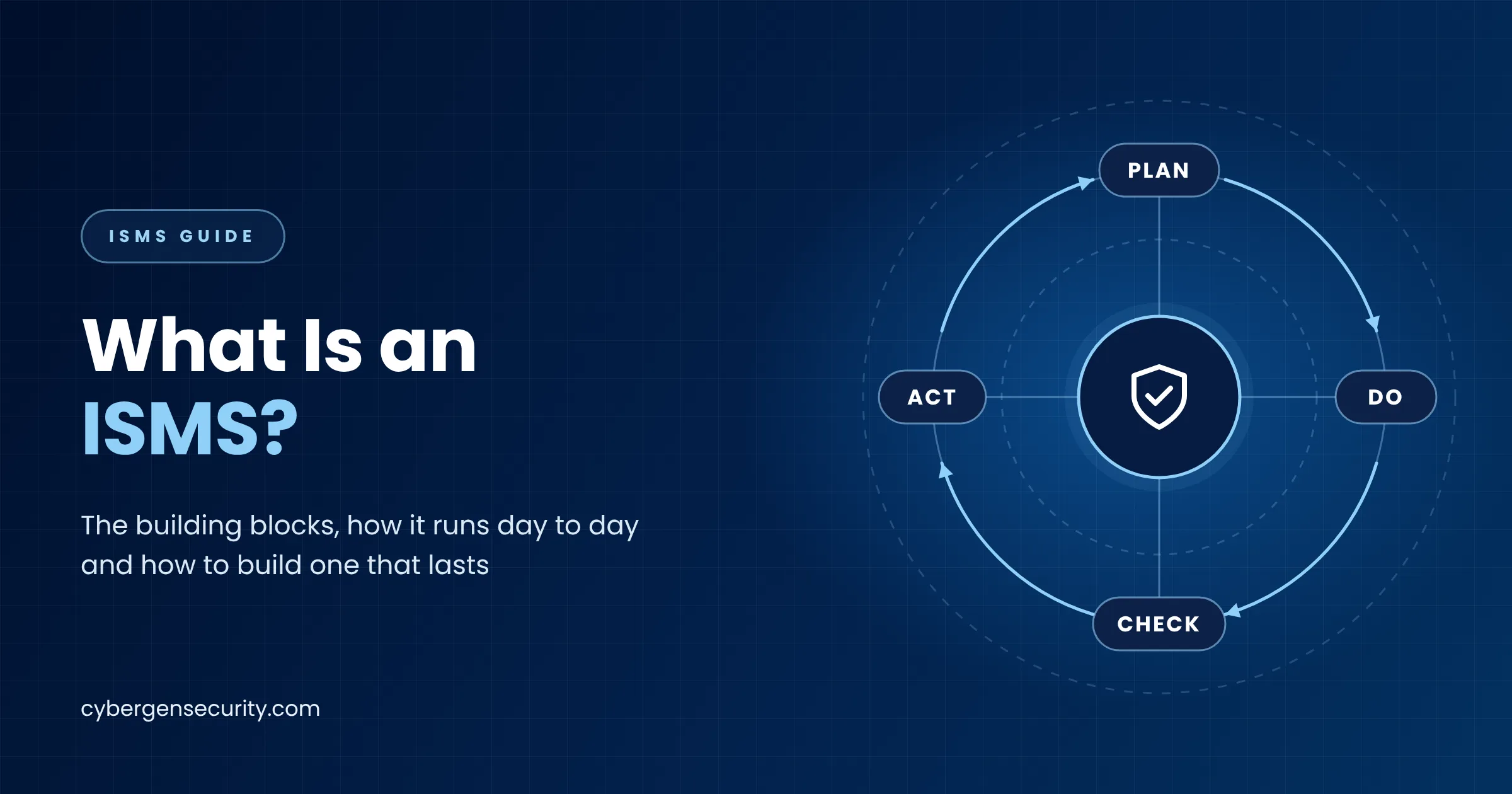
An ISMS follows the Plan, Do, Check, Act cycle. Plan what you will do based on risk. Do it. Check whether it worked. Act on what you learned. Then go round again.
Plan
- Review scope, context and objectives
- Assess and prioritise risks
- Choose controls and owners
Do
- Operate controls as part of normal work
- Train staff and keep records
- Manage incidents, changes and suppliers
Check and Act
- Measure, audit and review
- Log nonconformities and fix root causes
- Feed lessons into the next plan
In practice, most organisations run the ISMS on a simple annual calendar. A typical year looks like this:
- Monthly: review security metrics, new incidents, access changes and open actions.
- Quarterly: revisit the risk register, check supplier issues and report progress to leadership.
- Twice a year: run awareness campaigns and phishing simulations, and test incident response with a tabletop exercise.
- Annually: complete the internal audit, hold the management review, review every policy, retest with penetration testing and refresh objectives for the year ahead.
None of this needs to be heavy. The point is rhythm. When reviews happen on schedule and leave a record, the ISMS runs itself and audits become a matter of showing what you already do.
How to Build an ISMS That Lasts
Most ISMS projects that fail do so after certification, not before it. The documents are written, the audit is passed and then the system quietly stops running. These principles keep it alive.
- Start with risk, not templates. Policies written before the risk assessment describe a generic company, not yours. Do the risk work first and let it shape everything else.
- Build it into existing work. Use the meetings, ticketing systems and approval routes you already have. A separate "ISMS process" that sits beside real work will be the first thing dropped when people are busy.
- Keep documents short. A two page policy that people read beats a twenty page policy that nobody opens.
- Name owners, not departments. Every risk, control and policy needs a person accountable for it.
- Collect evidence as you go. Screenshots, meeting notes, training records and review logs gathered in the moment save weeks of scrambling before an audit.
- Keep leadership involved. If directors only hear about the ISMS once a year, it will be treated as a once a year problem.
- Make the internal audit genuinely independent. An audit carried out by the person who built the system rarely finds what matters.
ISMS Readiness Checklist
Use this checklist to see how far along your ISMS is today. It covers each of the building blocks above.
How complete is your ISMS?
Tick what your organisation already has. Nothing is sent or stored.
Common ISMS Mistakes
- Buying a platform and calling it an ISMS. Compliance platforms are useful for tracking evidence and tasks, but the decisions, ownership and reviews still have to happen.
- Treating the ISMS as an IT project. HR, legal, facilities, finance and suppliers all hold information risk. An ISMS run only by IT misses most of it.
- Writing for the auditor, not the business. Documents written to pass an audit tend to be long, generic and ignored.
- Letting the risk register go stale. If the register has not changed since the last audit, the business has changed and the ISMS has not noticed.
- Skipping the "check" stage. Without measurement and review there is no way to know whether controls work, and no basis for improving them.
How Cybergen Can Help
Cybergen helps organisations design, build and run an ISMS that suits the way they work, whether or not certification is the goal. Our team can:
- Run a gap analysis against ISO 27001 and tell you exactly where you stand
- Define a scope that matches what your customers need assurance about
- Build a practical risk method, risk register and Statement of Applicability
- Write short, usable policies and procedures with your team
- Provide the technical evidence through CREST penetration testing and vulnerability management
- Carry out independent internal audits and support you through Stage 1 and Stage 2
- Keep the ISMS running afterwards as your virtual CISO
If you are ready to go further, our guide on how to get ISO 27001 certification walks through every step, and our ISO 27001 for small businesses guide shows how to keep it proportionate. To talk it through, book a free ISMS readiness call with our team.
This guide reflects ISO/IEC 27001:2022 including Amendment 1:2024, as at November 2026.
Frequently Asked Questions
What does ISMS stand for?
ISMS stands for information security management system. It is the set of policies, processes, roles and reviews an organisation uses to manage risks to its information in a systematic way.
Is an ISMS the same as ISO 27001?
No. The ISMS is the system you build and run. ISO/IEC 27001 is the international standard that sets out what that system must include. Certification is an independent audit confirming that your ISMS meets the standard.
Do you need ISO 27001 certification to have an ISMS?
No. Any organisation can build and run an ISMS without certifying it. Certification adds independent proof, which customers, regulators and tenders often ask for, but the security benefits come from running the system.
Is an ISMS software?
No. Compliance software can help you track risks, tasks and evidence, but the ISMS is the way your organisation makes and reviews security decisions. A platform without ownership, risk assessment and review is not an ISMS.
How long does it take to build an ISMS?
Most small and mid sized organisations build a working ISMS in three to six months, then need a period of operation to produce evidence before a certification audit. Larger or more complex scopes take longer.
Who should own the ISMS?
Top management is accountable for the ISMS, and day to day ownership usually sits with a named information security lead or virtual CISO. Individual risks, controls and policies each need their own named owner.
Sources
CREST-certified consultants with over 100 years of combined experience in threat intelligence, penetration testing, MDR and compliance.