How to Get ISO 27001 Certification: A Step-by-Step Guide for Your Business
 Cybergen InsightsCREST-certified security team
|
|
11 min read
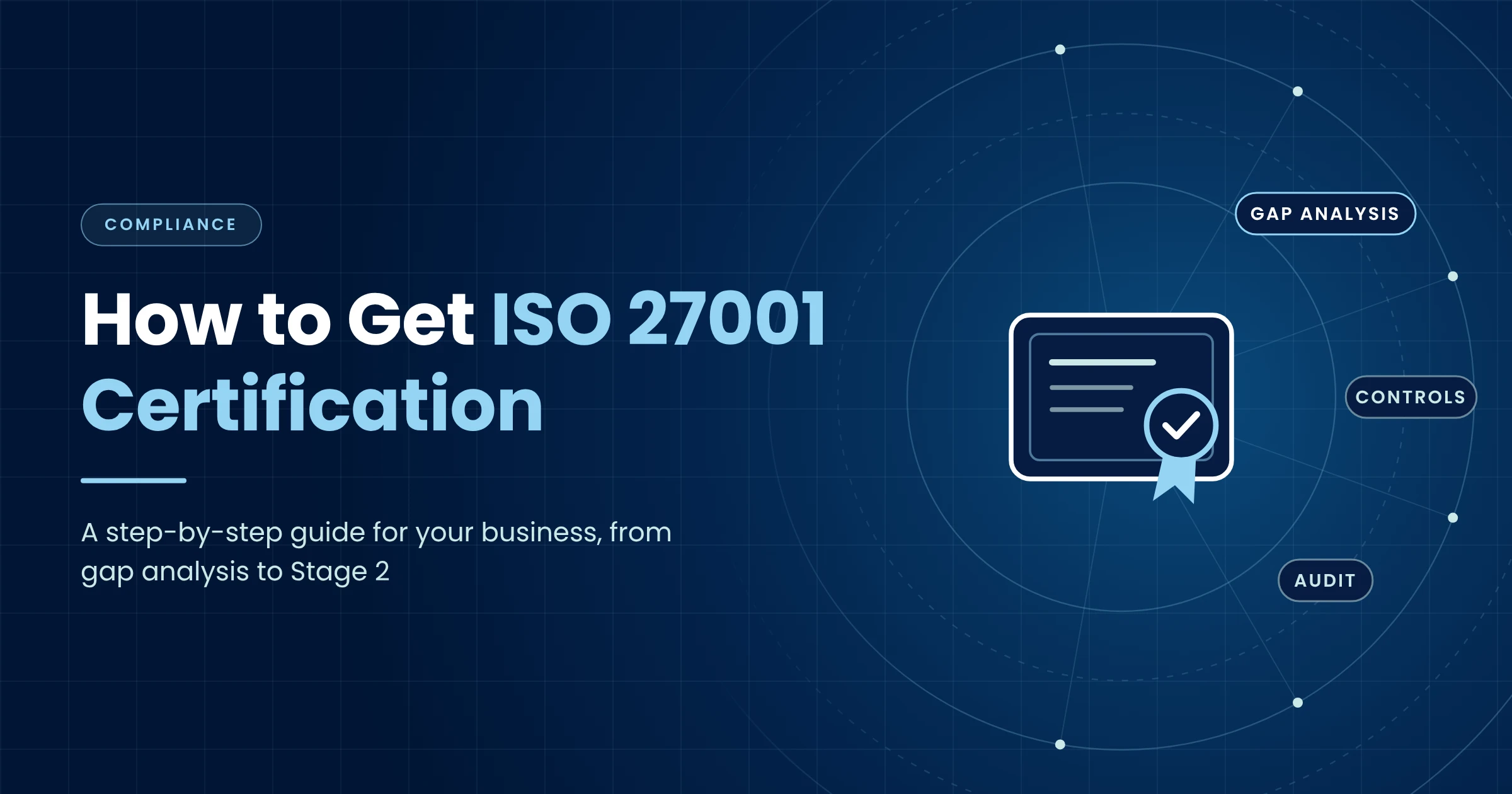
A customer sends over a supplier questionnaire and the very first question is "Are you ISO 27001 certified?" A tender you want to bid for lists it as a mandatory requirement. Your board asks how you would prove that information security is under control. Sooner or later, most growing businesses hit the same question: how do we actually get ISO 27001?
The good news is that the route is well defined. ISO/IEC 27001 is the international standard for an information security management system (ISMS), and certification follows the same pattern for every organisation, from a twenty-person software house to a global financial firm. What changes is the size of the scope and the effort, not the steps.
This guide walks through those steps in order, explains what auditors expect at each point and highlights the mistakes that most often add months to a project. If you want an expert to look at where you stand today, our ISO 27001 certification service starts with exactly that conversation.
What ISO 27001 Certification Actually Means
ISO 27001 sets out the requirements for an ISMS: a structured way of identifying information security risks, deciding how to treat them, putting controls in place and proving that the whole system keeps working and improving. The current edition is ISO/IEC 27001:2022, and certification to the older 2013 edition ended on 31 October 2025.
Certification means an independent, accredited certification body has audited your ISMS against the standard and confirmed it conforms. That independence is the point. Anyone can say they follow good security practice. A certificate from an accredited body is evidence a customer can rely on without auditing you themselves.
The standard has two parts that matter for certification:
- Clauses 4 to 10 are mandatory. They cover context and scope, leadership, planning and risk, support, operation, performance evaluation and improvement. Every one of them must be met.
- Annex A lists 93 information security controls in four themes: organisational, people, physical and technological. You decide which apply to you based on your risk assessment and justify any you exclude.
Our clause by clause requirements guide and guide to all 93 Annex A controls go deeper on each part. For now, the important thing is that ISO 27001 is a management system, not a technical checklist. Auditors want to see decisions, ownership and evidence, not just technology.
Three phases, ten steps
Prepare
- 1. Secure leadership commitment
- 2. Define the scope
- 3. Run a gap analysis
Build
- 4. Assess and treat risk
- 5. Write the Statement of Applicability
- 6. Implement controls and policies
- 7. Train people and run the ISMS
Prove
- 8. Internal audit
- 9. Management review
- 10. Stage 1 and Stage 2 audits
Step 1: Secure Leadership Commitment
Clause 5 of the standard puts responsibility firmly on top management. Leaders must set the information security policy, assign roles, provide resources and make sure the ISMS achieves its outcomes. Auditors will speak to senior leaders directly, and a project run entirely by one enthusiastic IT manager rarely survives contact with a Stage 2 audit.
In practice, this step means agreeing why you want certification (a key contract, a market, investor due diligence), who will own the ISMS day to day, what budget and time are available and a realistic target date. Write it down. That business case becomes the first evidence of leadership commitment.
Step 2: Define the Scope of Your ISMS
The scope statement (clause 4.3) sets the boundaries of what will be certified: which parts of the business, which locations, which services and which systems. It is one of the most important decisions in the whole project, because it drives effort, cost and audit days.
A tight scope built around what customers actually care about, for example "the design, development and support of our SaaS platform", is usually the fastest route to a meaningful certificate. You can extend it later. What you cannot do is exclude something customers will assume is covered, so check your scope against the contracts and tenders that triggered the project.
Scoping also means understanding context (clause 4.1) and interested parties (clause 4.2): the internal and external issues that affect information security, and what customers, regulators, staff and suppliers require of you. Since the 2024 amendment, that analysis must also consider whether climate change is a relevant issue for your organisation.
Step 3: Run a Gap Analysis
A gap analysis compares what you do today against every clause and every relevant Annex A control. It turns a large, vague project into a specific list of work: policies to write, processes to formalise, technical controls to add and evidence to start collecting.
Most organisations are further along than they think. If you already hold Cyber Essentials Plus, use multi-factor authentication, patch regularly and have an HR onboarding process, many technical and people controls are partly in place. What is usually missing is the management system around them: documented risk decisions, owners, measurement, internal audit and review. Our article on running an ISO 27001 gap analysis explains how to do this well.
Step 4: Assess and Treat Information Security Risk
Risk assessment is the engine of ISO 27001. Clause 6.1.2 requires a defined method that produces consistent, valid and comparable results, identifies risks to the confidentiality, integrity and availability of information, assigns risk owners, and evaluates each risk against criteria you have set.
Clause 6.1.3 then requires you to decide how to treat each risk (modify it with controls, avoid it, share it or retain it), produce a risk treatment plan and obtain risk owners' approval of the plan and acceptance of residual risk. Auditors will test that your controls trace back to risks and that the people who own those risks have signed off. Our ISO 27001 risk assessment guide covers the method step by step.
Step 5: Write the Statement of Applicability
The Statement of Applicability (SoA) lists all 93 Annex A controls, states whether each is included, explains why, and records whether it is implemented. For each excluded control you must justify the exclusion. It is the single document auditors refer to most, and it links your risk treatment decisions to the controls you actually operate.
Write it after the risk assessment, not before. An SoA that marks every control as applicable "because the standard lists it" is a warning sign that the risk assessment has not really driven decisions. See our guide to writing a Statement of Applicability.
Step 6: Implement Controls and Policies
This is usually the longest phase. It includes writing the information security policy and the topic-specific policies your risks call for, putting technical controls in place and turning informal habits into repeatable, evidenced processes.
Typical work includes access control and joiners, movers and leavers processes, supplier security assessments, secure configuration and patching, logging and monitoring, backup and recovery testing, incident management, secure development for software businesses and vulnerability management. Independent testing such as CREST penetration testing is a common way to evidence that technical controls work.
Keep policies short and true. Auditors test what policies say against what people actually do, so a fifteen-page policy nobody follows creates nonconformities rather than preventing them. Our guide to ISO 27001 policies explains which ones you need.
Step 7: Train People and Run the ISMS
Clause 7 requires that people are competent, aware of the policy and their responsibilities, and understand the consequences of not following the ISMS. Security awareness training, role-specific training for admins and developers, and records of both are standard evidence.
Just as importantly, the ISMS needs time to run. Auditors want to see records produced by the system working: risk reviews, access reviews, supplier assessments, incident logs, change records and metrics. A system that was switched on the week before the audit has no history to show, so plan for at least two to three months of operation before Stage 2.
Step 8: Carry Out an Internal Audit
Clause 9.2 requires an internal audit programme that checks the ISMS conforms to your own requirements and to the standard, and that it is effectively implemented and maintained. Auditors must be objective and impartial, which in a small organisation usually means bringing in an external internal auditor rather than asking the person who built the ISMS to mark their own work.
A full internal audit before Stage 2 is not optional in practice. It is also the best rehearsal you will get. Findings raised now can be fixed calmly. The same findings raised by the certification body cost time and can delay your certificate. Read more in our ISO 27001 internal audit guide.
Step 9: Hold a Management Review
Clause 9.3 requires top management to review the ISMS at planned intervals. The review must consider specific inputs, including the status of previous actions, changes in context, nonconformities, monitoring results, audit results, feedback from interested parties, risk assessment results and opportunities for improvement. Outputs include decisions on improvement and any changes needed.
Minute it properly. Auditors will ask to see the record and will check that every required input was discussed and that decisions led to actions.
Step 10: Pass the Stage 1 and Stage 2 Certification Audits
Choose an accredited certification body early, because their availability can set your timeline. In the UK, look for UKAS accreditation; elsewhere, look for an accreditation body that is a signatory to the IAF multilateral recognition arrangement. Your consultant and your certification body must be separate organisations.
The external audit then happens in two stages:
- Stage 1 reviews your documentation and readiness: scope, policy, risk method and results, SoA, internal audit and management review. The auditor confirms whether you are ready for Stage 2 and flags areas of concern.
- Stage 2 tests whether the ISMS is implemented and effective in practice. Auditors interview staff, sample records and look at systems. Any major nonconformities must be corrected before a certificate can be issued; minor ones need an agreed corrective action plan.
Our guide to the ISO 27001 certification audit explains what to expect on the day and how findings are graded.
How Long Certification Takes and What It Costs
From a standing start, most small and mid-sized organisations reach certification in six to twelve months. The biggest variables are scope, how much is already in place and how quickly decisions are made. Our article on how long ISO 27001 takes breaks down a realistic timeline.
Costs fall into three buckets: the certification body's audit fees (driven by headcount and complexity), preparation and implementation (consultancy, tooling and any security improvements), and your own people's time. See our breakdown of ISO 27001 certification cost for typical ranges. Compliance automation platforms such as Vanta and Drata can reduce the evidence burden, but they do not replace the risk decisions and leadership involvement the standard requires.
Common Mistakes That Delay Certification
- Starting with templates instead of risk. A pack of downloaded policies does not make an ISMS. Auditors look for decisions that trace back to your risks.
- A scope that is too wide. Including every office and every system on the first attempt multiplies effort. Start with what customers need.
- No operating history. Booking Stage 2 before the ISMS has produced records leads to findings on evidence.
- Leadership missing in action. If senior leaders cannot explain the policy or objectives, auditors will notice.
- Marking your own homework. Internal audits run by the person who built the ISMS rarely meet the impartiality requirement.
How Cybergen Helps You Get Certified
Cybergen takes organisations from first gap analysis to a certificate from an accredited certification body. Because we are security practitioners as well as ISO consultants, we can also deliver many of the controls the standard expects, from penetration testing and vulnerability management to 24x7x365 monitoring and incident response.
- Scoping and a full gap analysis against ISO/IEC 27001:2022
- Risk assessment method, risk register and Statement of Applicability
- Policies that fit how you actually work
- Implementation support for technical controls
- Independent internal audit and management review support
- Support through Stage 1, Stage 2 and surveillance audits
Visit our ISO 27001 certification page to see how the service works, or talk to our team about your timeline.
Frequently Asked Questions
Is ISO 27001 certification a legal requirement?
No. ISO 27001 is a voluntary international standard. In practice it is often a commercial requirement, because customers, tenders and supply chain contracts increasingly ask for it, particularly in financial services, technology, healthcare and the public sector.
Can a business certify itself to ISO 27001?
You can build and run an ISMS yourself and say you are aligned with the standard, but certification means an independent, accredited certification body has audited you. Customers and procurement teams almost always want to see a certificate from an accredited body.
How long does it take to get ISO 27001 certified?
Most small and mid-sized organisations take somewhere between six and twelve months from a standing start, depending on scope, existing controls and how quickly decisions are made. You also need the ISMS to have run for long enough to produce records such as an internal audit and a management review before Stage 2.
Do we need a consultant to get ISO 27001?
Not necessarily, but most first-time organisations use one for at least part of the journey, typically the gap analysis, risk method, Statement of Applicability and internal audit. A good consultant shortens the timeline and reduces the risk of nonconformities at audit. The consultant must not be the same organisation that certifies you.
How long is an ISO 27001 certificate valid for?
Three years, provided you pass the surveillance audits in years one and two. A recertification audit before the end of year three starts a new three-year cycle.
Which version of ISO 27001 should we certify to?
ISO/IEC 27001:2022, including its 2024 climate change amendment. The 2013 edition was withdrawn and all 2013 certificates expired on 31 October 2025.
Sources
CREST-certified consultants with over 100 years of combined experience in threat intelligence, penetration testing, MDR and compliance.