ISO 27001 or SOC 2: Which Should a Software Company Get First?
 Cybergen InsightsCREST-certified security team
|
|
12 min read
A promising deal reaches procurement and the customer's security team sends one short question: are you ISO 27001 certified, or do you have a SOC 2 report? If the answer is neither, the deal does not always die, but it slows down. You get a long questionnaire instead, more calls and more chasing, and sometimes a polite note that the buyer can only work with certified suppliers.
For growing software and SaaS companies, this question usually lands on the desk of a COO, CTO or head of operations who has a business to run. Both frameworks prove that an independent auditor has checked your security, but they come from different places, produce different evidence and suit different buyers. This guide explains how they differ, which your customers are likely to expect and how to plan so that getting one makes the other much easier.
What ISO 27001 Is
ISO/IEC 27001 is the international standard for an information security management system, or ISMS. It does not hand you a fixed checklist. Instead, it asks you to understand your risks, choose controls to treat them and run a system that keeps those controls working and improving: policies, a risk assessment, internal audits and regular management review.
The current version is ISO/IEC 27001:2022. Its Annex A lists 93 reference controls in four themes, organisational, people, physical and technological, down from 114 in the 2013 version, according to Plante Moran's summary of the update. Certificates to the old version expired when the transition period ended in October 2025, so any certificate you see today should name the 2022 edition.
ISO itself does not certify anyone. Certification comes from a certification body, which runs a two stage audit in the first year and surveillance audits in years two and three, before recertification. In the UK, look for a body accredited by UKAS. A cheap certificate from an unaccredited body may not be accepted by the buyers you are trying to win.
The result is a certificate you can publish on your website and attach to tenders, plus a Statement of Applicability that explains which controls you apply and why.
What SOC 2 Is
SOC 2 is an attestation report, not a certificate. It was created by the American Institute of Certified Public Accountants (AICPA) and is built on its Trust Services Criteria, which date from 2017. The AICPA revised the supporting points of focus in 2022 to add clarity, without changing the criteria themselves, as Baker Tilly explains in its overview of the updated SOC 2 guide.
The criteria fall into five categories: security, availability, processing integrity, confidentiality and privacy. Security, often called the common criteria, is required in every SOC 2. The others are optional, and you choose them based on what your customers rely on you for. A licensed CPA firm examines your controls and issues the report.
Type 1 and Type 2
A Type 1 report looks at whether your controls are designed properly at a single point in time. A Type 2 report goes further and tests whether they actually operated over a period. That observation window is usually between three and twelve months, with six months common for a first report and twelve months standard for renewals, according to Drata's comparison of the two types.
Most enterprise buyers want a Type 2. A Type 1 is useful as a first step, showing you are on the way while the observation window runs.
ISO 27001 and SOC 2 Side by Side
Put simply, ISO 27001 proves you run a security management system that meets an international standard. SOC 2 describes your controls in detail and gives an auditor's opinion on whether they meet the criteria you chose.
| ISO 27001 | SOC 2 | |
|---|---|---|
| What it is | An international standard for running an information security management system | An attestation report on your controls, built on the AICPA Trust Services Criteria |
| What you get | A certificate you can publish, plus a Statement of Applicability | A detailed report, usually shared with customers under NDA |
| Who assesses you | A certification body, ideally accredited (UKAS in the UK) | A licensed CPA firm |
| What it checks | That your management system works and your controls match your risks | That your controls meet the criteria you chose, and for Type 2, that they worked over a period |
| How long it lasts | Three years, with surveillance audits in years two and three | Customers expect a fresh Type 2 report every 12 months |
| Who asks for it most | UK, European, Asia Pacific and public sector buyers | North American buyers and technology companies |
There is one practical difference that matters a great deal in sales. An ISO 27001 certificate is short and public, so you can send it to anyone. A SOC 2 report runs to many pages and describes your systems in detail, so it is normally shared only under NDA. Buyers' security teams often value that detail, while procurement teams and tender panels often prefer the simplicity of a certificate.
Which One Do Your Customers Expect?
This is the question that decides it, and the answer depends far more on who your customers are than on which framework is better.
- UK, European and international buyers tend to ask for ISO 27001. It is widely recognised, it appears in public sector and regulated procurement, and a certificate fits neatly into a tender response.
- North American buyers, especially technology companies and larger enterprises, tend to ask for SOC 2. Many have standard supplier processes that expect a Type 2 report.
- Financial services and other regulated buyers may ask for either, and sometimes both, alongside their own questionnaire.
- UK public sector and smaller UK buyers often treat Cyber Essentials Plus as the minimum, with ISO 27001 as the stronger signal.
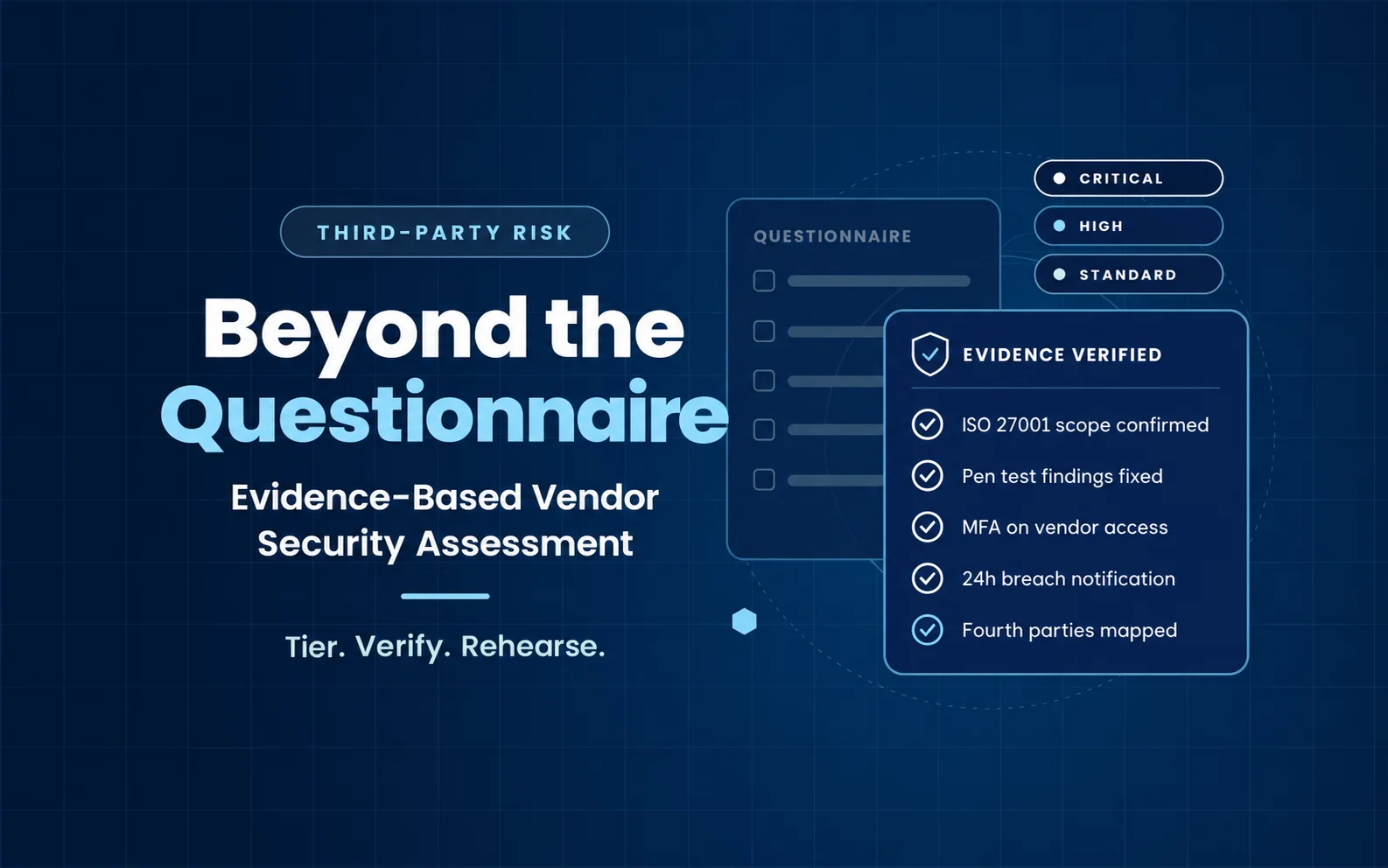
The most reliable guide is your own pipeline. Look at the last ten security questionnaires, tenders and procurement emails you received and count which framework they named. The pattern is usually obvious, and it tells you which investment will unblock the most revenue soonest. If you want to make sense of what buyers ask in those reviews, our guide to evidence based vendor security assessment shows the process from the buyer's side.
Which should you start with?
Answer four questions. Nothing is stored.
Your suggested starting point will appear here.
You Do Not Have to Do the Work Twice
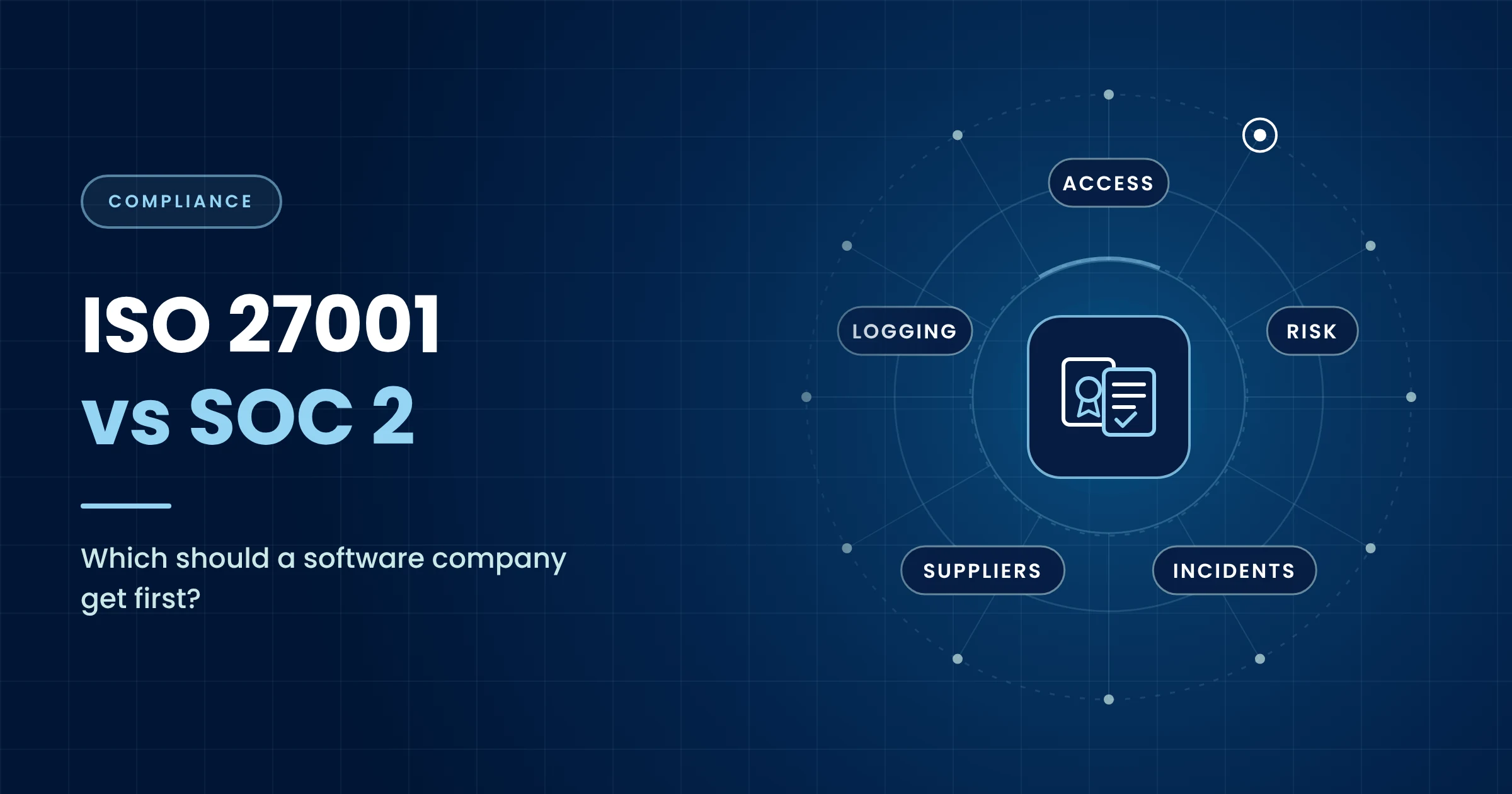
The good news for any company that will eventually need both is that the two frameworks overlap heavily. Access control, risk assessment, change management, incident response, supplier management, logging and monitoring all appear in each. The AICPA even publishes a mapping of the Trust Services Criteria to ISO 27001.
The most efficient approach for many software companies is to build one control set on the ISO 27001 management system, map it to the SOC 2 criteria from day one and collect evidence once. When you later add the second framework, most of the work is already done, and the extra effort is largely in the audit itself and any SOC 2 categories, such as availability or confidentiality, that you add.
Compliance automation platforms help a great deal here. Tools such as Drata and Vanta connect to your cloud, code repositories and HR systems, collect evidence continuously and show both frameworks against the same controls. For a lean team, that can turn audit preparation from weeks of screenshots into a steady background process.
How Long Each One Takes
Timelines depend on how mature your security already is, but the shape of the journey is predictable.
ISO 27001
Most of the time goes into readiness: defining scope, carrying out the risk assessment, writing policies, closing gaps and running the system long enough to complete an internal audit and a management review. A software company with good basic hygiene can often reach a certification audit in four to six months. The audit itself has two stages, a document review and then a full assessment, typically a few weeks apart.
SOC 2
Readiness covers similar ground. A Type 1 can follow soon after your controls are in place. A Type 2 then needs the observation window to run before the auditor can test it, so from a standing start a first Type 2 report is often nine to twelve months away. That is why many companies issue a Type 1 first, to give customers something credible while the clock runs.
Common Mistakes to Avoid
- Scoping too wide or too narrow. Scoping in the whole business can make the first audit far harder than it needs to be. Scoping in too little can leave you with a certificate or report that does not cover the product your customers actually buy. Scope around what customers rely on.
- Buying a certificate rather than building a system. Unaccredited, fast track certificates are easy to spot, and experienced buyers will ask who issued yours.
- Treating it as a one off project. Both frameworks expect controls to keep working. A system that only comes alive before the audit will struggle at surveillance or renewal time, and customers will notice when evidence goes stale.
- Forgetting technical testing. Neither framework names a penetration test as mandatory, but both expect you to find and fix technical vulnerabilities, and ISO 27001 includes a specific control for managing them. Auditors and customers routinely ask for an independent test. Our guide to how penetration testing supports ISO 27001 explains how to make one test serve both.
- Leaving it all with one engineer. Policies, supplier reviews and management reviews need business owners, not just technical ones. Give the programme an executive sponsor and a day to day owner.
Who Should Own It
In a growing software company there is rarely a full time security leader, so the programme often sits with the COO or CTO by default. That can work well, because both frameworks are as much about how the business runs as about technology. What matters is that someone senior owns the outcome and someone else owns the day to day work.
Many firms bring in outside help for the parts that need specialist experience: the risk assessment, the first set of policies, internal audit and preparing for the auditor. A virtual CISO can own the programme part time, attend customer security calls and keep the evidence current between audits, without the cost of a full time hire.
A 90 Day Starting Plan
Whichever framework comes first, the first three months look much the same. This plan gets you to the point where booking an auditor is a sensible next step.
First 30 days
- Name an executive sponsor and a day to day owner
- Agree scope: which product, environments and teams
- Run a gap analysis against ISO 27001, mapped to SOC 2
Days 31 to 60
- Write the risk assessment and core policies
- Close the quick wins: MFA, access reviews, logging
- Book an independent penetration test of the product
Days 61 to 90
- Start collecting evidence, ideally in one platform
- Run an internal audit and management review
- Book the certification body or CPA firm
Two things in that plan pay off in every sales conversation, whatever the framework. The first is an independent CREST penetration test of your product and cloud environment, with an executive summary and remediation letter you can share with customers. The second is a short, honest description of your controls that sales can send early, before a full questionnaire arrives.
How Cybergen Can Help
We help software and technology companies choose the right framework, get audit ready and use the result to win business:
- ISO 27001 consultancy, from gap analysis and scoping to policies, internal audit and certification support
- SOC 2 readiness, with controls mapped to both frameworks so you do the work once
- Drata and Vanta compliance automation, set up and configured for your environment
- CREST penetration testing with customer ready summaries for auditors and buyers
- Virtual CISO support to own the programme and the customer security conversations
If a customer has just asked for ISO 27001 or SOC 2 and you want a clear view of where you stand, talk to our team. One conversation is usually enough to know which to start with and how long it will take.
Standards and audit guidance change over time. This guide reflects ISO/IEC 27001:2022 and the AICPA Trust Services Criteria as at 15 November 2026.
Frequently Asked Questions
Is SOC 2 recognised outside the United States?
Yes. SOC 2 is an American attestation framework, but many international software companies hold SOC 2 reports because their customers ask for them. The report must be issued by a licensed CPA firm, and several firms deliver SOC 2 examinations for UK and European companies.
Is ISO 27001 harder than SOC 2?
They are hard in different ways. ISO 27001 asks you to build and run a management system, with a risk assessment, policies, internal audit and management review. SOC 2 Type 2 asks you to prove your controls operated consistently over a period of months. Most firms find the first year of either takes similar effort.
How long does it take to get ISO 27001 or SOC 2?
It depends on your starting point. A software company with good basic hygiene can often be ready for an ISO 27001 certification audit in four to six months. A SOC 2 Type 1 can follow readiness quickly, while a Type 2 needs an observation window, commonly six months for a first report.
Can we use one set of controls for both?
Yes, and you should. The two frameworks cover much of the same ground, and the AICPA publishes a mapping between the Trust Services Criteria and ISO 27001. Build one control set, map it to both, and collect evidence once. Compliance automation platforms make this much easier.
Do ISO 27001 and SOC 2 require penetration testing?
Neither names a penetration test as a mandatory item, but both expect you to find and fix technical vulnerabilities, and auditors routinely ask for independent test results as evidence. In practice, an annual penetration test of your product and cloud environment is expected by auditors and customers alike.
Is Cyber Essentials enough instead?
For many UK contracts it is the minimum, not the goal. Cyber Essentials covers five basic technical controls, while ISO 27001 and SOC 2 cover how you run security across the whole business. Many software companies hold Cyber Essentials Plus alongside ISO 27001 or SOC 2.
Sources
- ISO: ISO/IEC 27001 Information security management systems
- Plante Moran: The ISO 27001 information security update (January 2023)
- Baker Tilly: AICPA releases updated SOC 2 guide (October 2022)
- Drata: SOC 2 Type 1 vs Type 2
- AICPA and CIMA: Mapping the 2017 Trust Services Criteria to ISO 27001
- UKAS: United Kingdom Accreditation Service
CREST-certified consultants with over 100 years of combined experience in threat intelligence, penetration testing, MDR and compliance.