Do You Need a Managed SOC If You Already Run SentinelOne?
 Cybergen InsightsCREST-certified security team
|
|
10 min read
You have done the hard part. SentinelOne is on every laptop and server, the console is green and the board has been told the business has "next generation protection". So when someone suggests a managed security operations centre (SOC) on top, it is fair to ask why you would pay twice.
The honest answer is that you are not paying twice. SentinelOne is excellent technology, but technology and people do different jobs. This guide explains what SentinelOne handles on its own, what it leaves for a human to do, and how to decide whether you need a managed SOC. If you already know the answer, you can get a quote for SentinelOne licences or get a quote for licences with a 24x7x365 SOC.
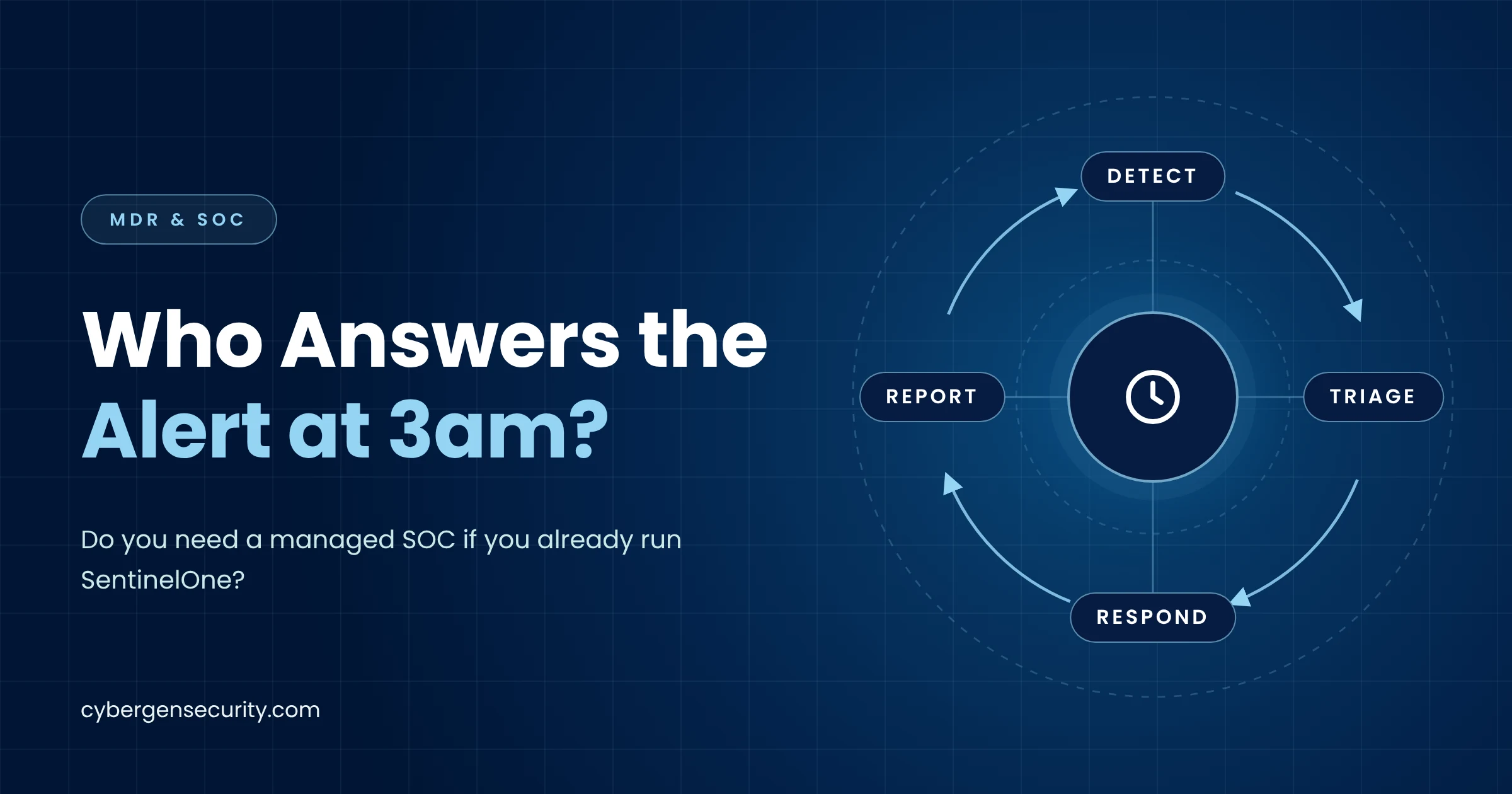
Great EDR, but Who Answers the Alert at 3am?
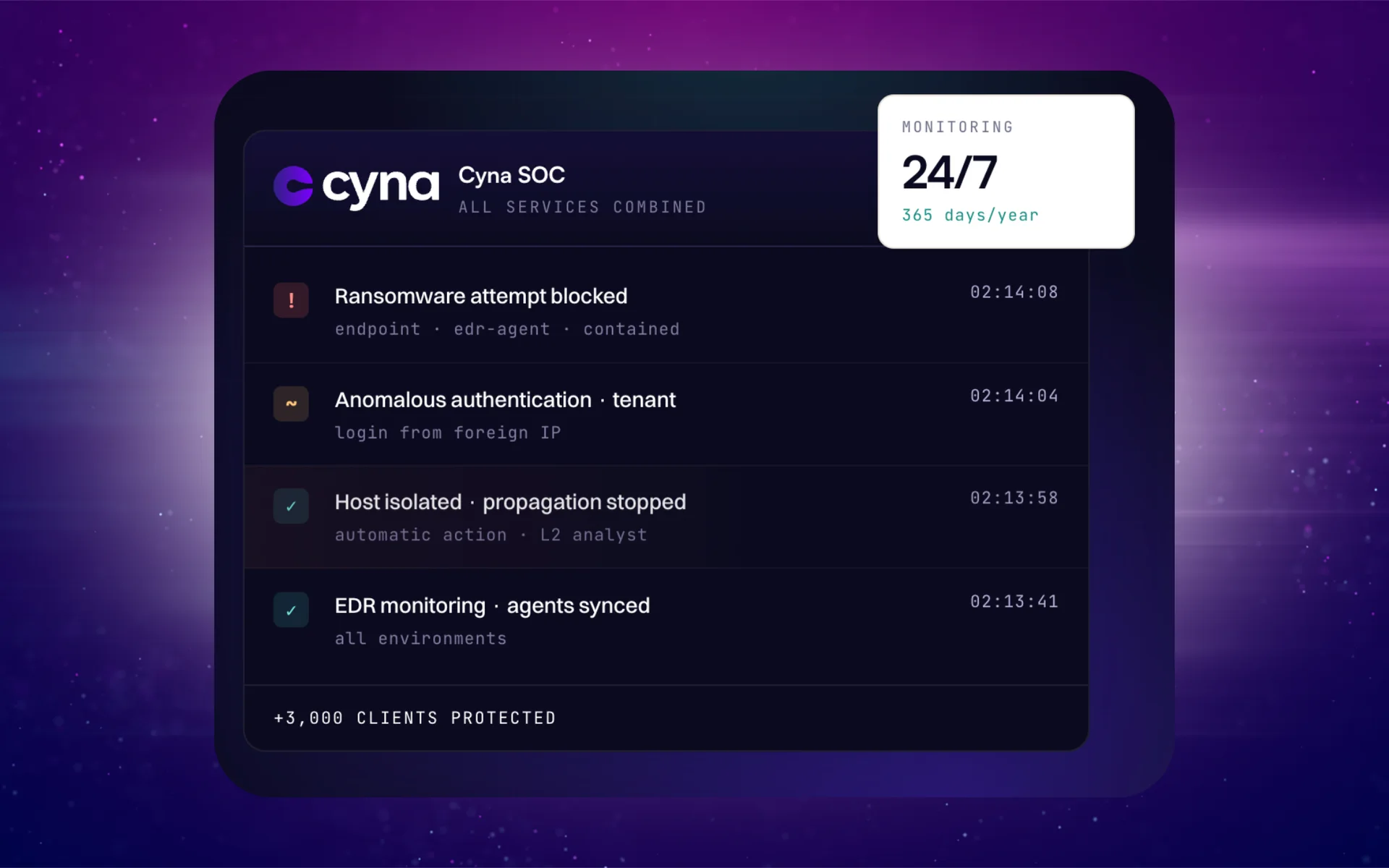
Picture a Saturday at 3am. A finance team member's laptop, left on at home, starts behaving oddly. SentinelOne spots a suspicious PowerShell command, kills the process and raises an alert. So far, so good. The platform did exactly what it was built to do.
Now the questions start. Was that the whole attack, or the first step? How did the attacker get there? Was it a phishing email, a stolen password or a malicious browser extension? Are the same credentials being used to log in to Microsoft 365 right now from another country? Has anything already been copied out?
SentinelOne records the evidence that answers those questions. It does not ring your phone, reset the user's password, check the email gateway, revoke the cloud sessions or decide whether to wake the managing director. Someone has to do that. If nobody is watching until Monday morning, the attacker has had more than two days.
That is the gap a managed SOC closes. It is not about replacing SentinelOne. It is about making sure every detection reaches a trained analyst who can investigate it, contain it and tell you what happened, at any hour.
What SentinelOne Does on Its Own
SentinelOne's Singularity platform is an endpoint detection and response (EDR) and extended detection and response (XDR) platform. Out of the box, it is very good at:
- Preventing known and unknown malware using behavioural AI rather than signatures alone
- Detecting suspicious behaviour on endpoints, servers and cloud workloads, and recording a full storyline of what happened
- Responding automatically by killing processes, quarantining files and isolating a device from the network
- Rolling back changes made by ransomware on supported Windows systems
- Giving hunters a rich data set to search when something looks wrong
For a large share of commodity threats, that automation is enough. The malware is blocked, the alert closes and nobody needs to do anything. If that were the whole picture, you would not need a SOC.
What SentinelOne Leaves for a Human
Modern attacks rarely look like malware. Attackers sign in with stolen passwords, use legitimate admin tools, abuse cloud apps and move slowly to avoid triggering automatic blocks. Those detections arrive as "suspicious", not "malicious", and they need judgement. A human analyst has to:
| Task | Why automation alone falls short | What happens without a SOC |
|---|---|---|
| Triage suspicious alerts | Admin tools and scripts look the same whether IT or an attacker runs them | Alerts pile up, or get ignored as noise |
| Investigate the full story | The endpoint is one piece; email, identity and cloud logs hold the rest | The visible symptom is fixed, the way in stays open |
| Contain beyond the endpoint | Resetting passwords, revoking sessions and blocking accounts happen elsewhere | The attacker carries on in Microsoft 365 or the VPN |
| Tune policies and exclusions | Every business has software that looks odd; exclusions need care | Over-broad exclusions quietly create blind spots |
| Hunt for what was missed | New techniques appear before detections catch up | Nobody looks until there is a visible incident |
| Decide and communicate | Escalation, insurers, regulators and customers need a human call | Decisions are made late, under pressure |
None of this is a weakness in SentinelOne. It is the nature of EDR. The platform gives you the eyes. A SOC gives you the brain and the hands, around the clock.
How a Managed SOC Handles a SentinelOne Alert
Go back to that Saturday at 3am. Here is what happens when a managed SOC is watching the same SentinelOne console.
Minutes 0 to 5
Detection and triageMinutes 5 to 30
Investigation and containmentWithin the hour
Escalation and recoveryBy Monday morning, instead of discovering an incident, you are reading a report on one that has already been contained. That difference is what you are paying for.
Build or Buy: The Real Comparison
It is tempting to compare the price of a managed SOC with the price of doing nothing. The honest comparison is with what it would cost to provide the same cover yourself. To staff a SOC around the clock you need:
- People: enough trained analysts to cover 168 hours a week, plus holidays, sickness, training and staff turnover in one of the tightest job markets in technology
- Tooling: log collection, case management and threat intelligence beyond the SentinelOne console
- Process: playbooks for every common alert, tested escalation paths and regular exercises
- Management: someone to lead the team, measure quality and keep skills current
For most organisations with fewer than 1,000 employees, a managed SOC costs a fraction of building one, and it is available from day one rather than after a year of recruiting. You also gain from the analysts seeing attacks across many customers, so they spot new techniques sooner than a single in-house team can.
There is a commercial point too. Cyber insurers increasingly ask whether endpoint detections are monitored around the clock, and some price policies accordingly. Many customers' security questionnaires ask the same question. A clear "yes, by a managed SOC" answer can shorten both conversations.
When You May Not Need a Managed SOC
A managed SOC is not right for everyone. You may be fine with SentinelOne licences on their own if all of these are true:
- You already have trained security analysts monitoring the console 24 hours a day, 7 days a week, 365 days a year, including holidays and sickness cover
- Your team can investigate across endpoints, email, identity and cloud, not just the SentinelOne console
- You have a tested incident response plan and the authority to act on it at night
- You review and tune policies and exclusions regularly, with a second person checking changes
In practice, very few organisations under 1,000 employees meet all four. Building a 24x7 rota needs at least five or six analysts once you allow for shifts, leave and training, before tooling and management. That is why most small and mid-sized organisations choose to buy the service rather than build it.
The Signs You Need One
Run through these questions with your IT lead. If you answer yes to two or more, a managed SOC is likely to pay for itself.
- Does nobody look at SentinelOne alerts outside office hours?
- Do alerts marked "suspicious" sit unresolved for days?
- Has your IT provider said they "manage" SentinelOne but cannot describe their response time at night?
- Would a ransomware attack at the weekend go unnoticed until Monday?
- Are your cyber insurer, customers or auditors asking how threats are monitored and responded to?
- Do you need to show evidence for ISO 27001, Cyber Essentials Plus, NIS2 or DORA that security events are monitored and acted on?
Licences, or Licences and a SOC: Your Two Options
Cybergen offers two ways to buy, so you only pay for what you need. Both include proper deployment and tuning, which is where many SentinelOne rollouts fall short.
Option 1: SentinelOne licences
- Singularity Endpoint, Cloud or Identity
- Deployment, policy tuning and migration
- Your own team monitors and responds
- Get a licence quote
Option 2: Licences + 24x7x365 SOC
- Everything in option 1
- Analysts investigate every detection, day and night
- Containment on your behalf, and a call when it matters
- Get a licences + SOC quote
Already have licences?
- Keep your existing SentinelOne estate
- Add the managed SOC on top
- We review your policies on day one
- Talk to our team
Our SOC is delivered with our partner Cyna, which buys SentinelOne licences in volume. That often makes licences cheaper through Cybergen than buying direct, particularly for organisations under 200 employees, and it means the people who supply your licences are the same people who watch them.
What to Ask Any SOC Provider
Whoever you choose, ask these questions before you sign. Our guide on how to choose an MDR provider goes into more depth.
- Coverage: is the service genuinely staffed 24x7x365, by analysts rather than on-call engineers?
- Response: what actions will you take on our behalf without asking, and how quickly?
- Scope: do you look beyond SentinelOne, at identity, email and cloud activity?
- Communication: who calls us, when, and what do we receive afterwards?
- Reporting: what will our board, insurer and auditor see each month?
- Exit: if we leave, do we keep our licences, policies and data?
How Cybergen Can Help
Cybergen is a SentinelOne partner and a 24x7x365 managed detection and response provider. We will:
- Review your current SentinelOne set-up, policies and exclusions
- Recommend the right Singularity licences for your estate, at volume pricing
- Deploy or migrate cleanly from your existing tool
- Put analysts on every detection, around the clock, with clear escalation to your team
- Report monthly in plain English, ready for your board and insurer
See the SentinelOne partner page to compare the options, or go straight to a quote for SentinelOne licences or SentinelOne licences with a 24x7x365 SOC.
Frequently Asked Questions
Does SentinelOne include a SOC?
No. SentinelOne licences give you the Singularity platform, which detects and can automatically respond to threats. Monitoring the console, investigating alerts and responding around the clock is a separate service, either your own team or a managed SOC or MDR provider.
What is the difference between EDR and a managed SOC?
EDR is the technology on each device that records activity, detects threats and can isolate a machine. A managed SOC is the team of analysts who watch those detections, investigate them, decide what is real and take action, 24 hours a day.
Can we buy SentinelOne licences and the SOC from the same supplier?
Yes. Cybergen supplies SentinelOne Singularity licences on their own, or together with a 24x7x365 managed SOC delivered with our partner Cyna. Buying both together gives you one supplier, one contract and one point of contact when something happens.
Is a managed SOC worth it for a small business?
Usually, yes. Small businesses are less likely to have anyone watching alerts out of hours, and attackers know it. A managed SOC gives a small team round-the-clock cover for a fraction of the cost of hiring analysts.
What if we already have an IT provider?
Many IT providers manage SentinelOne day to day but do not offer 24x7 security analysis. Ask whether they investigate and respond to detections at night and at weekends, and how quickly. If the answer is no or next business day, a managed SOC fills the gap.
Sources
CREST-certified consultants specialising in threat intelligence, penetration testing, MDR and compliance.