What Is Privileged Access Management? A Plain-English Guide
 Cybergen InsightsCREST-certified security team
|
|
11 min read
When ransomware attacks are investigated, a pattern repeats. They do not break in through some exotic flaw and immediately encrypt everything. They get a foothold with an ordinary account, then spend their time hunting for one thing: an account with administrator rights. Once they have it, disabling security tools, deleting backups and pushing ransomware to every machine becomes routine administration.
Privileged access management, usually shortened to PAM, is the discipline of making that hunt fail. It decides who can hold powerful access, for how long, from where, and with what oversight. This guide explains what PAM is in plain English, how it works, how it relates to identity and access management and zero trust, and where to start if you have never done it before.
Why Attackers Go Straight for Admin Accounts
An ordinary user account can usually read email, open shared files and use a handful of business applications. That is useful to an attacker, but limited. A privileged account can create new users, change security settings, turn off logging, read every mailbox and reach every server. In a Windows domain or a cloud tenant, the most powerful accounts can do all of that everywhere at once.
That is why the NCSC advises organisations to separate administration from everyday use and to group it into tiers by the damage a compromise could do, with the top tier treated as the root of trust for everything else. If an attacker controls your top-tier accounts, they control your environment, including the tools you would use to spot and remove them.
From one phishing email to the keys to everything
Watch the route an attacker takes, then switch on privileged access controls to see where the chain breaks.
- 1Phishing emailA user enters their password on a fake login pageMFA that resists phishing stops the reuse
- 2Foothold on a laptopThe attacker looks for anything with more power than the userNo local admin rights on everyday laptops
- 3Credential foundAn admin password cached in memory, a script or a spreadsheetAdmin passwords live in a vault and rotate after use
- 4Lateral movementThat credential opens servers the user never touchedAdmins log in from dedicated, separate devices only
- 5Domain administratorBackups deleted, security tools disabled, ransomware deployedNo standing rights: elevation is time limited and recorded
An illustrative attack path based on common intrusion patterns, not a specific incident.
Notice how little of that attack path involves technical brilliance. Each step relies on something ordinary: an admin password cached on a laptop, a privileged account used to browse the web, a server that accepts admin logins from any device. Most environments built up over years contain all three, which is why privilege escalation is so often the shortest part of an intrusion.
The rise of cloud services has widened the problem. Privileged access no longer means a handful of domain administrators. It includes cloud owner roles, software-as-a-service admin consoles, automation scripts with broad API permissions and the accounts your IT suppliers use to support you. Many of these are not people at all, and nobody reviews them.
What PAM Does: Vault, Just-in-Time Access, Session Monitoring
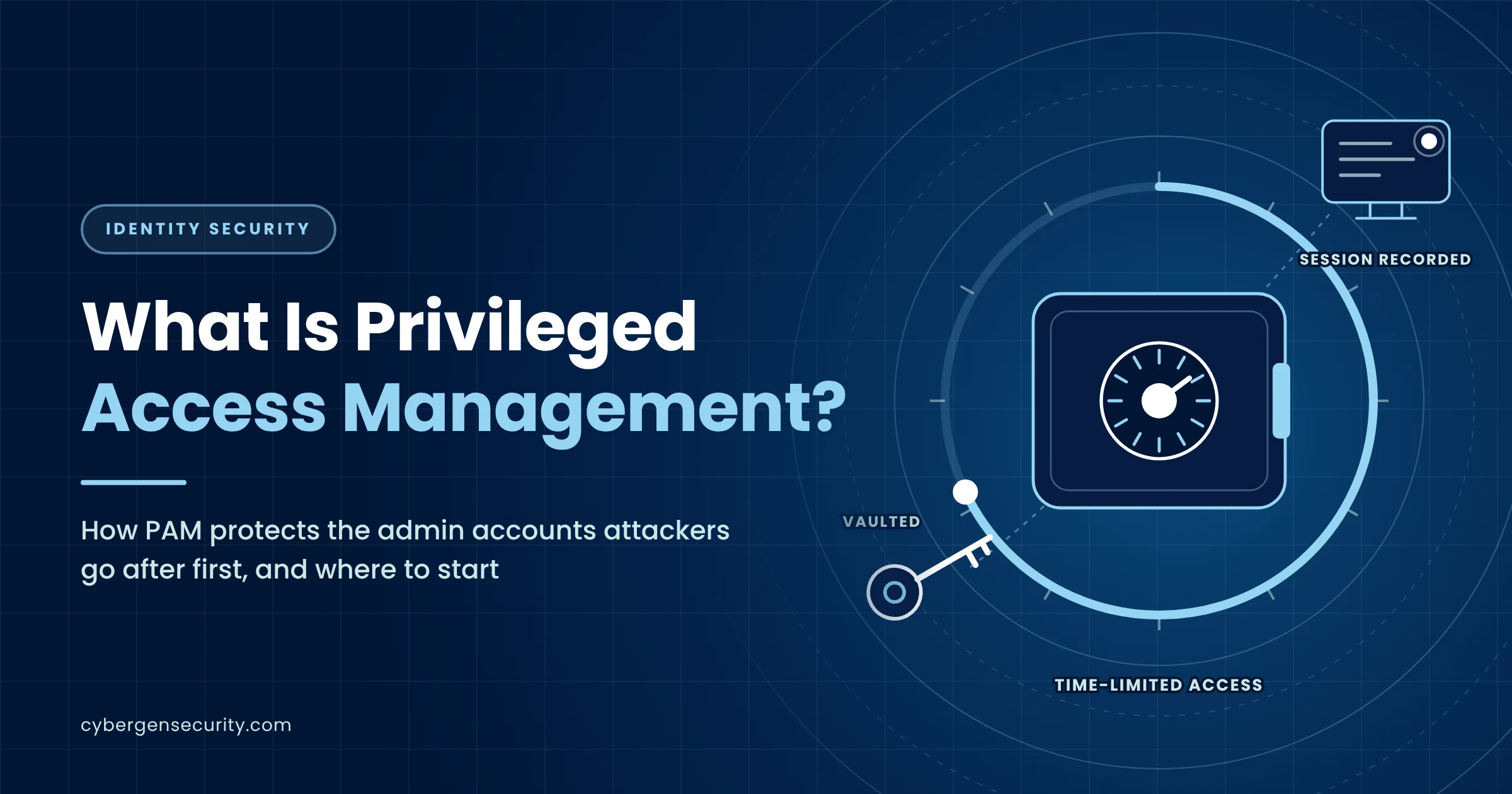
Privileged access management is not one product. It is a set of controls that work together around three ideas: keep the most powerful credentials out of people's heads, grant power only when it is needed, and watch what happens when it is used.
The vault
Privileged passwords and keys are stored centrally, checked out when needed and rotated after use, so nobody knows them by heart.
Just-in-time access
Rights are granted for a task and a time window, then removed automatically. Standing administrator access becomes the exception.
Session monitoring
Privileged sessions are brokered, recorded and searchable, so you can see exactly what was done and stop it if it looks wrong.
The Vault
A vault stores privileged passwords, keys and certificates centrally and encrypted. Administrators check a credential out for a task, often without ever seeing it, because the vault injects it into the session. After use, the password is rotated automatically. A password nobody knows cannot be written on a sticky note, reused on another system or phished.
Vaulting also fixes one of the oldest problems in IT: the shared admin password that has not changed since the person who set it left. Bringing those credentials into a vault gives you a list of what exists, a record of who used them and a way to change them all quickly after an incident.
Just-in-Time Access
Standing privilege is the real enemy. If an engineer holds domain admin rights every hour of every day, an attacker who compromises that account at three in the morning gets domain admin too. Just-in-time access removes the standing rights. People request elevation for a specific task and a set time, a rule or a colleague approves it, and the rights disappear when the window closes.
Admin rights that switch themselves off
- RequestAn engineer asks for server admin rights to apply a fix, with a reason
- ApproveA rule or a colleague approves it for one hour on named servers
- WorkThe session runs through the broker and is recorded
- RevokeRights disappear when the window closes, whether or not anyone remembers
The one-hour window is shown speeded up. Windows, approvals and scope are set by your own policy.
The best version goes further and grants only the rights the task needs, on only the systems involved. Someone patching a web server does not need to be able to reset the chief executive's password. Narrow, short-lived access shrinks what an attacker can do with any single stolen account.
Session Monitoring
The third pillar is visibility. Privileged sessions run through a broker that records them, captures commands and can alert on risky actions, such as disabling logging or creating a new administrator. Recordings make investigations faster, satisfy auditors and discourage misuse by insiders. Paired with your managed detection and response service, unusual privileged activity becomes one of the strongest signals you have that something is wrong.
PAM, IAM and Zero Trust: How They Fit Together
These three terms are often used interchangeably, which causes confusion when budgets are set. They are related but distinct.
Zero trust is the strategy, IAM is the foundation, PAM guards the crown jewels
Identity and access management covers every identity in the organisation. It handles joiners, movers and leavers, single sign-on and multi-factor authentication, and it decides who can use which application. It is the foundation, and without it PAM has nothing reliable to build on.
PAM is a specialised layer inside IAM for the small number of accounts whose compromise would be catastrophic. It adds the vault, the time limits and the recording that would be excessive for ordinary users but are essential for administrators.
Zero trust is the overall strategy. NIST describes it as removing implicit trust based on network location and checking every request on its own merits. PAM is one of the most practical ways to put zero trust into practice, because it applies the principle where it matters most: nobody is trusted with standing power just because they are on the inside. Our zero trust architecture work usually starts here for that reason.
Where to Start: Your First Ten Privileged Accounts
PAM programmes fail when they try to cover everything at once. The most effective approach starts with the accounts that would hurt most if stolen, protects them properly and expands from there. For most organisations, that means ten groups of accounts.
Your first ten privileged accounts
Tick each one you have found, owned and protected.
"Protected" means the account has a named owner, sits in a vault or behind just-in-time elevation, and uses phishing-resistant MFA. Nothing you tick is sent or stored.
For each group, work through the same four steps:
- Find them. Discover every account with that level of access, including forgotten ones, disabled accounts that were never removed and service accounts created by long-departed projects.
- Own them. Give each account a named owner who is accountable for whether it still needs to exist.
- Reduce them. Remove standing membership of the most powerful groups. Most organisations need far fewer permanent administrators than they have.
- Protect them. Vault the credentials, apply phishing-resistant MFA, require a separate admin account and, ideally, a dedicated administration device.
That last point deserves emphasis. The NCSC's guidance on privileged access workstations explains why: if administrators do their privileged work on the same laptop they use for email and browsing, any malware on that laptop can ride along. A separate, locked-down device for administration closes that route.
Service accounts deserve their own attention. They often hold more rights than any person, never use MFA and have passwords embedded in scripts. They are a favourite target precisely because nobody watches them. Our article on non-human identities goes deeper on this growing blind spot.
Signs Your Privileged Access Is Out of Control
You do not need a full audit to know whether privileged access is a problem. If any of these sound familiar, it is.
Each of these is fixable, and fixing them is rarely about technology alone. It is about deciding who should hold power, writing that down and making the secure route the easy one for administrators. A PAM rollout that makes engineers' jobs harder will be worked around. One that gives them fast, approved access through a single portal tends to be welcomed.
It also pays to test the result. A penetration test or a red team exercise that targets privileged access will show you whether an attacker who lands on a laptop can still reach domain admin, which is the question that matters. If you want the background on why the top tier deserves this focus, read our piece on securing tier zero.
How Cybergen Can Help
Our identity security and privileged access management service is built around getting the most powerful accounts under control quickly, then making it last. We can help you:
- Discover every privileged account across on-premises, cloud and software-as-a-service, including service accounts and supplier access
- Design a tiered administration model and a realistic PAM roadmap
- Introduce vaulting, just-in-time elevation and session recording in phases that do not stall your IT team
- Monitor privileged activity around the clock through managed detection and response
- Prove it works with CREST-accredited testing focused on privilege escalation
If you would like a straight answer on who holds the keys to your environment, speak to our team.
Frequently Asked Questions
Do small businesses need PAM?
Yes, although it does not have to mean a large platform. Small organisations often have the most concentrated risk, because one or two people hold every admin password and those accounts are used for everyday work. Separate admin accounts, phishing-resistant MFA, a password vault for shared credentials and removing standing rights you do not need are all PAM, and all achievable on a small budget.
Does MFA replace PAM?
No. Multi-factor authentication makes it harder to log in as an administrator, but it does nothing to limit what that administrator can do once inside, how long the access lasts or whether anyone can see what happened. Attackers also bypass weaker MFA through phishing kits, push fatigue and stolen session tokens. MFA is one control inside a PAM programme, not a substitute for it.
What counts as a privileged account?
Any account that can change systems, security settings or other people's access. That includes domain and global administrators, local admin rights on laptops and servers, cloud owner roles, database administrators, firewall and network device logins, backup consoles, and service accounts or API keys used by applications and scripts.
What is just-in-time access?
Just-in-time access means nobody holds administrator rights permanently. A person requests elevated access for a specific task, it is approved by a rule or a colleague, and it expires automatically after a set time. If an attacker steals the account outside that window, there is no privilege to steal.
How long does a PAM rollout take?
The first meaningful risk reduction can happen in weeks: discovering privileged accounts, vaulting the most powerful credentials and removing rights nobody needs. A full programme covering every system, service account and third party usually runs in phases over several months, because each phase changes how people work and needs bedding in.
Sources
CREST-certified consultants with over 100 years of combined experience in threat intelligence, penetration testing, MDR and compliance.