
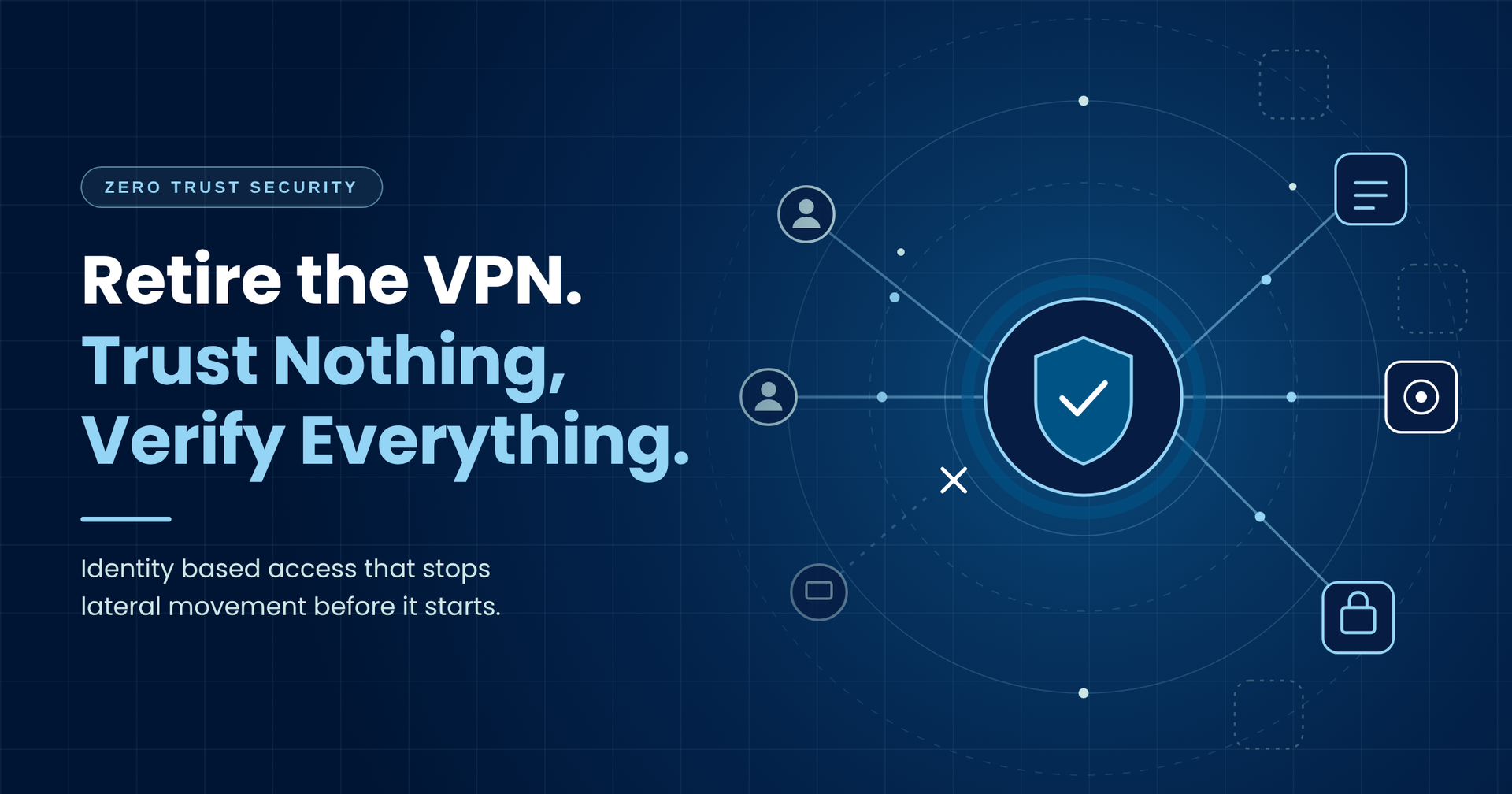
Zero Trust Security: Why It Is Time to Retire the VPN and Rethink Access


October 16, 2026

Introduction

For decades, organisations protected their data the same way medieval towns protected their people: build a strong wall, guard the gate, and trust everyone inside. That model made sense when staff sat at desks in a single office and every application lived in the company data centre. It makes far less sense today.


Your people now work from home, from client sites, from airports and from coffee shops. Your applications live across public cloud, private cloud and software as a service platforms. Contractors, partners and suppliers all need some level of access. The perimeter has not so much moved as disappeared, and attackers know it.


This is why zero trust security has become the defining approach to modern cyber defence. Rather than assuming that anything inside the network is safe, zero trust assumes that nothing is safe until it has been proven otherwise, and then keeps checking. In this guide, the security specialists at Cybergen explain what zero trust really means, why the traditional VPN is no longer fit for purpose, and how your organisation can move to a zero trust model with confidence.

What Is Zero Trust Security?

Zero trust security is a strategic approach to cyber security built on one simple principle: never trust, always verify. Every user, every device and every request for access is treated as potentially hostile until its identity, health and context have been confirmed. Access is then granted only to the specific resource required, and only for as long as it is needed.


It is important to understand that zero trust is not a single product you can buy and switch on. It is an architecture and a mindset that shapes how access is designed, granted, monitored and revoked across your entire estate. Technology plays a vital role, but so do policy, process and people.


Zero trust network access, often shortened to ZTNA, is the part of this approach that governs how users reach applications. Instead of connecting a user to the whole network, ZTNA connects them directly and securely to the individual applications they are entitled to use. Everything else remains invisible to them.


The result is a security model that follows the user and the data, rather than relying on where someone happens to be sitting. For organisations with hybrid workforces, multi cloud estates and complex supply chains, that shift is transformative.

Why Traditional VPNs Are No Longer Enough

The virtual private network has been the workhorse of remote access for more than twenty years. It did its job well in an era when most applications sat behind a corporate firewall. Today, however, the VPN has become one of the weakest points in many organisations’ defences.


The core problem is that a VPN grants broad network access. Once a user authenticates, they are effectively placed inside the network and can often see far more than they need. If that user’s laptop is compromised, or their credentials are stolen, the attacker inherits the same broad access. From there, they can move laterally from system to system, quietly exploring the estate, escalating privileges and searching for valuable data. This lateral movement is exactly how many ransomware attacks turn a single infected endpoint into an organisation wide crisis.


VPNs also expose applications and infrastructure to discovery. VPN gateways are visible on the internet, which makes them attractive targets for brute force attacks and for exploitation whenever a new vulnerability is disclosed. Security teams frequently find themselves racing to patch remote access appliances before attackers can take advantage.


There is a cost to the user experience too. Traffic is often backhauled through central gateways, adding latency and frustrating staff who simply want their applications to work. Meanwhile, IT teams must manage a growing collection of separate agents for VPN, web security, cloud application control and data loss prevention. Every additional agent adds complexity, conflicts and potential gaps. And in security, every gap is an attack path.

The Core Principles of Zero Trust

While every zero trust journey is different, the most effective programmes share a common set of principles. Understanding them is the first step towards building a model that genuinely reduces risk.


Verify Identity at Every Request

Trust is established through strong identity, not network location. Multi-factor authentication, device certificates and contextual signals such as location, time and behaviour combine to confirm that the right person, on the right device, is asking for the right thing. This check happens at every request, not just once at login.


Grant Least Privilege Access

Users should reach only the resources they are entitled to, and nothing more. By limiting each person’s access to the specific applications their role requires, organisations dramatically shrink the damage any single compromised account can cause.


Hide Applications From the Unauthorised

In a zero trust model, applications are not published to the internet for anyone to find. Unauthorised users cannot discover them, scan them or attempt to brute force them. If an attacker cannot see a target, they cannot attack it.


Verify Continuously

Trust is never assumed after sign in. Identity, device health and context are re evaluated throughout the session. If something changes, such as a device suddenly showing signs of compromise, access can be adjusted or withdrawn immediately.


Assume Breach and Contain Automatically

Zero trust accepts that breaches will happen and plans for them. When a device shows indicators of compromise, its access is revoked in real time, stopping malware and ransomware from spreading while security teams investigate.


Log Everything

Every access attempt, successful or not, is recorded with full context and fed into reporting and security information and event management platforms. This creates a complete audit trail for investigations, compliance and continuous improvement.

How Zero Trust Network Access Works in Practice

Imagine a member of your finance team working from home on a Monday morning. They open their laptop and launch the finance system. Behind the scenes, a zero trust platform checks who they are through multi-factor authentication, confirms that their device is managed, patched and healthy, and evaluates the context of the request. Only when all of those checks pass is an encrypted, application-specific connection created between that user and that one system.


The user never joins the wider network. They cannot see the HR platform, the engineering servers or the file shares they have no business accessing. To them, those systems simply do not exist.


Now imagine that, halfway through the morning, the laptop begins to behave suspiciously. Perhaps endpoint protection flags unusual activity. Because verification is continuous, the zero trust platform responds instantly, revoking the device’s access before any malicious code can reach other systems. The rest of the organisation keeps working as normal while the security team investigates that single endpoint.


The same approach works for contractors and third parties, including those using unmanaged devices, whose risk can be assessed in context and whose access can be tightly scoped. Many modern platforms also deliver zero trust access through global points of presence, so users connect to a nearby location rather than a distant data centre. That means faster performance and a smoother experience than traditional VPNs ever offered.

The Business Benefits of Zero Trust

Zero trust is often discussed in technical terms, but its greatest value is felt at board level. A well-designed zero trust model reduces risk, simplifies operations and supports the way modern organisations actually work.


The most immediate benefit is a dramatic reduction in attack surface. When applications are hidden from unauthorised users, there is no discovery surface for attackers to probe and no exposed gateway to brute force. Threats that rely on scanning the internet for vulnerable remote access systems simply have nothing to find.


Zero trust also brings lateral movement to an end. Because users are connected to individual applications rather than the whole network, a compromised endpoint cannot be used as a launch pad to reach everything else. This single change can be the difference between a contained incident and a business stopping ransomware event.


Operational simplicity is another major advantage. Many organisations are consolidating remote access, secure web gateway, cloud access security broker and data loss prevention capabilities into a single lightweight agent under a secure access service edge, or SASE, model. One agent and one policy model means less endpoint bloat, fewer conflicts, lower licensing and management costs, and far more consistent protection across every user and device.


Finally, zero trust strengthens compliance and governance. With every access attempt logged in detail, organisations can demonstrate exactly who accessed what, when and from where. That evidence is invaluable for audits, regulatory obligations and incident investigations alike. And because users enjoy faster, simpler access without the frustrations of a traditional VPN, security stops being a barrier to productivity.

Common Zero Trust Use Cases

Retiring the Legacy VPN


For many organisations, replacing the VPN is the natural starting point. Zero trust network access delivers identity based, application specific connectivity, so users see only what they are entitled to and attackers cannot pivot from a single endpoint to the rest of the network. The VPN concentrator, with all its patching headaches and exposure, can finally be decommissioned.


Containing Compromised Devices Automatically


When a device shows signs of compromise, every second counts. Zero trust allows access to be withdrawn in real time, preventing ransomware and malware from spreading laterally. Critical systems stay protected while the security team investigates and remediates the specific endpoint, rather than shutting down the entire business.


Securing Third Parties and Contractors

Suppliers and contractors are a frequent route into organisations. Zero trust gives them precisely scoped access to the systems they need, for the time they need it, often without requiring an agent on devices you do not control. Their activity is fully logged and their access can be removed the moment a contract ends.


Consolidating Security Under One Platform

Separate tools for remote access, web filtering, cloud application control and data protection create fragility and cost. Bringing them together under a single agent and policy framework reduces complexity while tightening consistency across the whole organisation.

How to Start Your Zero Trust Journey

Moving to zero trust does not require ripping out everything overnight. The most successful programmes are phased, pragmatic and guided by clear business priorities.


Start by understanding what you have. Map your users, devices, applications and data flows, and identify where your most sensitive information lives. Many organisations are surprised by how many applications are in use and how much access has accumulated over the years.


Next, strengthen identity. Robust multi-factor authentication and a reliable identity provider form the foundation of every zero trust model. Pair this with device posture checks so that only healthy, trusted devices can connect.

Then choose a high-value starting point. Replacing the VPN for a specific group of users, or protecting a particularly sensitive application, allows you to prove the model, build confidence and refine policies before scaling across the organisation.


As you expand, define least privilege access policies based on roles and real business need, and integrate logging with your security operations so that every access decision feeds your monitoring and response capability. Zero trust is most powerful when it is connected to round-the-clock detection and response.

Finally, treat zero trust as a continuous programme rather than a one off project. Threats evolve, applications change, and people move roles. Policies should be reviewed regularly, and the model should mature alongside your organisation. This is where the right partner makes all the difference.

Why Cybergen Is the Partner to Trust With Zero Trust

Zero trust is only as strong as the expertise behind it. Choosing a technology is the easy part. Designing an architecture that fits your organisation, deploying it without disrupting the business, and running it effectively day after day is where most programmes succeed or fail. That is exactly where Cybergen excels.


Cybergen brings together some of the most accomplished cyber security professionals working today. Our consultants, architects and engineers have designed and secured complex environments for organisations of every size, across both the private and public sectors. They do not simply understand zero trust in theory. They have delivered it in the real world, under real pressure, against real adversaries.


We are proudly independent in our thinking. Rather than forcing every client into a single product, we assess your environment, your risks and your goals, then design the zero trust approach that genuinely fits. We draw on a carefully selected ecosystem of leading technologies, and we can deliver every requirement ourselves or alongside trusted partners, giving you one accountable team from strategy to day-to-day operations.


Our work does not stop at deployment. Cybergen connects zero trust to round the clock managed detection and response, so suspicious activity is spotted and contained 24 hours a day, every day of the year. We help you define policies, train your people, integrate with your existing security tools and continuously mature your model as threats evolve.


For public sector organisations, Cybergen is available through G-Cloud, and we are equally happy to contract directly. Whichever route you choose, you gain a partner whose standards are uncompromising and whose focus is singular: keeping your organisation, your people and your data secure.

FAQs

Is Zero Trust Only for Large Enterprises?


Not at all. Small and medium-sized organisations are frequent targets precisely because attackers assume their defences are weaker. Cloud-delivered zero trust services make the model accessible and affordable for organisations of every size.


Does Zero Trust Mean We Do Not Trust Our Staff?


No. Zero trust is about verifying access, not doubting people. It protects your staff as much as your systems, because a stolen password or infected laptop can no longer be used to cause widespread damage in their name.


How Long Does It Take to Implement Zero Trust?


Initial use cases, such as replacing the VPN for a group of users, can often be delivered within weeks. A full zero trust programme is typically phased over a longer period, with measurable risk reduction achieved at every stage.


Will Zero Trust Slow Our Users Down?


Usually the opposite. Because users connect directly to applications through nearby points of presence rather than backhauling traffic through a central VPN gateway, most organisations see faster and more reliable access.

Summary: Retire the VPN and End Lateral Movement

The network perimeter that organisations once relied upon has gone, and the tools built to defend it are struggling to keep pace. Legacy VPNs grant too much access, expose too much infrastructure and give attackers the freedom to move once they are inside. Zero trust security changes the equation. By verifying every request, hiding applications from the unauthorised, granting only the access each user needs and containing threats automatically, it closes the gaps that modern attacks depend on.


The question for most organisations is no longer whether to adopt zero trust, but how quickly and how well. With the right strategy and the right partner, the journey can be smooth, phased and focused on the risks that matter most to your business.


If you are ready to retire your VPN, stop lateral movement and build a security model fit for the way your organisation works today, speak to Cybergen. Our experts will assess your current environment, show you where the risks lie and design a zero trust roadmap tailored to your goals. Get in touch with the Cybergen team today at cybergensecurity.com to book your zero trust consultation.

Ready to strengthen your security posture? Contact us today for more information on protecting your business.


Let's get protecting your business

Disaster Recovery

Keep your data secure and protected at all times.


Cybergen News

Sign up to get industry insights, trends, and more in your inbox.

Contact Us

SHARE THIS

Latest Posts

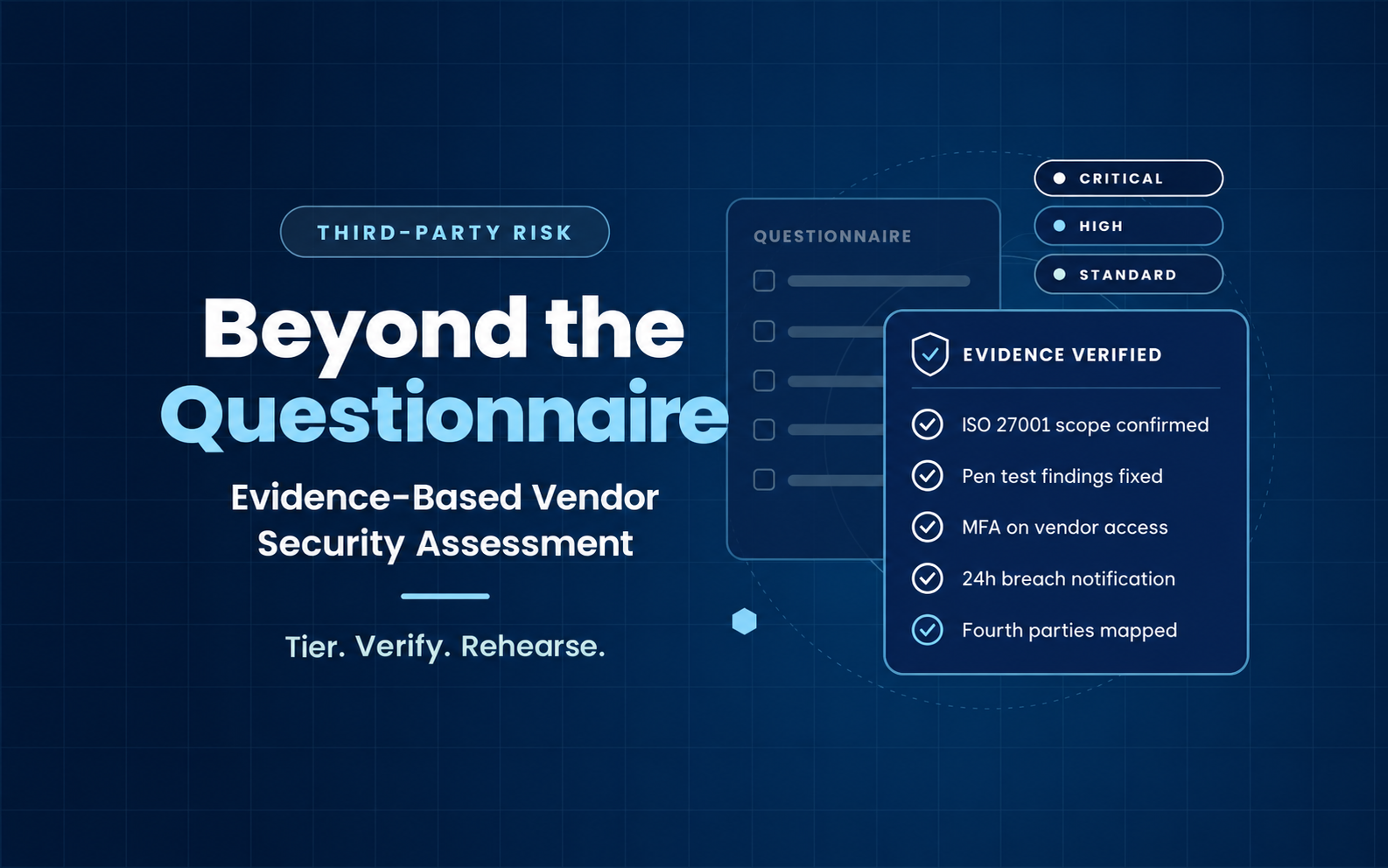
Blue security assessment slide titled “Beyond the Questionnaire” with vendor verification graphics
October 13, 2026
Vendor questionnaires create paperwork, not assurance. Learn how CISOs can tier suppliers, verify security evidence and rehearse a vendor breach before it happens.
Dark blue promotional banner reading “Bring Shadow AI Under Control” with smaller text about a 90-day plan.
October 9, 2026
Shadow AI is now the top concern for security leaders. A practical 90-day plan for CISOs to discover, classify and govern unapproved AI use without slowing the business.
Blue cybersecurity slide reading “Can You Actually Restore? A Cyber Recovery Testing Playbook for Security Leaders”
October 6, 2026
Backups are not a recovery plan until you have tested them under attack conditions. A practical playbook for CISOs to test, measure and evidence ransomware recovery.
Infographic on STIX and TAXII explained, with blue network diagram and labeled threat intelligence flow icons
October 3, 2026
What are STIX and TAXII? Learn how these open standards structure and share cyber threat intelligence, and how your SOC can use them to detect threats faster.
Blue tech-themed slide titled “How to Build a Cyber Threat Intelligence Program You Will Actually Use”
October 2, 2026
A practitioner's guide to building a cyber threat intelligence program: intelligence requirements, collection, analysis, SOC integration, metrics and a roadmap.
Cyber risk graphic with blue digital network background and text: “Your Supplier List Is Not a Resilience Plan.”
September 29, 2026
Learn how global enterprises can map supplier dependencies, find shared points of failure and strengthen third-party cyber risk management.
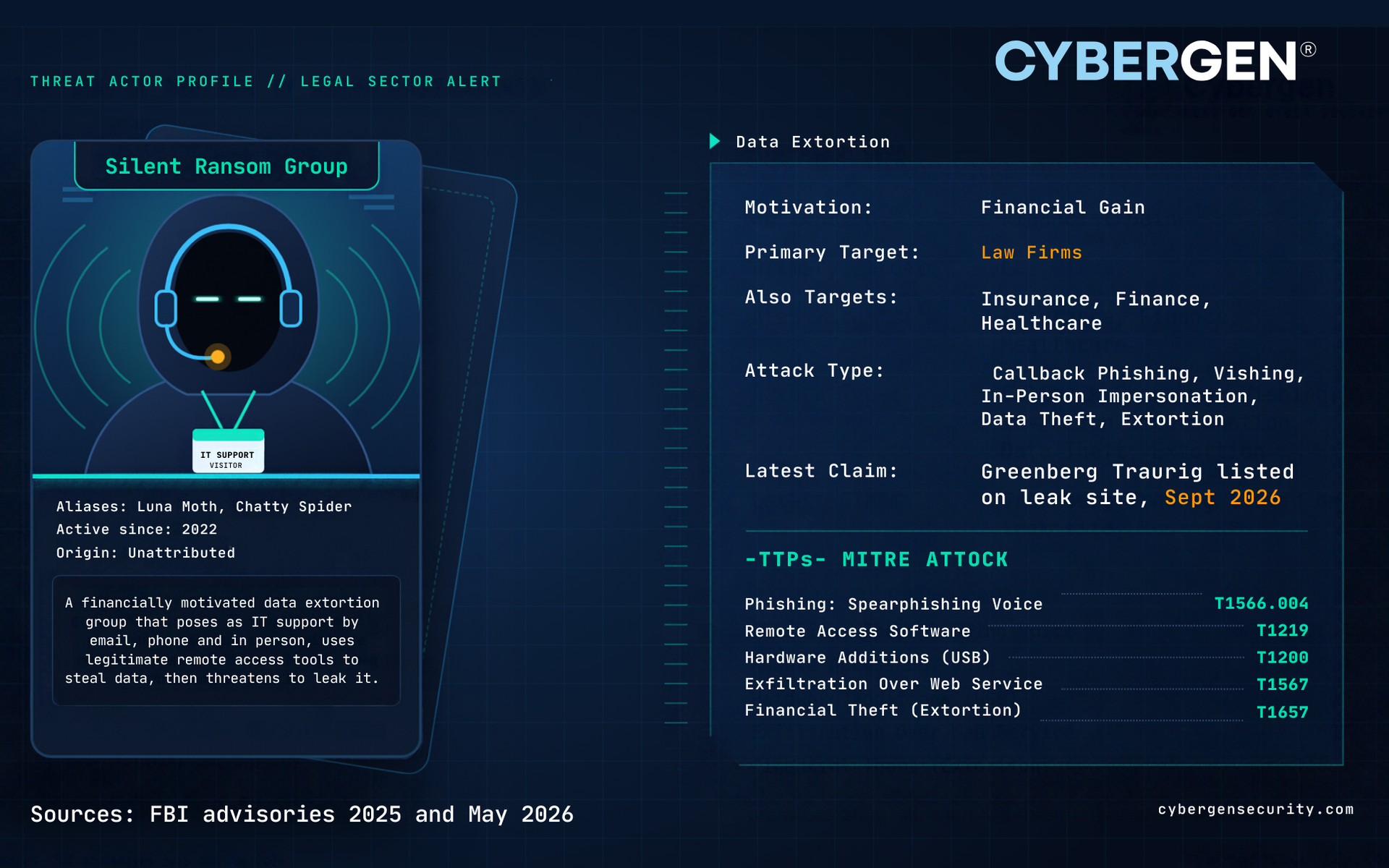
CyberGen dark blue dashboard with a central hooded avatar and security stats panel
September 28, 2026
Greenberg Traurig is the latest law firm hit as Silent Ransom Group targets the legal sector. Learn how these attacks work and how to protect your firm.

Glowing digital hand touching a touchscreen, with white connection lines and blue tech background
September 24, 2026
Non-human identities now outnumber employees by 50 to 1. Discover the risks of API keys, service accounts and AI agents, and how to secure them.
Blue skull with “RANSOMWARE” text and glowing digital lock icon on a dark cyber background
September 22, 2026
UK ransomware payment ban explained. Discover what public sector and CNI organisations need to do now to strengthen resilience, recovery and incident response.
Analytics dashboard with teal area chart, key metrics cards, and a task list sidebar
September 18, 2026
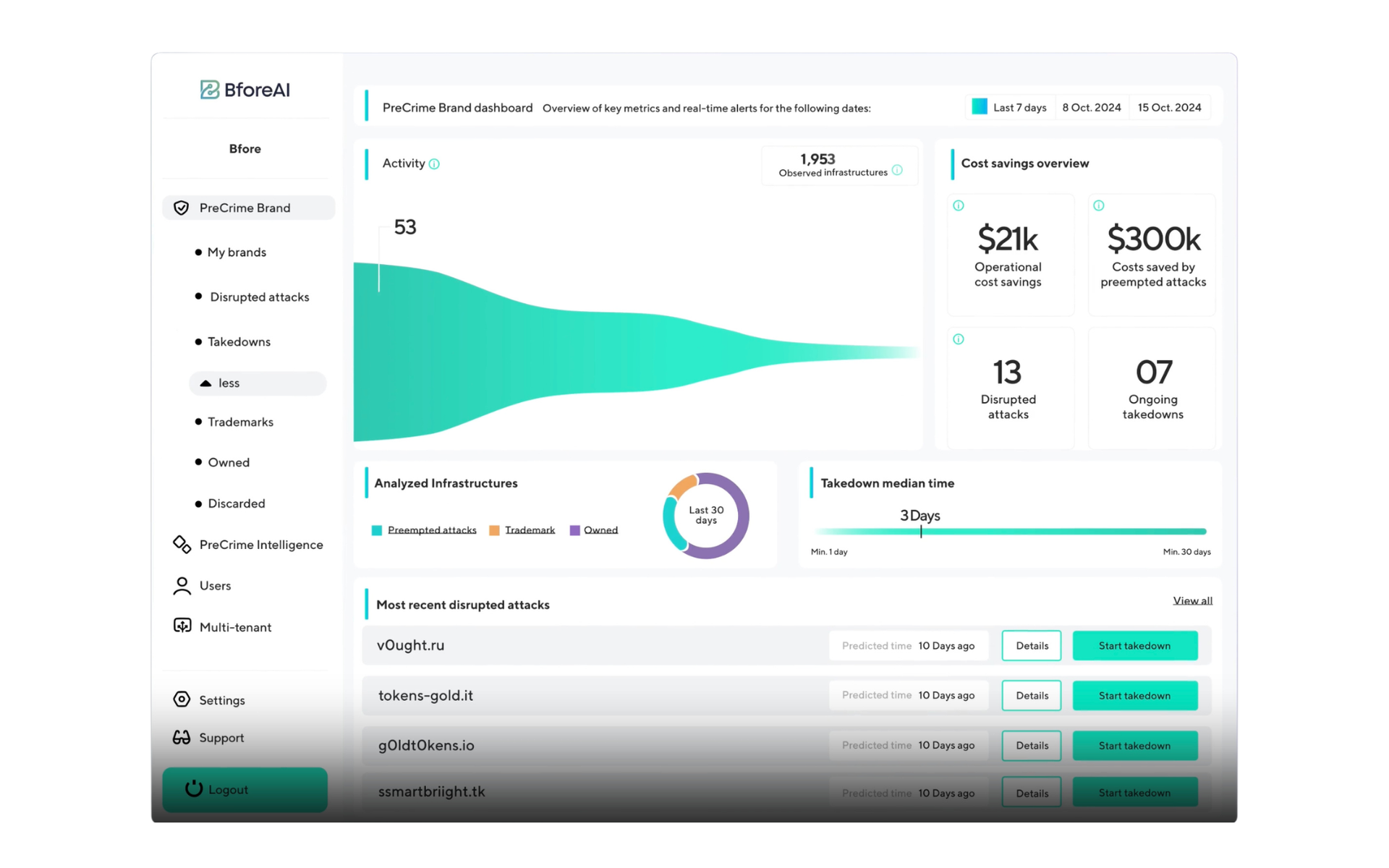
Manual phishing and domain takedown investigations cost security teams hundreds of hours a year. See how BforeAI's PreCrime™ predictive cybersecurity platform, available in the UK exclusively through Cybergen, detects and automates takedown of weaponized and impersonated domains before they cost you time or money.