Attackers Are Exploiting Five Mitel MiCollab Flaws: Why Internet-Facing Conferencing Servers Need Patching Now
 Cybergen Cyber NewsCREST-certified security team
|
|
7 min read
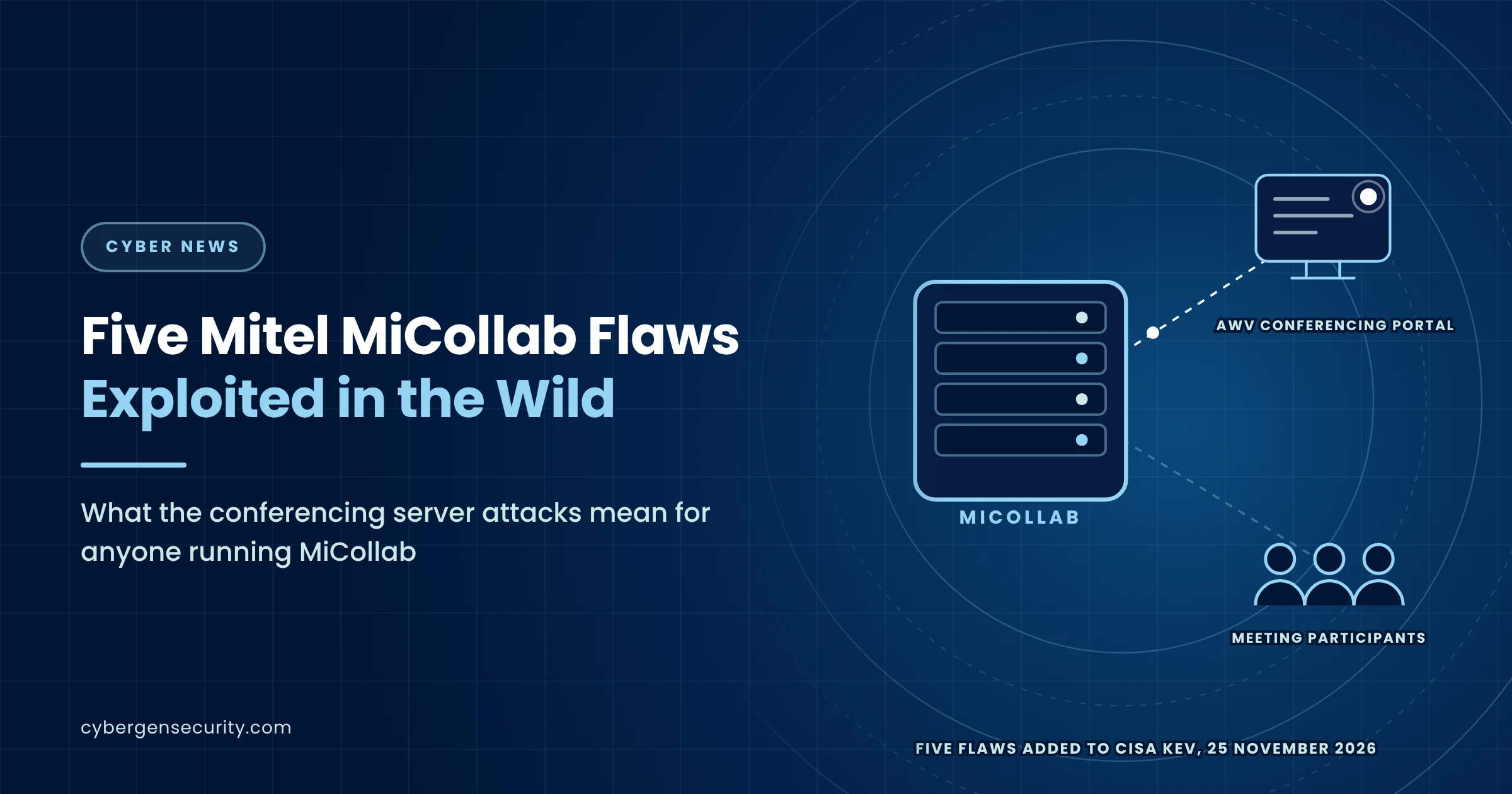
On Wednesday 25 November 2026, the US Cybersecurity and Infrastructure Security Agency (CISA) added ten vulnerabilities to its Known Exploited Vulnerabilities catalogue. Five of them are in a single product: Mitel MiCollab, the unified communications platform that many organisations use for voice, chat, presence and web conferencing. CISA only lists a flaw once it has evidence that attackers are using it, so for anyone running MiCollab this is no longer a patching exercise for next month. It is a question of whether someone has already been in.
All five flaws sit in the same place, MiCollab's Audio, Web and Video Conferencing component (AWV), which is the part most often reachable from the internet so that outside guests can join meetings. None of them needs a login, and the worst is rated 10.0, the maximum score.
What Happened
Mitel published security advisory MISA-2026-0012 on 16 November 2026, describing five vulnerabilities in the AWV component of MiCollab 10.3 (10.3.0.18) and earlier. At that point they carried only Mitel's internal reference numbers. On 24 November Mitel revised the advisory to add CVE identifiers, and the following day CISA added all five to its catalogue. The Canadian Centre for Cyber Security had already published its own alert on 19 November.
Mitel's advisory does not say whether the flaws have been exploited, and it names no researchers. CISA's listing is what confirms exploitation in the wild. Neither organisation has said who is behind the attacks, how many organisations have been affected, or whether ransomware groups are involved. CISA marks known ransomware use as unknown for all five.
| CVE | What it allows | CVSS (Mitel) | CISA deadline |
|---|---|---|---|
| CVE-2026-133323 | Blind OS command injection, no login needed | 10.0 Critical | 28 November 2026 |
| CVE-2026-133303 | XML injection leading to command execution, using pre-staged content | 9.0 Critical | 28 November 2026 |
| CVE-2026-133275 | Upload of arbitrary files due to weak file type checks | 5.3 Medium | 28 November 2026 |
| CVE-2026-133324 | Authentication bypass allowing unauthorised actions | 5.3 Medium | 28 November 2026 |
| CVE-2026-133311 | Access to sensitive conferencing information | 5.9 Medium | 9 December 2026 |
Mitel's own warning is the important line: exploited together, these issues "can significantly amplify their impact". An attacker who can bypass authentication, upload a file and inject commands into the same exposed service has everything needed to take control of the server, without ever logging in.
Not the First Time for MiCollab
MiCollab has been a target before. In January 2025, CISA added two earlier MiCollab path traversal flaws, CVE-2024-41713 and CVE-2024-55550, to the same catalogue after researchers had published details of how to chain them. Communications servers are attractive for a simple reason: they sit at the edge of the network, they hold directory and user information, and they are trusted by the systems behind them.
Who Is Affected
Any organisation running MiCollab 10.3 (10.3.0.18) or earlier is affected. The greatest risk is to those whose AWV conferencing portal is reachable from the internet, which is a common set-up for organisations that host meetings with customers, suppliers or the public. Mitel says products past their end of support were not assessed, so older MiCollab installations should be treated as vulnerable and have no fix coming.
MiCollab is widely used in sectors that run their own telephony, including the public sector, healthcare, education, hospitality and professional services. Many organisations do not manage it themselves: it is often installed and run by a telephony partner or managed service provider. If that is your situation, the patch will depend on them, so ask today.
Why It Matters
The timeline here is short. Mitel disclosed the flaws on 16 November, CVE numbers appeared on 24 November and CISA confirmed exploitation on 25 November. US federal agencies have been given until 28 November to fix four of the five, three days after the listing. That compressed deadline tells you how seriously CISA rates the risk.
It also fits a pattern Cybergen sees across Threat Watch week after week. Systems built to be reached from the internet, such as remote support tools, firewalls, VPN gateways and communications servers, are exploited within days of disclosure, sometimes before. Recent examples include the ScreenConnect panel hijacking and the PHP2Shell firewall attacks. The organisations that come through these waves well are the ones that know exactly what they expose and can patch it within days rather than at the next maintenance window.
The same CISA update also confirmed exploitation of three flaws in Danfoss AK-SM 800A refrigeration controllers, the type of system behind the attacks on supermarket fridges in France and the second wave against blood banks in Norway, together with flaws in HPE Juniper Session Smart routers and Xen Orchestra. All ten are tracked on Threat Watch.
What To Do Now
Find out whether you run MiCollab. Check your asset register, ask your telephony or IT provider, and look at your external attack surface for MiCollab and AWV conferencing pages. Include systems a supplier runs on your behalf.
Apply Mitel's fix. Patch MiCollab 10.3 (10.3.0.18) using the instructions in Mitel knowledge base article KB000129195, or move to a later release that includes the fix. If you are on a version past end of support, plan an upgrade now.
If you cannot patch today, close the door. Mitel's workaround is to restrict external access to the AWV component. Take the conferencing portal off the internet or allow only known addresses until the patch is in place.
Assume it may have been reached. If AWV was exposed before you patched or restricted it, check the server for unexpected files, new accounts, unusual processes and outbound connections, and review web and system logs from mid-November onwards. If anything looks wrong, preserve the evidence before rebuilding.
Ask your provider for confirmation in writing. If a partner manages MiCollab for you, ask them to confirm the version, the date the fix was applied and whether they checked for signs of compromise.
Get alerts for your own stack. CISA's catalogue now holds more than 1,800 exploited vulnerabilities. Threat Watch lets you pick the vendors you use and be told when one of them is added.
How Cybergen Can Help
Cybergen's vulnerability management service finds exposed systems like MiCollab and tracks them to a fix, and our CREST penetration testing team can confirm whether a patched server is really closed. If you think a system was reached before it was patched, our incident response service can investigate.
Frequently Asked Questions
Which Mitel MiCollab versions are affected?
Mitel's advisory MISA-2026-0012 says MiCollab 10.3 (10.3.0.18) and earlier are affected. The fix is a patch for 10.3.0.18 described in Mitel knowledge base article KB000129195, and later MiCollab releases will include it. Mitel did not assess versions that are past end of support, so anyone running one of those should treat it as vulnerable.
Are these flaws really being exploited?
Yes. CISA added all five to its Known Exploited Vulnerabilities catalogue on 25 November 2026, which it only does when it has evidence of exploitation in the wild. Mitel's own advisory does not comment on exploitation, and neither CISA nor Mitel has named the attackers or said how many systems have been hit.
What can an attacker do with them?
All five sit in the Audio, Web and Video Conferencing (AWV) component and none needs a login. The most serious, CVE-2026-133323, is a command injection rated 10.0 that lets an attacker run commands on the server. Others allow file upload, authentication bypass and access to conferencing data. Mitel warns that used together their impact is significantly greater.
What should we do if we cannot patch today?
Mitel's workaround is to restrict external access to the AWV component until the patch is applied. Take the conferencing portal off the internet or limit it to known addresses, then patch, then check the server for signs that it was accessed before you closed it off.
We do not use MiCollab. Does this matter to us?
The specific flaws do not, but the pattern does. Unified communications servers, remote access gateways and other edge systems are exposed to the internet by design and are exploited within days of disclosure. Knowing exactly what you expose, and being able to patch it within days, is the lesson for every organisation.
Sources
- CISA alert: ten known exploited vulnerabilities added to the catalogue (25 November 2026)
- CISA: Known Exploited Vulnerabilities catalogue (version 2026.11.25) (accessed 26 November 2026)
- Mitel: Product Security Advisory MISA-2026-0012, MiCollab Multiple Vulnerabilities (16 November 2026, revised 24 November 2026)
- Daily CyberSecurity: Mitel MiCollab vulnerabilities including a CVSS 10 command injection (17 November 2026)
- ZeroHour: CISA lists five exploited Mitel MiCollab flaws with near-term deadlines (accessed 26 November 2026)
- SecurityWeek: CISA warns of Mitel MiCollab vulnerabilities exploited in attacks (8 January 2025)
CREST-certified consultants with over 100 years of combined experience in threat intelligence, penetration testing, MDR and compliance.