What Does a Virtual CISO Do? Roles, Costs and When You Need One
 Cybergen InsightsCREST-certified security team
|
|
10 min read
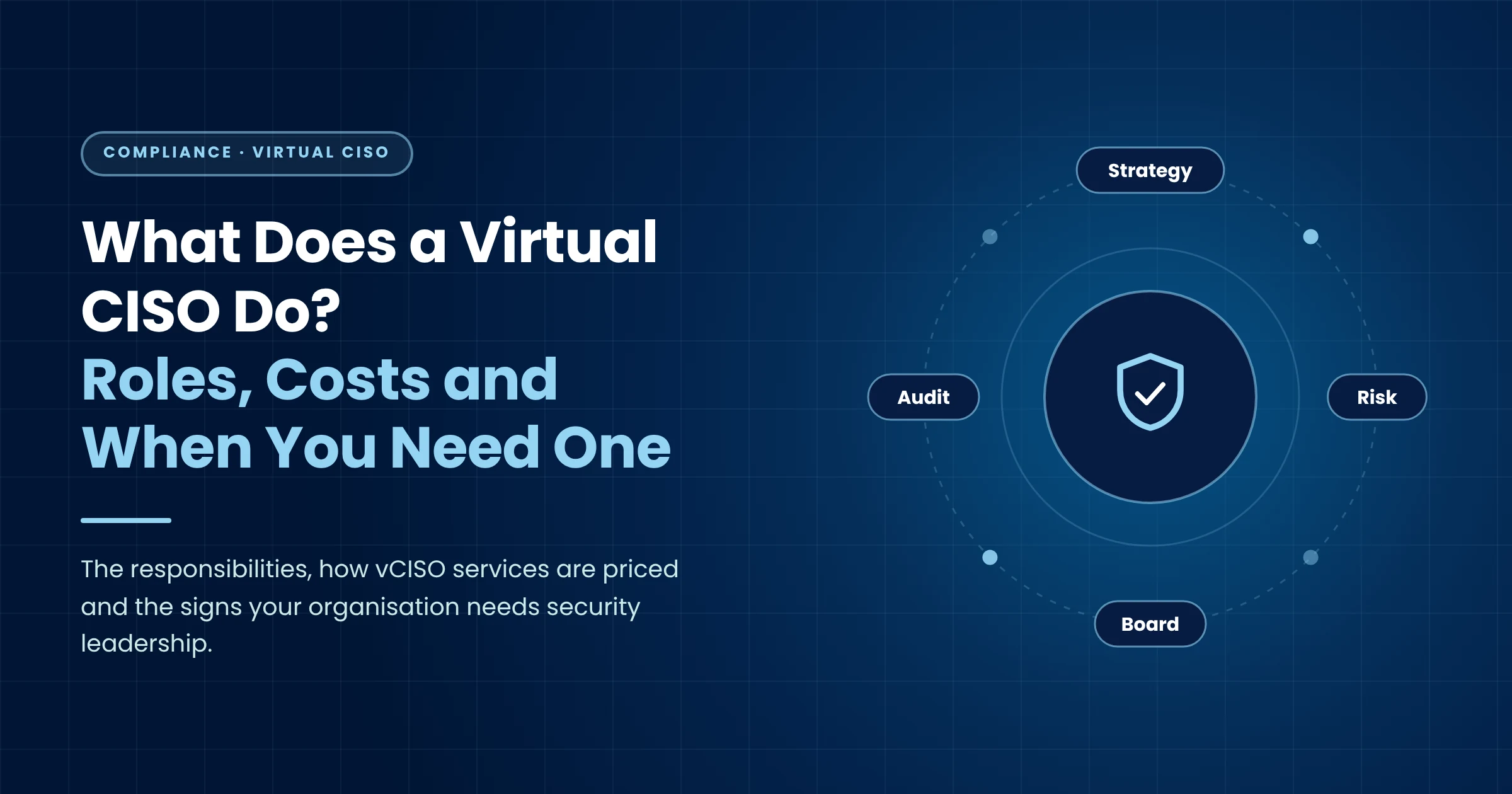
Ask a growing business who is responsible for cyber security and the answer is often a pause, followed by the name of the IT manager, the managed service provider or, occasionally, "all of us". None of those is wrong exactly. But none of them is the same as having a senior person who owns security risk, sets direction and can explain it to the board.
That is the job of a chief information security officer, or CISO. Large organisations employ one full time. Many others cannot justify a permanent executive, or cannot find one, yet face the same customers, regulators and attackers. A virtual CISO fills that gap.
This guide explains what a virtual CISO does, what the first 90 days usually look like, how vCISO services are priced, the signs you need one and how the role compares with a full-time hire.
What a Virtual CISO Is (and Is Not)
A virtual CISO, also called a vCISO or fractional CISO, is an experienced security leader who works with your organisation on a part-time or flexible basis. They take on the responsibilities of a CISO: owning the security strategy, managing cyber risk, reporting to leadership and making sure the organisation meets its obligations. The difference is that you share their time rather than employ them full time.
The word "virtual" can be misleading. A good vCISO is not a remote adviser who sends a report and disappears. They attend leadership meetings, meet suppliers, sit in on incident calls and become a familiar part of how the organisation makes decisions. Much of the work can happen remotely, but the relationship should feel like having a senior colleague.
What a virtual CISO is, and what it is not
It is
- An experienced security leader, part time
- Accountable for strategy, risk and reporting
- The person who briefs the board in plain English
- A guide through audits, certifications and questionnaires
- A steady hand during an incident
It is not
- An extra pair of hands for the IT helpdesk
- A box ticked on a tender response
- Someone who writes policies and disappears
- A replacement for your security tools or monitoring
- A way to move accountability off the board
It also helps to be clear about where accountability sits. A vCISO advises and leads, but the board remains accountable for cyber risk. The UK government's Cyber Governance Code of Practice is explicit that directors own this risk, and the NCSC's Board Toolkit sets out the questions they should be asking. A vCISO helps them carry that responsibility with confidence rather than taking it away from them.
Typical Responsibilities in the First 90 Days
Every engagement is different, but the first three months tend to follow a familiar arc: understand the organisation, decide what matters most, then build the habits that keep security moving.
From discovery to a plan the board has signed off
Days 1 to 30: Understand
- Meet leadership, IT and key suppliers
- Review policies, controls and past incidents
- Map assets, data and critical services
- Identify urgent risks and quick wins
Days 31 to 60: Prioritise
- Build or refresh the risk register
- Benchmark against a framework
- Agree risk appetite with the board
- Draft a 12-month security roadmap
Days 61 to 90: Embed
- Present the roadmap and budget case
- Set up regular board reporting
- Test the incident response plan
- Start delivering the first projects
Understand the Organisation
The first month is about listening. A vCISO will meet the leadership team to understand the business, its plans and its appetite for risk. They will talk to IT, review existing policies and controls, look at any past incidents and find out which suppliers have access to systems and data. A cyber risk maturity assessment is often the quickest way to establish a baseline.
Urgent issues rarely wait for the plan. If administrator accounts lack multi-factor authentication or backups have never been tested, a good vCISO will flag it in week one and get it fixed.
Decide What Matters Most
In the second month, findings turn into priorities. The vCISO builds or refreshes the risk register, benchmarks the organisation against a recognised framework such as ISO 27001 or the NIST Cybersecurity Framework and agrees with the board how much risk the business is willing to accept. The output is a roadmap: what will be done, in what order, by whom and at what cost.
Build the Habits
By the third month, the focus shifts to rhythm. Regular board reporting starts, the incident response plan is tested, policies are refreshed so they reflect how people actually work, and the first projects get under way. Our article on writing security policies that matter covers why that last point is more important than it sounds.
After the First 90 Days
Once the foundations are in place, the role settles into ongoing leadership. A typical month might include a security report to the board, a review of new risks and incidents, progress checks on the roadmap, answering a difficult customer questionnaire and advising on a new system or supplier before it is signed.
The vCISO also becomes the organisation's security voice in the moments that matter: when a regulator writes, when an auditor arrives or when an incident escalates out of hours. Having someone who already knows the business, its systems and its people makes those moments far less fraught.
How vCISO Services Are Priced
There is no single price list for virtual CISO services, because the scope varies so much. What you are really paying for is senior time and expertise, and providers package it in one of three ways.
Three ways vCISO services are usually priced
Monthly retainer
A fixed monthly fee for an agreed scope, such as board reporting, policy ownership and a set level of availability.
Best for ongoing leadershipDays per month
A set number of days each month, often with the option to flex up around audits, incidents or board cycles.
Best for predictable workloadsProject based
A defined outcome over a fixed period, such as preparing for ISO 27001 or responding to a regulator.
Best for a specific goalSeveral factors shape the scope, and therefore the fee: the size and complexity of the organisation, how many sites and systems are involved, the regulations you need to meet, whether there is an internal security or IT team to delegate to and how often the vCISO needs to attend board or committee meetings.
When comparing proposals, look beyond the headline fee. The questions that matter are what is included, how much availability you get, whether incident support is covered, and how easily the arrangement can flex up during an audit and down again afterwards.
It is also worth comparing like with like. A full-time CISO comes with salary, benefits, recruitment costs and the time it takes to find the right person. A vCISO is usually a fraction of that commitment, which is why the model suits so many growing and mid-sized organisations. The right answer depends on how much leadership time your organisation genuinely needs.
Signs You Need Security Leadership Now
Most organisations do not decide to appoint a vCISO in the abstract. Something prompts it: a demanding customer, a regulator, an incident or a board that wants better answers. Use the check below to see how many of the common triggers apply to you.
Signs you need security leadership now
Tick any that apply to your organisation.
Nothing you tick is sent or stored.
Regulation is one of the strongest drivers. Organisations that fall within NIS2, DORA or the UK's Cyber Security and Resilience Bill need clear security governance and senior accountability. Even outside regulated sectors, larger customers increasingly expect suppliers to show who leads security and how risk is managed. Our guide to NIS2 compliance explains what those expectations look like in practice.
Growth is another common trigger. Investors and acquirers now look closely at cyber risk during due diligence, and a credible security programme with a named leader can make that process far smoother.
vCISO vs Full-Time CISO
Neither option is better in every situation. The right choice depends on the size of your organisation, how heavily regulated you are and how central security is to what you sell.
Virtual CISO or full-time CISO?
A vCISO brings breadth. Because they work across several organisations, they see which approaches work, which threats are rising and how regulators are behaving. That perspective is hard to build from inside one company.
A full-time CISO brings depth and constant presence. In large or highly regulated organisations, or where security is a core part of the product, that is often essential. Many organisations use both at different stages: a vCISO to build the foundations and define the role, then a permanent CISO once the organisation is ready. Some keep a vCISO alongside a permanent security manager, who handles daily operations while the vCISO provides strategy and board-level challenge.
If you do choose a vCISO, ask any provider four questions before you sign: who exactly will be your vCISO, and will that person stay with you? What security and sector experience do they have? How do they work with your existing IT provider? And what happens if you have an incident at the weekend? Clear answers to those questions tell you more than any brochure.
How Cybergen Can Help
Cybergen's virtual CISO service gives you experienced security leadership without the cost and delay of a full-time hire. Your vCISO works alongside your leadership team and IT provider to set direction, manage risk and report to the board. We can also support the work that comes out of the roadmap:
- Cyber risk maturity assessments to set a clear baseline
- ISO consultancy for ISO 27001 and related standards
- Tabletop exercises to test your incident response with leadership
- Supplier risk management built around real access
If you are weighing up whether a vCISO is right for you, speak to our team. We will give you a straight answer, even if the answer is that you do not need one yet.
Frequently Asked Questions
Can a vCISO report to the board?
Yes, and in most engagements that is one of the most valuable parts of the role. A vCISO can attend board or risk committee meetings, present a regular security report and translate technical risk into business terms. Accountability for cyber risk still sits with the board.
How many days a month is typical?
It depends on size, risk and what is happening. Smaller organisations often start with a few days a month, rising around audits, certifications or incidents. A good provider will agree a level that matches your needs and review it regularly rather than locking you into more time than you use.
How is a vCISO different from a security consultant?
A consultant usually delivers a defined piece of work and moves on. A vCISO takes ongoing ownership of the security programme, sets direction, reports to leadership and is accountable for progress over time.
Will a vCISO work with our IT provider?
Yes. A vCISO sets the security direction and holds delivery to account, while your internal IT team or managed service provider runs the day-to-day operation. That separation also gives you an independent check on your IT provider's security work.
When should we hire a full-time CISO instead?
When security leadership needs a full-time presence: typically in large organisations, highly regulated sectors or businesses where security is part of the product. Many organisations use a vCISO first and then use that experience to define and recruit the permanent role.
Sources
CREST-certified consultants with over 100 years of combined experience in threat intelligence, penetration testing, MDR and compliance.