Visa, Mastercard and JPMorgan Customer Data Leaked Through Marketing Vendors: How the n0n Gang Named 59 Companies Without Breaching Them Directly
 Cybergen Cyber NewsCREST-certified security team
|
|
6 min read
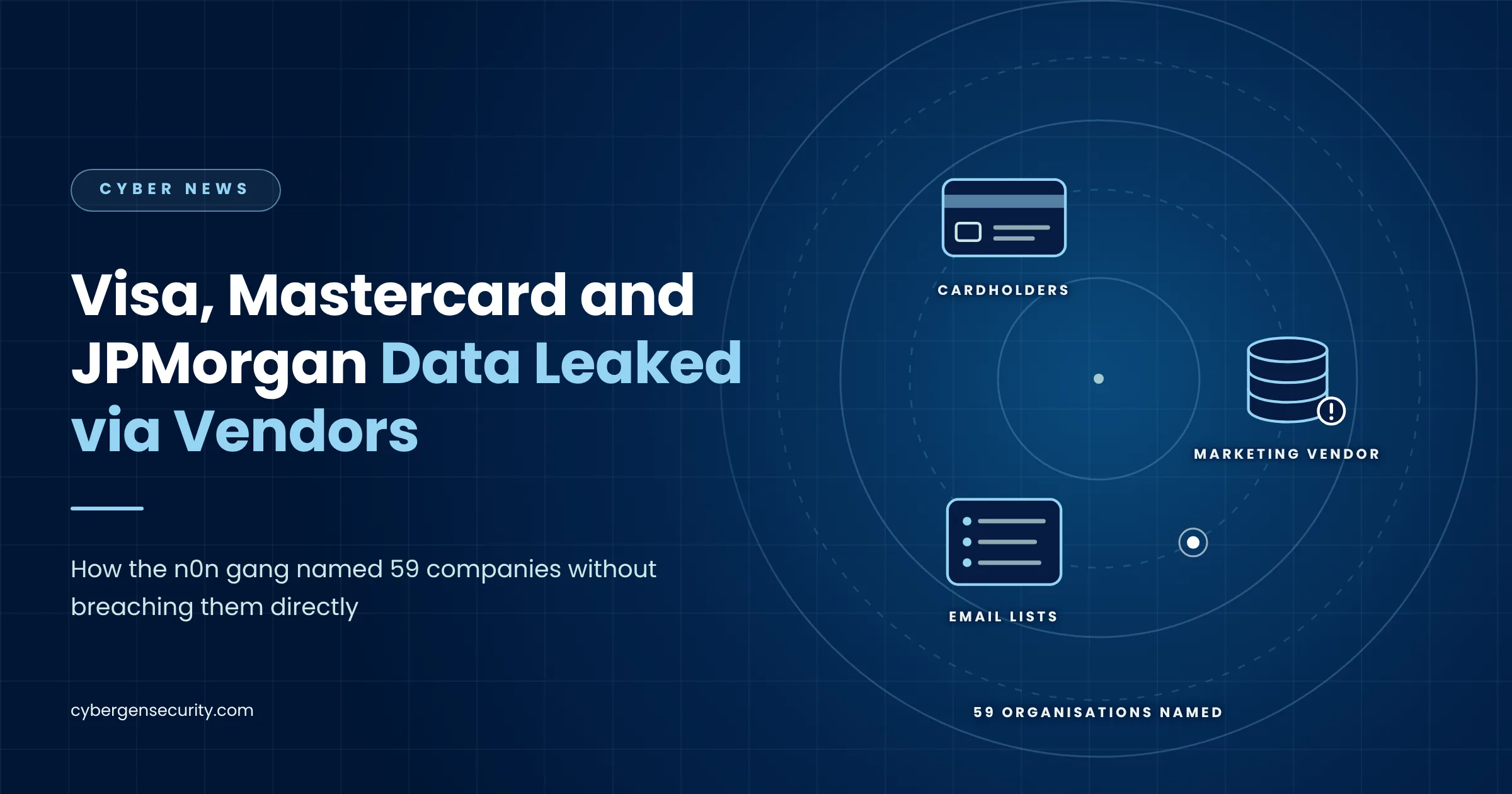
Customer information linked to Visa, Mastercard and JPMorgan Chase was published online this week after a new extortion group called n0n carried out a threat to leak it. None of the three companies' own networks were breached. The data came from third-party service providers that hold marketing and campaign records on their behalf.
All three companies say their payment systems were not affected and that no card numbers or payment details were taken. But the leak, and the 59 organisations n0n has named on its leak site, show how much customer data now sits with marketing and data vendors rather than with the brands themselves.
What Happened
On 16 November, n0n's leak site replaced a list of numbered placeholders, posted since 9 November, with the names of 59 organisations. Alongside Visa, Mastercard and JPMorgan Chase, the names included Eli Lilly, Walmart, Procter & Gamble, Debenhams, Pandora, Patagonia, Airbnb, Block, Nielsen and Expedia. The group set a 48-hour countdown on 17 November and published data linked to the three payment and banking firms after it ran out.
Visa confirmed an incident at a third-party service provider in Asia Pacific and said its own systems were not involved or affected. JPMorgan Chase said attackers had targeted third-party vendors and accessed certain marketing data they held, and that it would contact affected customers directly. Mastercard said the exposure involved a limited number of email addresses from a small group of cardholders in a specific benefit programme, with no effect on its payment network.
None of the companies has named the vendors involved. A service outage at JPMorgan earlier in the week, which also delayed payments at other banks, was caused by a software bug, according to the bank, and is not linked to the leak.
Who n0n Is
n0n is a new group. Researchers at Bitdefender first tracked it in mid-September, after finding its encryption code on an exposed server, and at that point assessed that it had hit just over 20 victims. Its recent claims suggest it has grown quickly by going after suppliers that hold data for many companies at once. On 12 November, Expedia disclosed that attackers had compromised a third-party data platform and used that trusted access to reach systems at multiple companies, and n0n has since claimed Expedia as a victim.
Who Is Affected
According to a Reuters review of the leaked files:
- JPMorgan Chase: more than 16,000 customer email addresses and about 124 belonging to bank employees, with some phone numbers and postal codes.
- Visa: thousands of customer email addresses and phone numbers and details of marketing campaigns, mainly for customers in Asia Pacific markets such as Hong Kong, Japan, Australia and Singapore.
- Mastercard: marketing records for customers in North America, West Asia and Africa, plus email addresses of a small number of employees.
n0n also claims to hold travel and dining booking records for premium cardholders and histories of how customers responded to marketing campaigns. Claims about the other 56 organisations on its list have not been verified, and some may turn out to be limited or exaggerated.
Why It Matters
The most sensitive financial data at these companies was not touched, yet their names are now attached to a leak. Customers do not distinguish between a bank and the agency that sends its marketing emails, and regulators expect organisations to answer for data held on their behalf.
Marketing data is also more useful to criminals than it may look. A list of premium cardholders with their names, emails, phone numbers and the benefit programmes they belong to is ideal for phishing. A message that mentions a real rewards scheme, sent to someone who really is a member, will be far more convincing than a generic scam.
The pattern matches the other supplier breaches in this month's news, from Optimizely to Fireworks AI and Infoblox. Attackers are going after the smaller firm that holds data or access for many larger ones, because one breach pays off many times over.
What To Do Now
Map who holds your customer data. List every marketing agency, CRM platform, analytics provider and campaign tool that stores customer details on your behalf, including any that teams have signed up to directly.
Share less. Send vendors only the fields they need for each campaign, and ask them to delete data when a campaign ends.
Check the contract. Make sure each vendor must tell you promptly about a breach, meets clear security standards and lets you check that it does.
Prepare your customers. If your name appears in a leak like this, tell customers plainly what was and was not taken, and warn them about scams that use the leaked details.
Watch the leak sites. Monitoring extortion sites and criminal forums can give you early warning that your name, or a supplier's, has appeared.
How Cybergen Can Help
Cybergen's third-party and supply chain risk management service helps you find out which suppliers hold your data and how well they protect it. Our cyber threat intelligence team can watch extortion sites and forums for your organisation and your key suppliers, so you hear about a claim before your customers do.
Frequently Asked Questions
Were Visa, Mastercard or JPMorgan hacked?
Not directly, according to the companies. The data came from third-party service providers that held marketing and campaign records on their behalf.
Was card data stolen?
No. All three companies say their payment systems were not affected and that no card numbers or payment details were taken.
What data was leaked?
Mainly customer email addresses, some phone numbers and postal codes, and details of marketing campaigns. n0n also claims to hold booking records for premium cardholders.
Who is n0n?
A new extortion group first tracked by Bitdefender in mid-September. It has named 59 organisations on its leak site, many apparently reached through shared suppliers.
I am a cardholder. What should I do?
Be wary of emails, texts or calls that mention your card or rewards programme, even if they use your name. Contact your bank using the number on your card rather than any number in a message.
Sources
- Business Standard (Reuters): Visa, Mastercard, JPMorgan customer data exposed in ransomware attack (20 November 2026)
- Daily Security Review: n0n ransomware gang claims Visa, JPMorgan; both dispute cyberattack (18 November 2026)
- Cybernews: Visa confirms cyberattack as hackers claim JPMorgan was hit too (18 November 2026)
CREST-certified consultants with over 100 years of combined experience in threat intelligence, penetration testing, MDR and compliance.