Passing Customer Security Questionnaires: A Guide for SaaS Firms
 Cybergen InsightsCREST-certified security team
|
|
12 min read
Your biggest deal of the quarter is nearly done. The champion is keen, the budget is approved and procurement has started. Then an email arrives from the customer's security team with a spreadsheet attached: 200 questions about encryption, access control, penetration testing, incident response and sub-processors. Nobody in sales knows the answers, your one engineer who does is shipping a release, and the deal quietly slips into next quarter.
For software and SaaS companies, the security questionnaire has become one of the most common reasons a deal stalls. It is not going away. Buyers are under pressure from regulators, insurers and their own boards to prove they manage supplier risk, and the questionnaire is how they do it. The good news is that it is a solvable problem. This guide explains what buyers are really checking, how to build an evidence pack and answer library that does most of the work for you, and how to write answers that close questions rather than open new ones.
Why Buyers Send Security Questionnaires
When a customer puts their data into your platform, or connects your product to their systems, your security becomes part of theirs. If you are breached, they may be breached too, and they will still have to answer to their regulator, their customers and their board. The questionnaire is how they show they checked.
In the UK, the NCSC's supply chain security guidance encourages organisations to understand the risks their suppliers bring and to set clear security requirements. Its supplier assurance questions give buyers a simple set of open questions to ask. Financial services firms face their own operational resilience rules, and the coming Cyber Security and Resilience Bill will push supplier expectations further down the chain. For software specifically, the government's Software Security Code of Practice sets out what buyers can reasonably expect from vendors.
So when a questionnaire arrives, the buyer is rarely trying to catch you out. They are trying to answer three questions for their own records: is this supplier competent, is it honest, and will it tell us quickly if something goes wrong?
The Questionnaires You Will Meet
Most questionnaires are either a recognised standard or a buyer's own spreadsheet borrowed from one. Knowing the common formats helps you build answers once and reuse them.
| Questionnaire | Who sends it | Size and effort |
|---|---|---|
| SIG Lite Shared Assessments | Mid-sized buyers and lower risk suppliers | 128 questions. Hours to days |
| SIG Core Shared Assessments | Banks, insurers and large enterprises | 627 questions across 21 domains. Days to weeks |
| CAIQ v4 Cloud Security Alliance | Buyers of cloud and SaaS services | 261 yes or no questions mapped to the Cloud Controls Matrix |
| NCSC supplier assurance questions | UK public sector and regulated buyers | Short, open questions that expect real evidence |
| The buyer's own spreadsheet | Almost everyone | Anywhere from 30 to 300 questions, often borrowed from the above |
The Standardized Information Gathering questionnaire, or SIG, from Shared Assessments is widely used by financial services firms. The full SIG Core has 627 questions across 21 risk domains, while SIG Lite has 128. The Cloud Security Alliance's Consensus Assessments Initiative Questionnaire, or CAIQ, is common for cloud services. Its fourth version cut the question count to 261 from 310, according to Help Net Security's coverage of the release.
Whatever the format, the same themes come up again and again.
What Buyers Are Really Checking
It is tempting to treat each question as a box to tick. Experienced security reviewers read differently. They are looking for a handful of signals that tell them how mature you are.
Independent evidence
A claim backed by a third party carries far more weight than your own description. That means certifications such as Cyber Essentials Plus and ISO 27001, a SOC 2 report for US focused buyers and, above all, a recent independent penetration test. The NCSC's penetration testing guidance explains why: a test shows whether your controls work in practice, not just on paper.
Consistency
Reviewers notice when answer 14 says all data is encrypted at rest and answer 87 mentions an unencrypted backup. Inconsistency suggests either confusion or carelessness, and both lower trust. A single answer library, owned by one person, is the best protection.
Honesty about gaps
No supplier is perfect, and reviewers know it. A clear "no, but here is our compensating control and our plan to fix it by March" is far stronger than a vague yes. Overclaiming is the fastest way to lose a security reviewer's confidence, and they will often test claims with follow up questions or contract terms.
Speed and ownership
How quickly and clearly you respond tells the buyer how you will behave during an incident. A supplier who takes three weeks and four chasers to answer a questionnaire is unlikely to notify them within hours of a breach.
Write Answers That Close Questions
The difference between a weak and a strong answer is usually detail and evidence, not length. Compare these two answers to one of the most common questions buyers ask.
"Do you perform regular penetration testing?"
A good answer follows a simple pattern: state the control, give the scope and frequency, name who checks it and offer evidence. Write each library answer that way once and you will rarely need to rewrite it. Avoid absolutes such as "never" and "all" unless they are literally true, and avoid marketing language. Security reviewers read hundreds of these and can spot filler at a glance.
Build an Evidence Pack Once
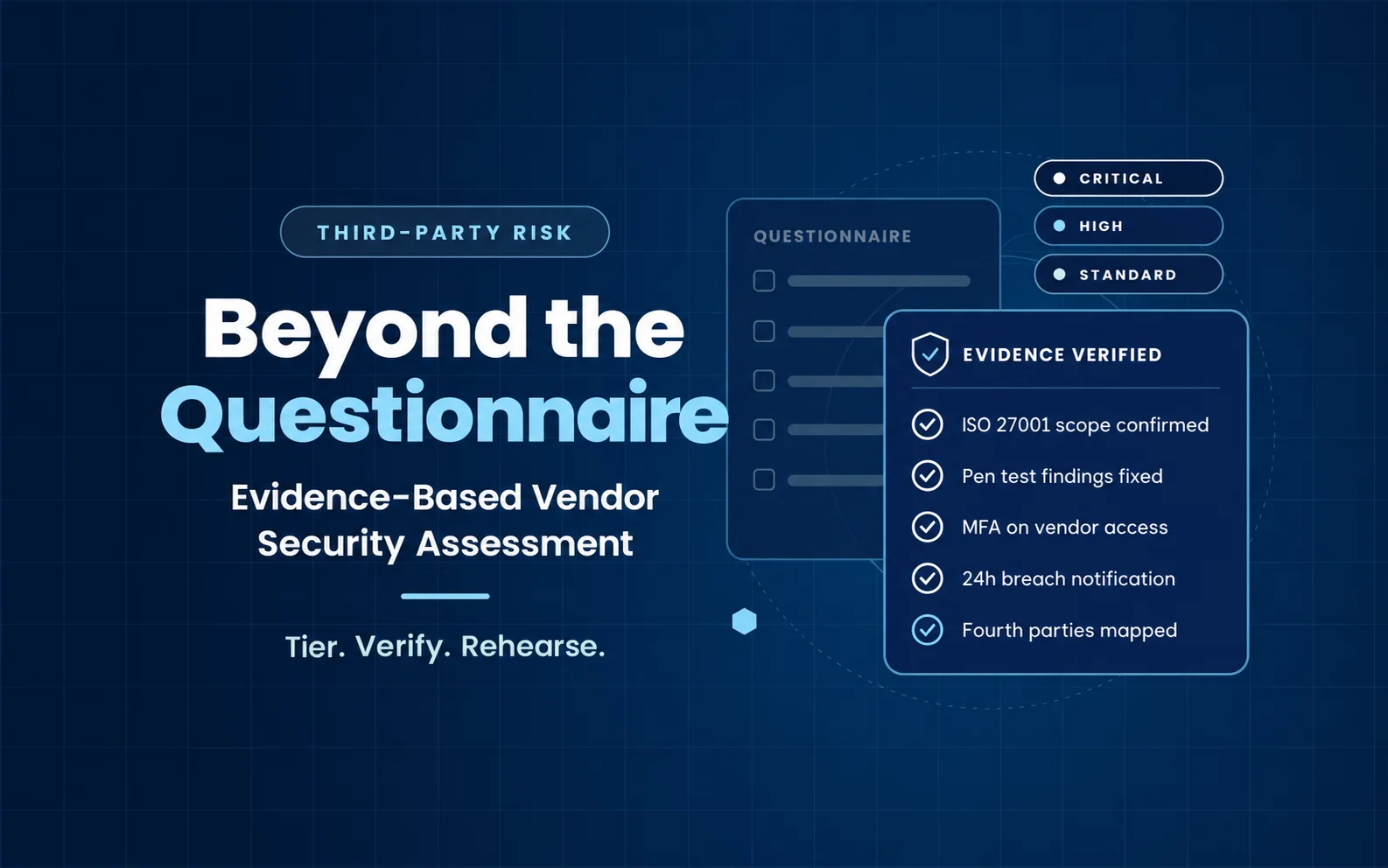
The fastest way to clear questionnaires is to answer most of them before they arrive. An evidence pack is a set of documents you can send, often under NDA, that answers whole sections at a time. Many buyers will accept it in place of individual answers, or at least use it to cut the questionnaire down. Use this builder to see where you are.
What to have ready before the questionnaire arrives
Tick what you already have ready to send. Nothing is stored.
Two items deserve special attention. The first is a recent penetration test. Buyers almost always ask about testing, and a CREST accredited test of your production application and cloud environment, with evidence that findings were fixed, answers dozens of questions in one go. Share the executive summary and a remediation letter rather than the full technical report. Our CREST penetration testing service is built to produce exactly that kind of evidence, and our guide to penetration testing costs explains how to scope one sensibly.
The second is a one page architecture diagram. Showing where you host, how data flows, where it is encrypted and how admins get access answers a surprising number of questions and makes the rest easier to understand.
The Questions SaaS Firms Find Hardest
Some questions trip up even well run software companies, usually because the honest answer is complicated. Prepare these in advance and you will avoid most of the follow ups.
Where is our data, and who else can see it?
Buyers want to know the hosting regions, any support access from other countries and every sub-processor that touches their data. Keep a dated sub-processor list with locations and purposes, and be clear about whether support staff can access production data and how that access is approved and logged. For UK and European buyers, international transfers are a common sticking point, so state the transfer mechanism you rely on.
How do your AI features use our data?
This is now in most questionnaires. Buyers want to know whether their data is used to train models, which AI providers you use, where prompts and outputs are processed and stored, and whether customers can switch AI features off. Write a short, plain statement and keep it current, because this area is changing quickly and vague answers raise immediate concern.
How quickly will you tell us about an incident?
Buyers increasingly want a number, such as notification within 24 or 48 hours of confirming an incident that affects their data. Make sure the commitment in your questionnaire matches your contracts and your incident response plan, and that you can actually meet it at a weekend. Our guide to cyber incident reporting explains why regulated customers are tightening these clocks.
Who holds the encryption keys?
Saying data is encrypted is not enough for a careful reviewer. Explain what is encrypted in transit and at rest, which standards you use, where keys are stored and who can access them. If you offer customer managed keys, say so. If you do not, explain the controls that protect the keys you manage.
How do you secure your own development?
Buyers increasingly ask about the security of your build pipeline as well as your product: code review, dependency scanning, secrets management and who can deploy to production. Describe the controls simply and, where you can, point to independent testing that covers them.
Build an Answer Library
Most SaaS firms find that the large majority of questions repeat across customers, even when the wording changes. Capturing your best answer to each one, with its evidence and the date it was last checked, turns every new questionnaire into an exercise in matching rather than writing.
- Start from what you have. Collect your last ten completed questionnaires and pull out every distinct question and the best answer you gave.
- Map to a framework. Tag each answer to the domains in SIG or CAIQ, or to ISO 27001 controls, so you can find it whatever the wording.
- Give every answer an owner and a review date. An out of date answer is worse than no answer.
- Use tools carefully. Software and AI assistants can match questions to library answers quickly, but a person who knows your security programme must approve every response.
Stop Questionnaires Stalling Deals
Most delays are caused by process, not by security gaps. A few changes in how sales and security work together make a big difference.
- Ask early. Train sales to ask about the buyer's security review process in the first meetings, not after the verbal yes. Knowing the format and the reviewer's name in advance saves weeks.
- Lead with the pack. Send the evidence pack proactively and offer a short call with the buyer's security team. A 30 minute conversation often replaces half a questionnaire.
- Publish a trust page. A public page covering your certifications, hosting, data handling and how to request the evidence pack answers basic questions before they are asked.
- Set a target turnaround. Agree internally how fast questionnaires are returned and track it like any other sales metric.
Sometimes the questionnaire reveals a real gap, such as no recent penetration test or no formal incident response plan. Treat that as useful information. Fixing it once will help every future deal, and some buyers will accept a dated plan in the meantime.
Your 30 Day Plan
If questionnaires are slowing your sales right now, this plan will make a noticeable difference within a month.
Week one
- Name an owner for security reviews
- Collect your last ten questionnaires
- Start an answer library from them
Weeks two and three
- Fill the gaps you keep answering "no" to
- Book a CREST penetration test if your last one is over a year old
- Draw a one page architecture diagram
Week four
- Publish a trust page with what you can share openly
- Agree an NDA route for the rest
- Brief sales on when to bring security in
How Cybergen Can Help
We help software and SaaS companies turn security reviews from a blocker into a selling point:
- CREST penetration testing of your application, APIs and cloud, with customer ready summaries and remediation letters
- Cyber Essentials Plus and ISO 27001 consultancy to give buyers the certifications they ask for
- Application security and DevSecOps advisory to strengthen the controls behind your answers
- Virtual CISO support to own your answer library, evidence pack and buyer security calls
If a deal is stuck in security review right now, talk to our team and we will help you get it moving.
Questionnaire formats and question counts change between versions. This guide reflects published versions as at 14 November 2026.
Frequently Asked Questions
What is a vendor security questionnaire?
It is a list of questions a customer sends a supplier to check how well the supplier protects systems and data. Buyers use them during procurement and at renewal, especially when the supplier will hold their data or connect to their systems. Common formats include SIG, CAIQ and the buyer's own spreadsheet.
How long should it take to complete a security questionnaire?
With no preparation, a large questionnaire can take one or two weeks of a senior person's time. With an answer library and an evidence pack, most SaaS firms can return a typical questionnaire in a few days, and a short one in hours. The preparation is what makes the difference.
Do we need ISO 27001 or SOC 2 to pass questionnaires?
Not always, but they help a great deal. Many buyers will accept a certificate or report in place of dozens of questions. UK buyers often ask for Cyber Essentials as a minimum, while larger and international customers increasingly expect ISO 27001 or SOC 2. Choose based on who your customers are.
Should we share our full penetration test report?
Usually not. Share an executive summary, the scope and dates, the tester's accreditation and a letter confirming critical and high findings have been fixed. Offer to walk a buyer's security team through the details under NDA if they need more. The full report is a map of your weaknesses.
Is it acceptable to answer no to a question?
Yes, as long as you explain. An honest no with a compensating control or a dated plan is far stronger than a vague yes that falls apart under follow up. Buyers are assessing risk and trustworthiness, and inconsistent answers damage both.
Can AI tools answer security questionnaires for us?
They can speed up drafting by pulling answers from your library and documents, but a person who knows your security programme must check every answer before it is sent. An AI tool will happily produce a confident answer that is not true, and that is exactly what a buyer's follow up questions are designed to find.
Sources
- Wolfia: What is a SIG questionnaire? (April 2026)
- Help Net Security: Cloud Security Alliance updates its CAIQ (June 2021)
- Cloud Security Alliance: CAIQ
- NCSC: Supplier assurance questions
- NCSC: Supply chain security guidance
- NCSC: Penetration testing guidance
- GOV.UK: Software Security Code of Practice
- NCSC: Cyber Essentials overview
CREST-certified consultants with over 100 years of combined experience in threat intelligence, penetration testing, MDR and compliance.