Binance Loses $6.3 Billion After a Compromised Engineer's Laptop: The Largest Crypto Theft on Record and What It Teaches Every Organisation
 Cybergen Cyber NewsCREST-certified security team
|
|
9 min read
On the evening of Thursday 29 October 2026 the world's largest cryptocurrency exchange watched roughly $6.3 billion leave its hot wallets in under four hours. By Friday morning Binance had suspended withdrawals, frozen what it could, promised to cover every loss and published a preliminary finding that should make every CISO sit up: the suspected starting point was not a flaw in blockchain cryptography but a compromised laptop belonging to a DevOps engineer.
The incident is already being described as the largest theft in the history of cryptocurrency, roughly four times the $1.5 billion taken from Bybit in February 2025. This article sets out what is known so far, who the analysts believe was responsible, and why the attack chain matters far beyond the crypto industry.
What Happened
According to on-chain analysis cited by Euronews, Binance's withdrawal system signed away funds from 17 hot wallets between 21:04 and 00:56 Central European Time on the night of 29 to 30 October. Binance first flagged a potential security issue at 22:29 CET, initially saying funds were safe, and then suspended deposits, withdrawals and its Binance Alpha trading product as the scale became clear.
TRM Labs, quoted by The Hacker News, described a carefully prepared operation. The attacker funded an operator wallet with three small withdrawals from a mixing service at least a day in advance and tested code against three wallets a few hours before the theft. At 20:20 UTC the operator submitted a single transaction containing 50 authorisations, each signed by a Binance hot wallet and pointing at a sweeper contract. Around three and a half minutes later the hot wallet was instructed to send its entire balance to an attacker-controlled address, moving 167,464 ETH and 63 tokens including about 1.6 billion USDT. Funds then moved to fresh addresses across nine blockchains, with Ethereum, Bitcoin and TRON hit hardest.
The detail that matters most is how those signatures were obtained. Elliptic's analysis, also cited by The Hacker News, concludes that the attacker did not steal private keys but got Binance's own systems to sign the transactions. TRM Labs notes that signatures for 50 consecutive nonce values were prepared in advance so that one would be valid whenever the transaction executed, which suggests the attacker's access to the signing path was time-limited or had to be requested through a system.
Binance's preliminary findings
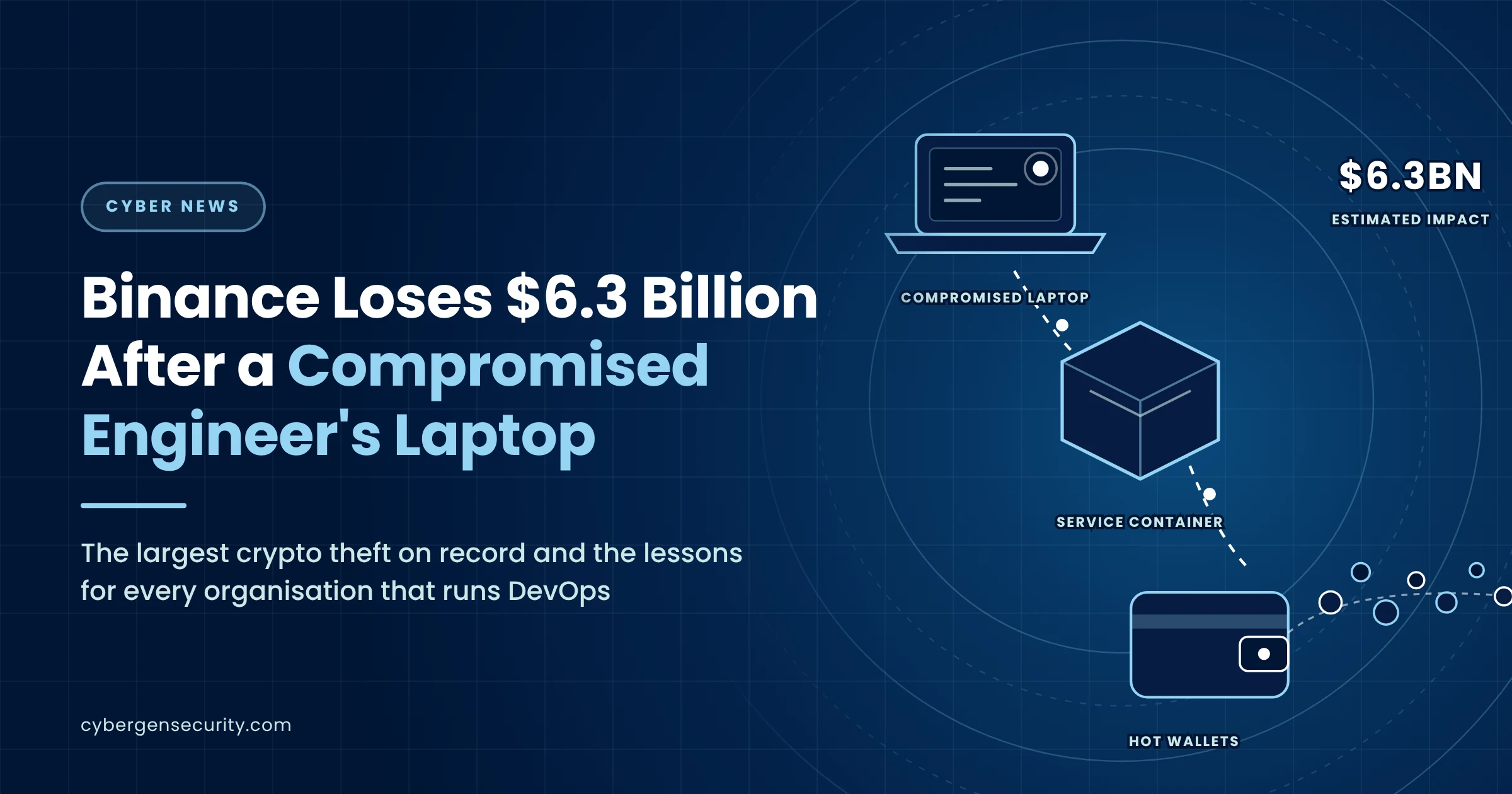
Binance's announcement, published on 30 October, says its initial investigation points to "a compromised DevOps engineer's laptop, which allowed an attacker to gain access to a service container" that was then used to submit unauthorised withdrawal transactions. The company says it has found no evidence of a wallet private key leak. In a later update it said investigators had identified additional points of breach, and co-CEO Richard Teng stressed that "the attacker did not simply use one engineer's permissions, and this was not a single 'one-click' action."
Binance says it revoked authorisation for the affected address, engaged law enforcement and blockchain intelligence partners, and began a security revamp of its withdrawal service and related addresses before allowing withdrawals to resume. It has committed to publish a detailed technical post-mortem once the facts are verified and an updated Proof of Reserves after remediation.
The recovery effort
Stablecoin issuers moved quickly. The Block reports that Tether froze more than $1.57 billion in USDT, Circle more than $800 million in USDC, Ripple around $200 million and World Liberty Financial around $29 million across its tokens. The Arbitrum Security Council froze a further $30 million or so in ETH and ARB. Binance's own frozen-asset figure rose from $2.54 billion to $3 billion overnight. The company also announced that it had set aside more than $6.34 billion to make customers whole, with around $5 billion already held in the affected assets and the remaining $1.3 billion being acquired through market and over-the-counter purchases.
The attacker nonetheless retained control of a very large sum. Elliptic estimated around $3.33 billion across roughly 43 addresses, mostly in Ether and Bitcoin that no issuer can freeze. Independent estimates of the total stolen range from Chainalysis at about $5.9 billion to Elliptic at $6.43 billion.
Who Is Affected
Binance says user funds are safe and that it is covering every loss. The immediate impact on customers was a suspension of withdrawals while the withdrawal service was rebuilt, with deposits continuing to operate. Bitcoin fell below $77,000 and Binance's BNB token dropped as news spread, so anyone holding crypto assets felt the price effect whether or not they use the exchange.
Attribution is not official, but the analytics firms are unusually aligned. TRM Labs attributes the attack with high confidence to TraderTraitor, the North Korean cluster the FBI linked to the Bybit theft. Chainalysis also links the funds to the Democratic People's Republic of Korea with high confidence, noting that proceeds were commingled with funds from an earlier exchange exploit. Elliptic points to similar tradecraft but urges caution because of differences in laundering speed and the absence of a published root cause. Binance itself has not named anyone.
For UK and European organisations the relevance is wider than one exchange. FCA-registered crypto firms, payment companies and any business running DevOps pipelines that can move money or data should read the preliminary findings as a description of their own exposure. Financial entities subject to DORA will recognise the attack as exactly the kind of ICT-related incident the regulation expects them to detect, contain and report.
Why It Matters
Strip away the blockchain vocabulary and the chain is familiar. An engineer's endpoint was compromised. That endpoint had, or could obtain, access to an automation environment that was trusted to perform a high-value action. The attacker studied the environment, prepared the action in advance and executed it in a window of minutes. Nothing in that sequence is unique to crypto. The same pattern applies to a payroll system, a payments platform, a cloud administration console or a software release pipeline.
Three lessons stand out. First, privileged endpoints are the new perimeter. The laptops of DevOps engineers, cloud administrators and release managers carry credentials, tokens and tooling that can reach production. If they are managed like ordinary staff devices, the organisation's most sensitive controls depend on a phishing email not landing. Second, segregation and multi-party approval work. Binance's own statements suggest the attacker needed more than one engineer's permissions, and the pre-signed nonces hint at a system that constrained access. Where those controls hold, attackers are forced into complex, noisy operations; where they do not, one compromise is enough. Third, speed of detection and response decided how much was recovered. Issuers froze almost half the stolen value within a day because Binance identified addresses and engaged partners immediately. Organisations that cannot explain what a compromised service account did within hours will not get the same result.
The incident also arrives in a month in which, as S-RM's intelligence briefing and other trackers note, attackers have increasingly used AI tooling to automate reconnaissance and exploitation. Whether or not AI played any part in this attack, the combination of automated tooling and a well-funded state actor makes the window between a single compromised device and catastrophic loss shorter than most risk registers assume.
What To Do Now
Treat DevOps and administrator devices as privileged assets. Enrol them in device management, enforce disk encryption and endpoint detection and response, block unapproved software and browser extensions, and require phishing-resistant multi-factor authentication for every console they touch. Where possible, separate day-to-day work from production access by using dedicated privileged access workstations or isolated jump environments. Our privileged access management service covers the design and rollout.
Find and shorten long-lived credentials in your pipelines. Inventory the tokens, keys and service accounts that your CI/CD systems, containers and automation hold. Rotate anything that is static, move secrets into a vault with short-lived issuance, and make sure a developer laptop cannot hold a credential that can reach production on its own.
Require more than one person for high-value actions. Payments above a threshold, changes to withdrawal or payout destinations, production deployments and privilege grants should all need a second approver who cannot be the same compromised identity. Review who can approve, how approvals are logged and whether an attacker with one engineer's access could satisfy the rule alone.
Monitor service accounts for behaviour, not just failures. The authorisations in this case were valid and signed by the right system. Detection depends on noticing a service container doing something new: unusual volume, unusual destinations, actions outside normal hours or a burst of pre-prepared transactions. Baseline what normal looks like for your automation identities and alert on departures from it.
Rehearse the first hour. Binance's ability to revoke an address, name counterparties and engage partners within hours recovered billions. Run a tabletop exercise that assumes a privileged laptop is compromised and ask who can halt the affected process, who calls the bank or payment partner, and what evidence you would need to give law enforcement and regulators within 24 hours.
How Cybergen Can Help
Cybergen's CREST penetration testing and red teaming services simulate exactly this scenario, starting from a single compromised endpoint and measuring how far an attacker could reach. Our 24/7/365 managed detection and response watches privileged identities and service accounts for the behavioural changes that precede a theft, and our incident response service gives you a team on call for the first hour. For organisations building or hardening a privileged access programme, our identity security and PAM consultancy designs the controls that turn one compromised laptop into a contained event rather than a headline.
Frequently Asked Questions
How much was stolen from Binance?
Binance put the estimated impact at around $6.3 billion in its 30 October 2026 announcement. Independent blockchain analytics firms gave figures between roughly $5.9 billion and $6.4 billion. Around $3 billion had been frozen on-chain by stablecoin issuers and others at the time of writing, and Binance said it would cover all losses from its SAFU fund and corporate reserves.
How did the attackers get in?
Binance's initial investigation points to a compromised laptop belonging to a DevOps engineer, which gave the attacker access to a service container that could submit withdrawal transactions. Binance later said additional points of breach were found and that the attack did not rely on one engineer's permissions alone. No wallet private keys were leaked, according to the company. A full post-mortem has been promised.
Who was behind the Binance hack?
Binance has not attributed the attack. TRM Labs and Chainalysis have both linked it with high confidence to North Korean state-sponsored actors, with TRM naming the TraderTraitor cluster that the FBI connected to the Bybit theft in February 2025. Elliptic has urged caution until a root cause is published. These are the firms' assessments, not an official government attribution.
Were Binance customers' funds lost?
Binance says user funds are safe and that it has set aside more than $6.34 billion to cover the losses. Withdrawals were suspended while the withdrawal service was rebuilt, with deposits continuing. Customers should rely on official Binance channels and ignore unsolicited recovery offers or requests for credentials.
What is the lesson for organisations outside crypto?
The same chain, a compromised engineer's device leading to a trusted automation environment that can move money or data, exists in almost every business. Harden and monitor privileged endpoints, separate the roles that can approve high-value actions, require multi-party approval for them, and make sure your monitoring would spot a service account doing something it has never done before.
Sources
- Binance: Announcement on the security incident and preliminary findings (30 October 2026)
- The Hacker News: Binance suffers security breach affecting $6.3 billion in assets, nearly $3 billion frozen (30 October 2026)
- CyberInsider: Binance links $6.3 billion security incident to compromised laptop (30 October 2026)
- Euronews: How the Binance hack happened and who was behind it (30 October 2026)
- The Block: Binance says it has $6.34 billion ready to cover hack losses (30 October 2026)
- S-RM Cyber Intelligence Briefing: Binance hit by potentially record-breaking hack (30 October 2026)
CREST-certified consultants with over 100 years of combined experience in threat intelligence, penetration testing, MDR and compliance.