LIVE Threat Watch 36 actively exploited vulnerabilities added in the last 30 days. Latest: CVE-2026-118527 in Ivanti Connect Secure See all live vulnerabilities
Free guide · Industrial cyber security

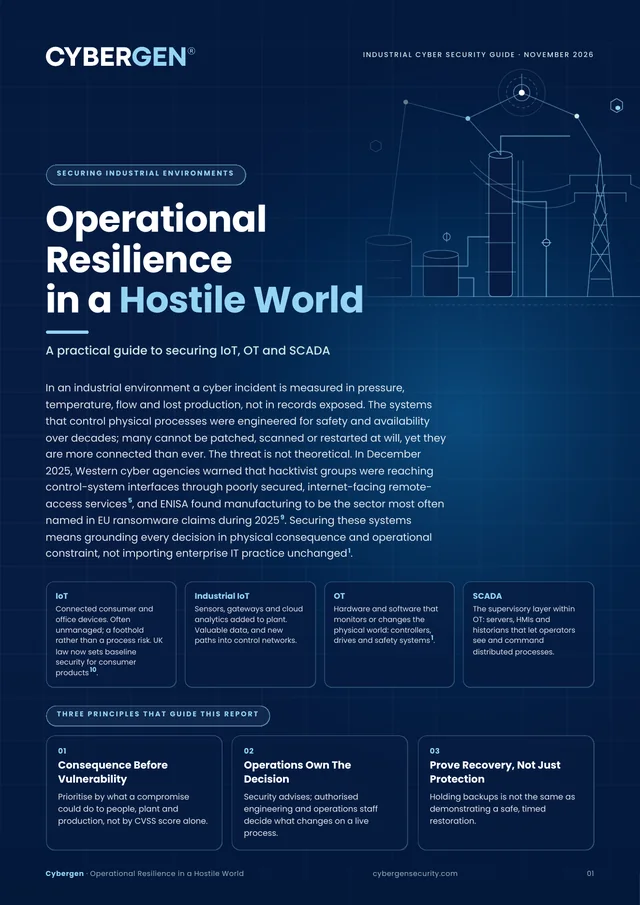
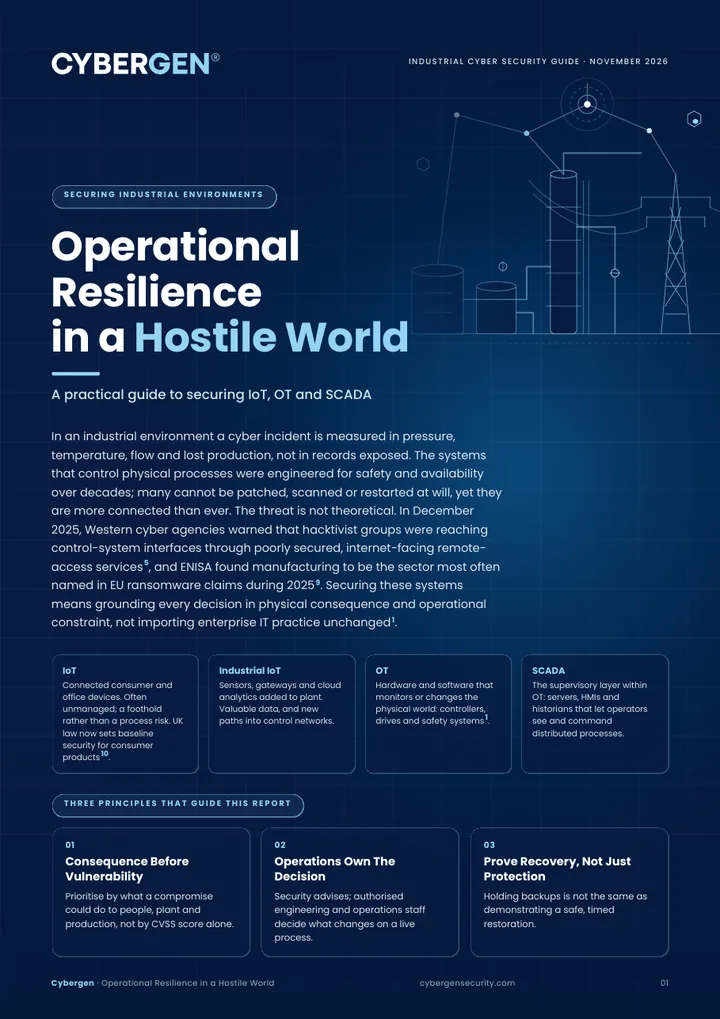
Operational Resilience in a Hostile World

A practical guide to securing IoT, OT and SCADA. In an industrial environment a cyber incident is measured in pressure, temperature, flow and lost production, and the systems that control physical processes often cannot be patched, scanned or restarted at will. This guide grounds every decision in physical consequence and operational constraint.

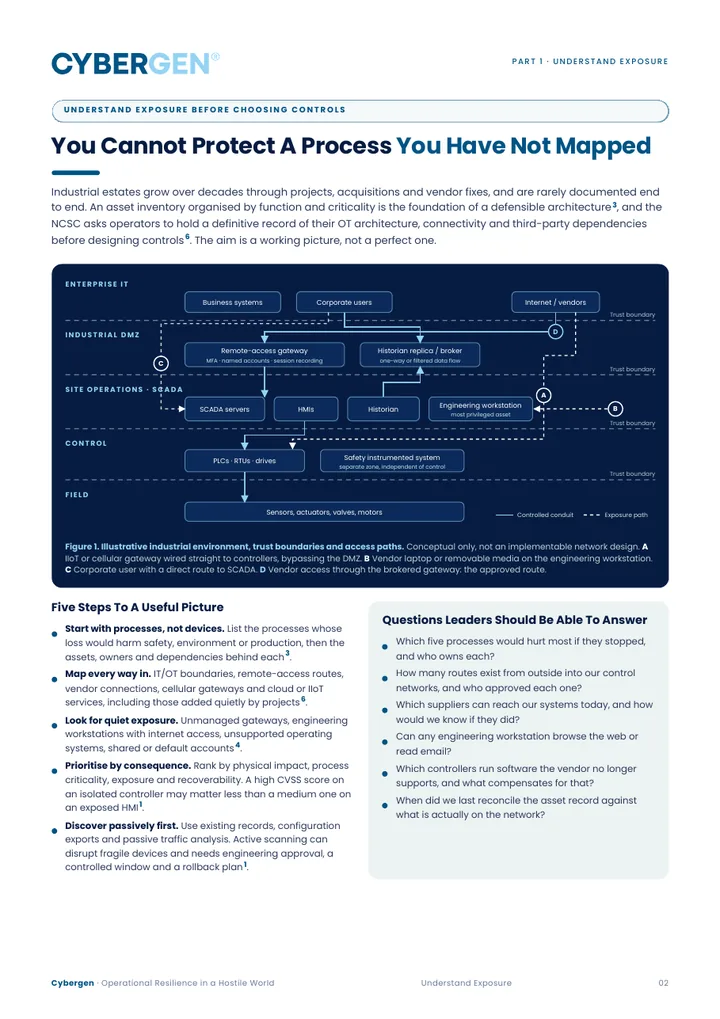
  • Map your exposure first: processes, access routes and the quiet paths into control networks
  • Seven controls in order of return on effort, each with an owner and a way to prove it works
  • A first-hour response flow, a recovery-readiness checklist and a measurable 90-day plan
PDF · 5 pages · 319 KB12 min readNo sign-up, no form
10sources · NIST · ISA/IEC 62443 · NCSC · CISA 90-dayplan included
What's inside

Four parts, from exposure to proof

Each part ends in something you can act on: a question to answer, a control to own, a procedure to rehearse or a measure to report.

Part 1

Understand exposure

You cannot protect a process you have not mapped: five steps to a useful picture of your estate, and the questions leaders should be able to answer.


Part 2

Apply controls

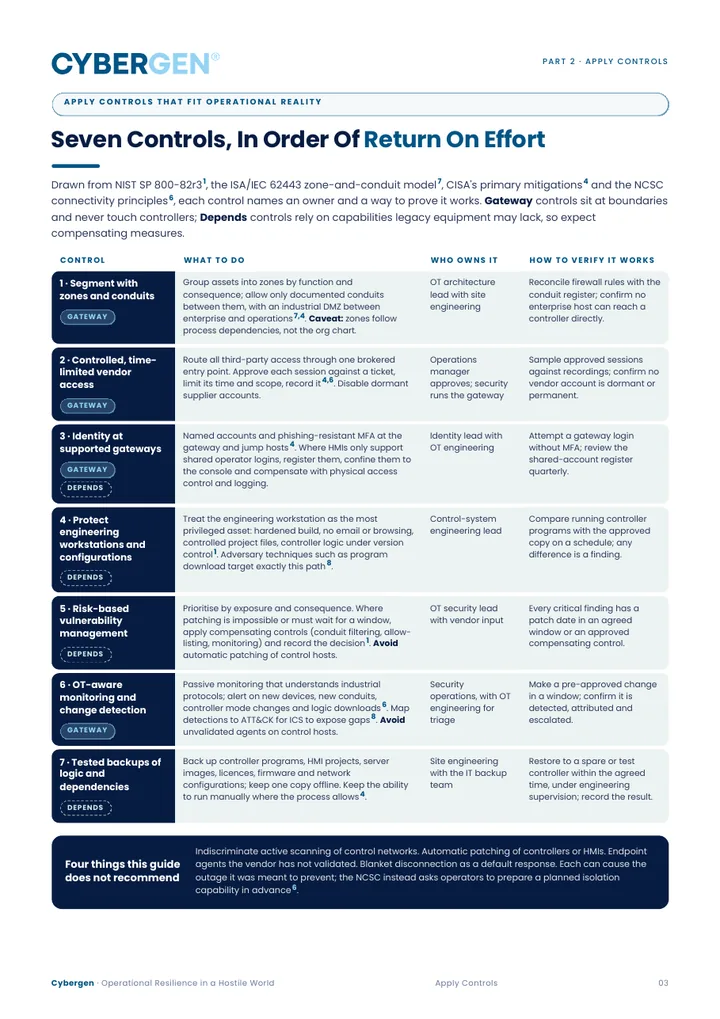
Seven controls in order of return on effort, each with what to do, who owns it and how to verify it works. Plus four things the guide does not recommend.
Part 3

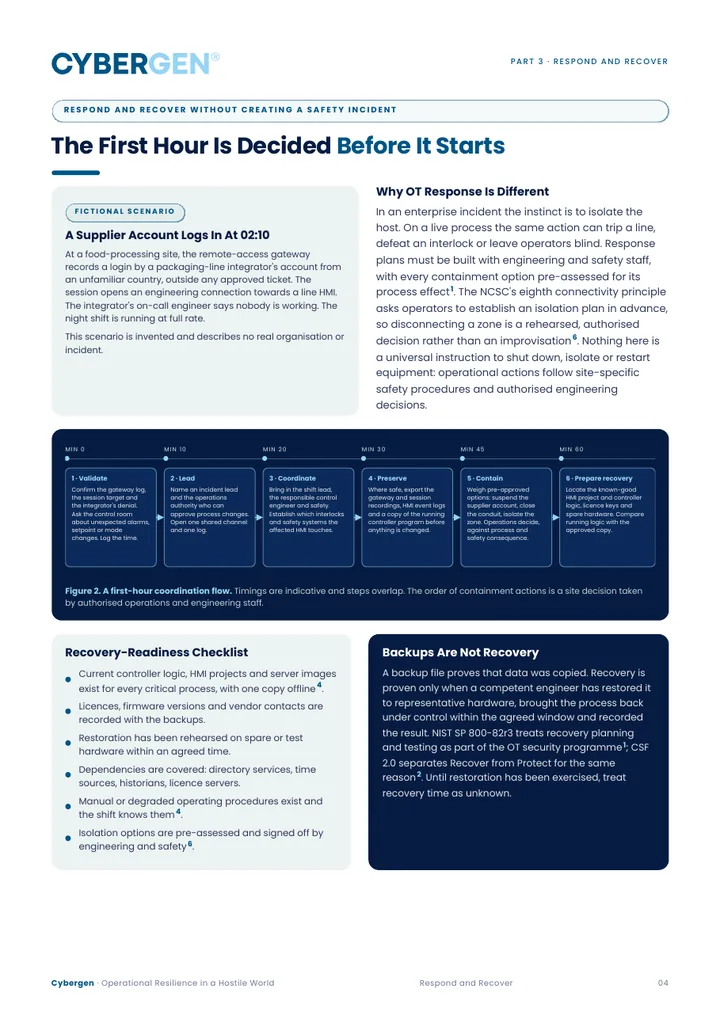
Respond and recover

Why OT response is different, a first-hour coordination flow, a recovery-readiness checklist and why backups are not recovery.
Part 4

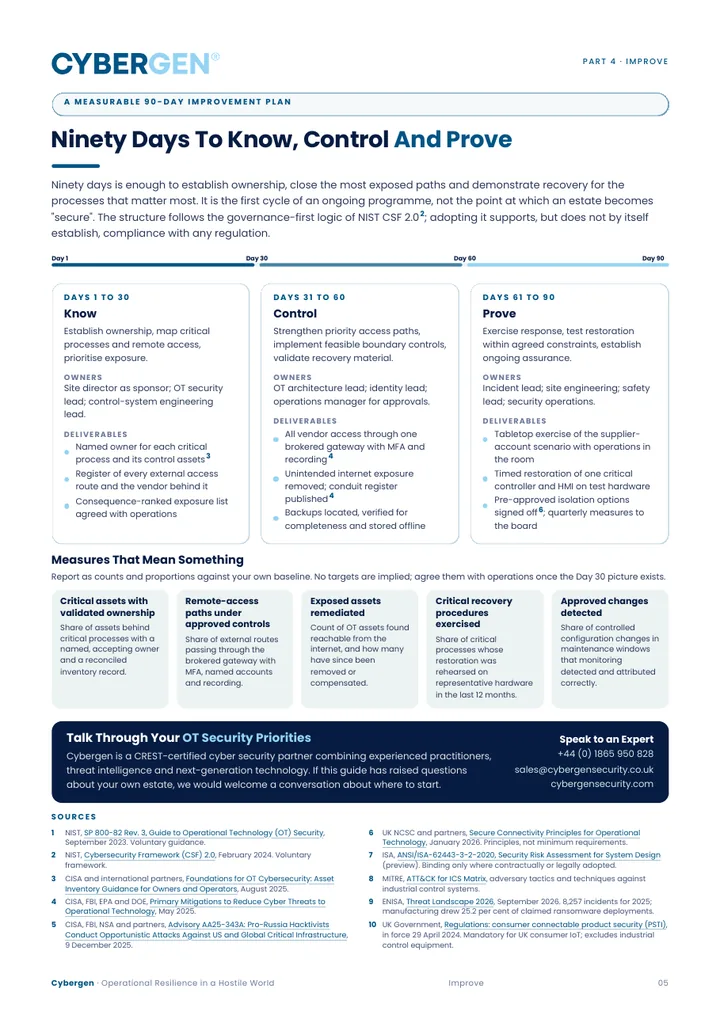
Improve

A measurable 90-day plan to know, control and prove, with owners and deliverables for each phase and five measures that mean something.

Three principles

The ideas that guide every page

Enterprise security practice cannot be imported unchanged into an industrial environment. These three principles keep the guide grounded.

01

Consequence Before Vulnerability

Prioritise by what a compromise could do to people, plant and production, not by CVSS score alone.

02

Operations Own The Decision

Security advises; authorised engineering and operations staff decide what changes on a live process.

03

Prove Recovery, Not Just Protection

Holding backups is not the same as demonstrating a safe, timed restoration.

Part 2 preview

Seven controls, in order of return on effort

Drawn from NIST SP 800-82r3, the ISA/IEC 62443 zone-and-conduit model, CISA's primary mitigations and the NCSC connectivity principles. The guide gives each control an owner and a way to verify it works.

1
Segment with zones and conduitsAn industrial DMZ between enterprise and operations; zones follow process dependencies, not the org chart.
Gateway
2
Controlled, time-limited vendor accessOne brokered entry point, every session approved against a ticket and recorded. Dormant supplier accounts disabled.
Gateway
3
Identity at supported gatewaysNamed accounts and phishing-resistant MFA at the gateway and jump hosts, with compensation where HMIs only support shared logins.
Gateway
4
Protect engineering workstationsTreat the engineering workstation as the most privileged asset: hardened build, no email or browsing, logic under version control.
Depends
5
Risk-based vulnerability managementPrioritise by exposure and consequence; compensating controls where patching must wait. No automatic patching of control hosts.
Depends
6
OT-aware monitoring and change detectionPassive monitoring that understands industrial protocols; alert on new devices, conduits, mode changes and logic downloads.
Gateway
7
Tested backups of logic and dependenciesController programs, HMI projects, server images, licences and firmware, one copy offline, restoration rehearsed.
Depends

Gateway controls sit at boundaries and never touch controllers. Depends controls rely on capabilities legacy equipment may lack, so expect compensating measures.

Part 4 preview

Ninety days to know, control and prove

Enough time to establish ownership, close the most exposed paths and demonstrate recovery for the processes that matter most. The first cycle of an ongoing programme, not the point at which an estate becomes "secure".

DAYS 1 TO 30

Know

Establish ownership, map critical processes and remote access, prioritise exposure.

  • Named owner for each critical process and its control assets
  • Register of every external access route and the vendor behind it
  • Consequence-ranked exposure list agreed with operations
DAYS 31 TO 60

Control

Strengthen priority access paths, implement feasible boundary controls, validate recovery material.

  • All vendor access through one brokered gateway with MFA and recording
  • Unintended internet exposure removed; conduit register published
  • Backups located, verified for completeness and stored offline
DAYS 61 TO 90

Prove

Exercise response, test restoration within agreed constraints, establish ongoing assurance.

  • Tabletop exercise of the supplier-account scenario with operations in the room
  • Timed restoration of one critical controller and HMI on test hardware
  • Pre-approved isolation options signed off; quarterly measures to the board
Free download

Get the guide, no form required

Read it, share it with your operations and engineering teams, and use the questions in Part 1 at your next site review. If it raises questions about your own estate, we would welcome a conversation about where to start.

Download the free guide PDF · 5 pages · 319 KB
Who it is for

Written for the people who own the process

Operations and plant directors

Understand what a cyber incident means in pressure, temperature and lost production, and what to ask your teams.

OT and control engineers

Controls that respect fragile equipment, vendor constraints and safety systems, with an owner and a way to verify each one.

CISOs and security leaders

A way to bring enterprise security discipline to industrial environments without importing enterprise IT practice unchanged.

Boards and risk owners

The questions to ask, the measures to expect and a 90-day structure to hold the programme to account.

Talk through your OT security priorities

Questions about your own estate?

Cybergen is a CREST-certified cyber security partner combining experienced practitioners, threat intelligence and next-generation technology. From OT penetration testing to exposure mapping and recovery exercises, we can help you decide where to start.

Download the free guide