Your Supplier List Is Not a Resilience Plan: A Global Guide to Third-Party Cyber Risk
September 29, 2026
Introduction
A global enterprise may have thousands of suppliers on record. It may also rely on a much smaller number of shared providers to run identity, cloud infrastructure, communications, payments, endpoint management and business-critical applications.
That difference matters. A supplier register tells you who the organisation buys from. It may not show that several business units depend on the same identity platform, that a regional service relies on a subcontractor, or that one compromised management tool could affect systems in multiple countries.
The challenge for third-party cyber risk management is therefore not simply to assess more suppliers. It is to understand how dependencies connect—and where a disruption could travel across the business.
This is especially important for multinational organisations. Different regions may have separate legal entities, contracts and security teams, yet depend on the same global technology provider. A problem in one part of that provider’s service could cross organisational boundaries that look separate on an internal chart.
The 2026 Verizon Data Breach Investigations Report found third-party involvement in 48% of breaches in its dataset, up from the previous year. That figure describes Verizon’s analysis of reported incidents; it is not a prediction that half of any individual company’s incidents will involve a supplier. It does, however, reinforce the need to understand how external relationships feature in an organisation’s exposure. (Verizon 2026 DBIR findings)
Why Supplier Reviews Miss Shared Exposure
A conventional supplier review usually focuses on one provider at a time. It asks about security controls, certifications, incident response, data handling and business continuity. Those questions are useful. The answers help determine whether a particular relationship meets the organisation’s requirements.
But a series of supplier reviews can still leave a blind spot: the combined exposure created by multiple suppliers that rely on the same underlying service or technology.
Consider three regional business units. Each uses a different local systems integrator. Each integrator has a separate contract and completes its own security review. Yet all three may depend on the same cloud identity service, remote support platform or software update channel. If that common provider is disrupted or compromised, the enterprise may face one incident affecting three apparently separate arrangements.
The same pattern appears in other areas:
- Several applications use the same single sign-on provider.
- Multiple suppliers rely on one cloud infrastructure provider.
- Regional support providers use the same remote management software.
- Business units use different security products that share one data or update service.
- Several suppliers subcontract a critical function to the same fourth party.
- Local recovery plans depend on the same external communications channel.
The problem is not that organisations use shared providers. Shared platforms can improve efficiency, consistency and security. The problem is assuming that supplier count equals resilience. If many services depend on the same provider, the number of contracts does not tell you how many independent ways the business can keep operating.
Think In Business Services, Not Supplier Tiers Alone
A supplier hierarchy is helpful for tracing who provides what to whom. But global enterprises also need to connect those relationships to business outcomes.
Start with a small number of important services, such as processing customer orders, paying employees, manufacturing products, servicing equipment or settling transactions. Then work backwards:
- Which internal systems support this service?
- Which external providers support those systems?
- Which identity, network, cloud, communications or security platforms do those providers rely on?
- Which regions, teams and legal entities use those same platforms?
- What would be disrupted if one shared dependency became unavailable or untrusted?
This approach makes the analysis relevant to business resilience. A cloud provider’s name on a vendor list becomes more meaningful when leaders can see that it supports order management in six countries, identity for two business units and recovery for a regional data platform.
NIST’s supply-chain risk guidance recommends examining supplier relationships and interdependencies in the context of enterprise mission, business processes, geography, architecture and criticality. Its 2026 due-diligence quick-start guide also calls out supply-chain tiers, resilience, foundational cyber practices, provenance and foreign ownership, control or influence as areas for ICT supplier assessment. (NIST SP 800-161 Rev. 1, NIST SP 1326)
These are useful prompts, not a requirement to map every relationship at maximum depth. Focus first on dependencies that could create material operational, customer, safety, financial or regulatory impact.
Build A Shared-Failure Map
A practical map does not need to be a sophisticated visualisation. It can begin as a structured record that links business services to suppliers and shared platforms.
For each priority business service, record:
- Service owner: Who is accountable for the business outcome?
- Internal systems: Which applications, identity stores, networks and data platforms are involved?
- Direct suppliers: Which providers operate, support or host those systems?
- Underlying dependencies: Which cloud, software, communications, payment, identity or security platforms do those suppliers use?
- Geographic reach: Which countries, regions, legal entities or business units depend on each element?
- Access and data: What can each supplier access, administer, change or process?
- Failure effect: What would stop, slow down or become unsafe if a dependency failed?
- Recovery route: How could the service continue, and what would be required to restore it?
- Evidence and confidence: How was the dependency information confirmed, and when was it last checked?
The purpose is not to collect every possible piece of supplier information. It is to let decision-makers trace a plausible disruption from provider to platform, from platform to system, and from system to business process.
For global organisations, the map should distinguish between local
dependencies and shared dependencies. A local payroll bureau may affect one country. A global identity provider may affect access across multiple regions. That difference should influence the depth of the review and the recovery planning.
Keep the map proportionate
Mapping every fourth party across every supply chain is rarely practical. Start with what is known about the most critical services and their direct providers. Ask those providers about dependencies that could materially affect your service. Then go deeper where the impact, concentration or uncertainty justifies the effort.
This is consistent with risk-based supply-chain management: gather enough detail to make a decision, then increase the depth of investigation where the consequences warrant it.
Treat the map itself as sensitive information. It could reveal which providers hold privileged access, where key data resides, which platforms are shared, and which business services have limited alternatives. Limit access to people who need it, keep it current, and avoid distributing detailed diagrams more widely than necessary.
Find concentration risk across regions and business units
Once dependencies are mapped, look for concentration. A provider may be important because of its individual role, but its risk to the enterprise may be greater when many critical services rely on it.
Useful questions include:
- How many important business services rely on this provider?
- How many regions or legal entities use the same service?
- Does one provider hold access to several environments?
- Do supposedly separate suppliers use the same underlying platform?
- Are there alternative providers, and could they take over in practice?
- Would the alternative work across the same countries, data locations and operating hours?
- Does the recovery plan depend on the same identity, network or communications service that is affected?
This analysis can reveal common-mode failure: one event that affects multiple services or regions because they share an underlying dependency.
Common-mode risk is not limited to a supplier being hacked. It can also involve a technology outage, a vulnerability in a shared software component, a compromised update, a cloud control-plane problem, a sudden service suspension, or an incident that makes access unsafe while the facts are still being established.
The 2026 ENISA Threat Landscape, covering incidents observed during 2025, highlights that cyber dependencies expand the attack surface and complicate the prevention and mitigation of incidents. Its focus is the European Union, so it should not be treated as a global incident census. The dependency lesson, however, is relevant to multinational enterprises operating in interconnected environments. (ENISA Threat Landscape 2026)
Assess the dependency, not just the provider
Supplier assurance remains important. The shared-failure map helps make those reviews more specific.
For a provider that can administer identity or infrastructure, examine the access model, authentication, monitoring, separation of duties and ability to revoke access. For a provider that supports a critical business process, focus on service continuity, recovery evidence and practical alternatives. For a software provider, consider how its product is built, maintained, updated and supported, as well as the components and services on which it depends.
A good review asks for evidence that relates to the service and exposure. A certificate may help establish that certain controls were assessed within a defined scope and period. It does not automatically show how a supplier’s access is configured in your environment, whether recovery has been exercised for your specific dependency, or whether the certificate covers the part of the service your business relies on.
For each high-impact dependency, capture:
- What assurance evidence exists and what it covers.
- What assumptions the organisation is making about the provider.
- What information remains unknown.
- Which controls or contract terms reduce the exposure.
- What the organisation would do if the assumption proved wrong.
- Who owns the remaining risk and when it will be reviewed.
NIST’s 2026 due-diligence guide offers a useful frame for evaluating ICT suppliers through supply-chain tiers, resilience, foundational cyber practices, provenance and ownership or control considerations. Those areas can help global procurement, security, legal and business teams structure due diligence, while tailoring the work to the organisation’s own risk and obligations. (NIST SP 1326)
Make Access Containable Across The Enterprise
A provider’s access should be understood in enough detail that the organisation can respond if the relationship becomes unsafe. This matters particularly for managed service providers, cloud administrators, software support teams, identity integrations and security vendors.
For each critical provider, confirm:
- Which accounts, keys, tokens, agents, connections and support tools it uses.
- Whether access is named, individual and limited to the task.
- Which environments, tenants, countries or subsidiaries it can reach.
- Where activity is logged and who can retrieve the records.
- Who can suspend access and how quickly.
- Whether the organisation can revoke access without relying solely on the supplier.
- What operational services would be affected by disabling the connection.
- How access is restored and re-approved after an incident.
Global enterprises should also define who has authority to take containment actions. A local team may understand the regional impact, while a central security function sees the shared platform risk. Both perspectives matter. The response model should explain who can make the decision, how local and global teams coordinate, and what happens when time zones or legal entities complicate escalation.
Do not assume that shutting off a provider is always the right first move. It may interrupt critical operations, destroy useful evidence or complicate recovery. The organisation needs a decision path that weighs the security risk against the business impact and gives responders the information and authority to act.
Plan for operational disruption, not just data breach
A supplier incident may not involve confirmed access to your data. It can still prevent your business from operating. A provider may take a service offline, suspend accounts, disable integrations or pause support while investigating.
For each critical dependency, agree:
- How long the business can tolerate disruption.
- Which processes must be prioritised.
- Whether staff can use a manual or alternate process.
- What data, configuration or credentials are needed to recover.
- Who can access those materials if the provider is unavailable.
- Whether an alternate provider is technically and contractually viable.
- How the organisation will validate that the restored service is safe.
A recovery plan should not rely on the affected provider as the sole source of information or assistance. Ensure that internal teams know where relevant system records are kept, who owns the relationship, how to contact the provider, and what evidence the organisation can access itself.
For globally distributed services, consider whether recovery assumptions hold in each operating region. An alternative route that works in one country may not be available in another because of data residency, local infrastructure, licensing, language support or business-hour constraints. Those constraints should be visible before an incident.
Put cross-border coordination into the response plan
When an incident spans countries, response teams may need to coordinate different business owners, regulators, legal requirements, contracts, data locations and communications plans. Requirements vary by jurisdiction and sector, so a global playbook should establish the process for identifying applicable obligations and involving local counsel or compliance teams. It should not assume one notification deadline or legal interpretation applies everywhere.
The response plan should identify:
- Who determines which countries and entities are affected.
- How local legal, privacy and regulatory teams are engaged.
- How facts are shared with regional leaders without creating conflicting accounts.
- Who approves communications to customers, employees and partners
- How evidence is preserved across systems and jurisdictions.
- How response and recovery decisions are recorded.
This is not a reason to create a separate incident process for every country. It is a reason to test whether the global process can bring the right local experts into the response quickly.
Exercise the shared dependency scenario
A tabletop exercise can turn the dependency map into a practical test. Choose one common provider and simulate a plausible event: a software supplier reports a compromised update channel, a cloud control plane becomes unavailable, or a managed service provider’s support platform is under investigation.
Bring together security, IT, business service owners, procurement, legal, privacy, communications and regional representatives who would actually take part. Ask:
- Which services and regions depend on the affected provider?
- How do we confirm what is known and what remains uncertain?
- Which accounts, integrations, systems or updates could be affected?
- Who can suspend access, and what business functions would that interrupt?
- What logs and evidence can we access directly?
- Which regions or entities need local assessment?
- What workarounds or recovery routes are available?
- Who decides when the service is safe to restore?
- How will we communicate across internal teams and external stakeholders?
Record gaps as actions with owners and dates. If the exercise reveals that several critical services rely on one provider with no tested alternative, the next step may be a risk decision, a resilience investment or a change to architecture, not another questionnaire.
A 90-day plan for global enterprises
Days 1–30: Choose critical services. Select a small number of business services with significant operational, customer, financial, safety or regulatory impact. Name accountable service owners and identify the core systems and direct suppliers involved.
Days 31–60: Map shared dependencies. Ask service owners and technical teams to identify common cloud, identity, network, software, security and support providers. Record geographic reach, access, data flows and known recovery routes. Mark unknowns rather than hiding them behind assumed answers.
Days 61–75: Prioritise concentration. Identify providers or platforms that appear across several important services or regions. Assess the impact of their disruption, whether access is containable and whether alternative routes are workable.
Days 76–90: Exercise and decide. Run a cross-functional scenario focused on one shared dependency. Turn findings into decisions: reduce access, improve evidence, amend an agreement, change recovery arrangements, address concentration or explicitly accept the remaining exposure.
The goal after 90 days is not a complete model of every supplier. It is a clearer view of the enterprise’s most consequential shared dependencies and a set of owners who know what to do about them.
Questions for the executive risk committee
A concise set of questions can keep the discussion focused on resilience:
- Which critical business services depend on the same external provider or platform?
- Where do our regional environments rely on common identity, cloud, network or support services?
- Which supplier can reach the greatest number of important systems?
- Which key dependencies have no tested alternative?
- Can we contain a supplier’s access without losing control of our own environment?
- What evidence supports our confidence in the suppliers that matter most?
- Which risks are being reduced, transferred, accepted or monitored?
- What would we need to change to recover within the business’s tolerance for disruption?
These questions help translate technical dependency maps into decisions about service continuity, investment and risk ownership.
Frequently Asked Questions
What is third-party cyber risk management?
Third-party cyber risk management is the process of identifying, assessing and managing risks associated with external suppliers, service providers, contractors and technology partners. For global enterprises, it should also consider how those suppliers depend on fourth parties and shared platforms that may support multiple business services or regions.
What is fourth-party risk?
Fourth-party risk is the cyber or operational risk introduced by a supplier’s own providers and subcontractors. For example, a software vendor may depend on a cloud provider or a managed service provider may use a common remote administration platform. The enterprise may not have a direct contract with that fourth party, but it could still be affected if the dependency fails or is compromised.
How can a global company identify supplier concentration risk?
Map critical business services to the systems, suppliers and underlying platforms they depend on. Then look for providers that appear across multiple services, business units or regions. Assess the operational impact if each shared dependency becomes unavailable or untrusted, and check whether the organisation has tested alternatives or recovery routes.
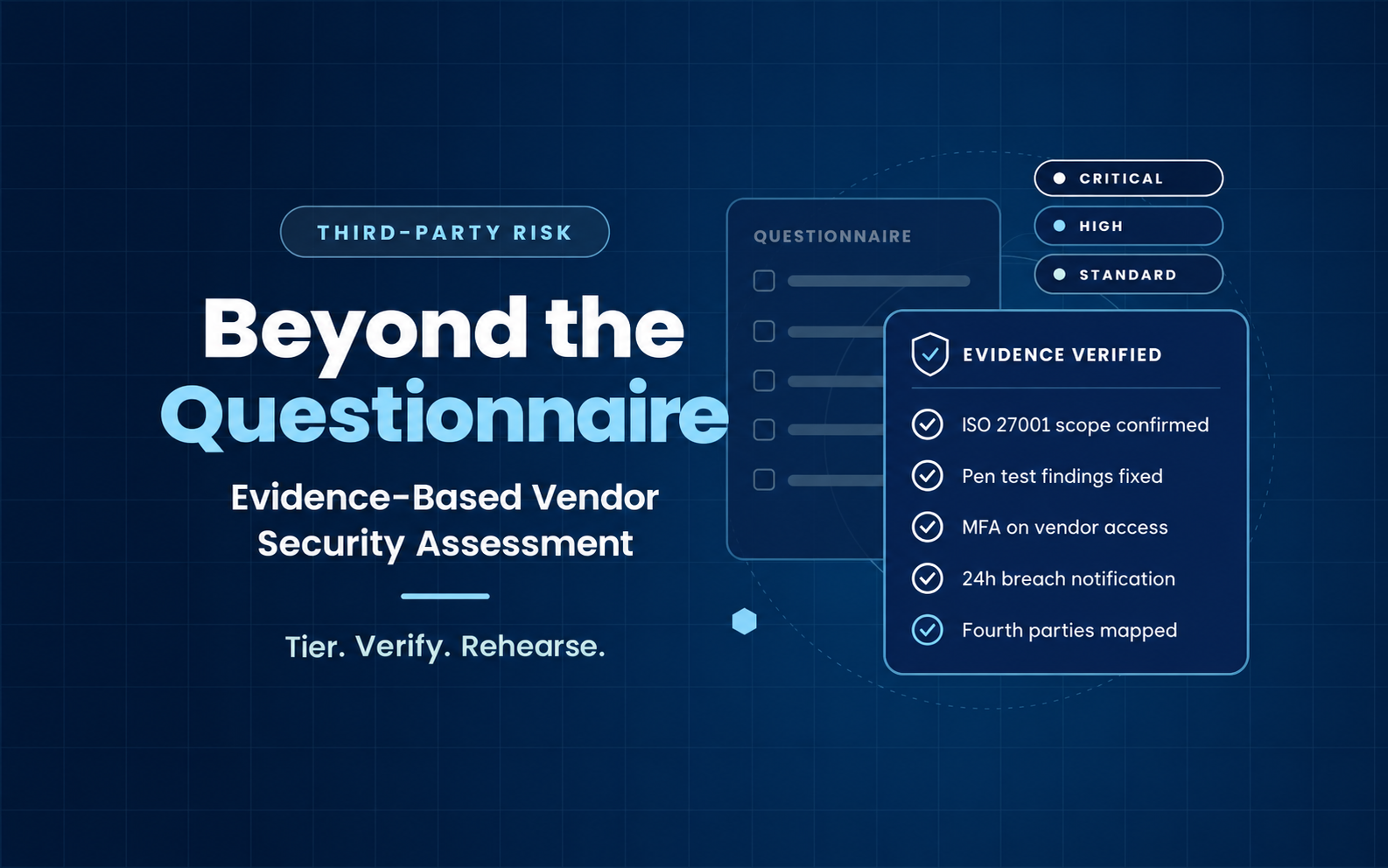
Is a supplier questionnaire enough?
A questionnaire can collect useful information, but it is only one part of assurance. It should be combined with evidence relevant to the service, access and data involved, and with an understanding of how the relationship affects the business. A completed questionnaire does not, by itself, show that the enterprise can contain access or recover from a supplier disruption.
How often should global enterprises review suppliers?
Set review timing according to the supplier’s importance, access and exposure, and revisit the assessment when the service or dependency changes. Examples include a change in access model, subcontractor, data handling, geographic footprint or the enterprise’s reliance on the provider. A critical dependency may warrant more frequent attention than a low-impact supplier.
Should a global enterprise use one supplier risk framework?
A common framework can improve consistency and make enterprise-wide comparisons easier. It should allow regional teams to account for local services, business conditions and applicable obligations. The aim is a shared way to identify, assess and escalate risk—not to force every supplier relationship into an identical review regardless of impact.
Resilience starts with the connections between suppliers
A supplier register and an assurance programme are valuable foundations. Global cyber resilience also depends on seeing how providers connect to business services, where regions share critical platforms, and what happens when one dependency fails.
Build the map around important services. Identify shared providers and common failure points. Test containment and recovery with the teams that would be responsible. Then use the findings to make explicit decisions about access, alternatives and risk ownership.
Summary
If your organisation is reviewing global supplier exposure, mapping critical dependencies or testing recovery scenarios, gety in touch with us today.
Ready to strengthen your security posture? Contact us today for more information on protecting your business.
Let's get protecting your business
Thank you for contacting us.
We will get back to you as soon as possible.
By submitting this form, you acknowledge that the information you provide will be processed in accordance with our Privacy Policy.
Please try again later.
Cybergen News
Sign up to get industry insights, trends, and more in your inbox.
Contact Us
Thank you for subscribing. It's great to have you in our community.
Please try again later.
SHARE THIS
Latest Posts