The CISO's Guide to Automated Domain Takedown: How Predictive Cybersecurity Ends the Manual Grind
September 18, 2026
Introduction
Somewhere in your SOC right now, an analyst is probably doing exactly this: a customer or employee has flagged a suspicious email, the analyst pulls the domain, runs a WHOIS lookup, checks the registrar, screenshots the fake login page, drafts an abuse report, submits it to a hosting provider, waits, chases up, escalates, and finally, days later, logs the takedown as resolved. Multiply that by every impersonating domain, fake app, and spoofed social profile targeting your brand this month, and you have a full-time job that exists purely because attackers moved faster than your tools did.
That is the reality most CISOs are quietly managing: not a lack of awareness of domain impersonation and phishing infrastructure, but a lack of time to deal with the sheer volume of it using manual, reactive processes. Predictive cybersecurity changes that equation entirely, and it is why BforeAI's PreCrime™ platform, now available in the UK exclusively through Cybergen, is becoming a standard line item in serious threat intelligence strategies.
The Real Cost: What Manual Domain Takedown Really Costs Your Security Team
Every weaponized or impersonated domain that reaches your SOC as an alert triggers the same chain of manual work: triage and verification, WHOIS and hosting lookups, evidence capture, drafting a takedown request, identifying the correct registrar or hosting abuse contact, submission, follow-up, escalation if there's no response, and finally documentation for compliance and board reporting. For a mid-sized enterprise dealing with even a modest volume of impersonation attempts each month, that workflow can easily consume dozens of analyst hours, hours that aren't spent on threat hunting, incident response, or the strategic work a CISO actually wants their team focused on.
The problem compounds because the threat landscape doesn't wait. According to BlackBerry's Global Threat Intelligence Report, the average phishing site lives for roughly 12 hours before it disappears, either taken down or simply retired by the attacker once it has served its purpose. IBM's 2025 Cost of a Data Breach Report puts the average cost of a phishing-initiated breach at 4.8 million US dollars. When your team's takedown process is measured in days and the attacker's window of exposure is measured in hours, the maths simply doesn't work in your favor. Manual processes are not built for a threat that moves this fast, and no amount of additional headcount fixes a fundamentally reactive workflow.
What Is Domain Impersonation, and Why Is It Accelerating in 2026
Domain impersonation covers any web address registered to mimic a legitimate brand, executive, or product: typosquatting (yourbrand-secure.com), combosquatting (yourbrand-support.com), homoglyph attacks that swap letters for near-identical characters, and lookalike subdomains designed to pass a quick glance. These domains are used to host phishing pages, credential-harvesting portals, fake customer support scams, counterfeit storefronts, and malware distribution points.
The volume has grown sharply for reasons every CISO will recognize. Domain registration is cheap and near-instant. Generative AI now lets attackers produce convincing fake sites, cloned branding, and phishing copy in minutes rather than days. Research cited by the Anti-Phishing Working Group and Mimecast found that 1,642 different brands were impersonated using malicious QR codes alone in a single quarter, with household names like Walmart and DHL topping the list in consecutive periods. Your organization's digital footprint, main domain, regional sites, subdomains, mobile apps, and social channels, has also expanded faster than most security budgets, giving attackers a wider surface to copy and a longer list of places for your team to monitor manually.
Why Traditional Threat Intelligence and Brand Protection Tools Aren't Enough
Most brand protection, digital risk protection, and anti-phishing tools share the same underlying limitation: they detect domains and content that already exist. They crawl the live web, check blocklists, or wait for a phishing email to be reported before flagging a threat. That means the earliest possible moment of detection is after the infrastructure is built and, in a growing number of cases, after it has already reached victims.
Attackers have adapted specifically to exploit this gap. Domains are frequently registered, parked, and left dormant for days or weeks before being activated as a live phishing page, timed deliberately to slip past detection windows and catch security teams off guard when the campaign finally launches. Traditional tools, no matter how comprehensive their crawling, simply cannot see intent before activation. They can only ever be reactive, and reactive tools generate reactive workloads for your team.
Predictive Cybersecurity: What PreCrime by BforeAI Actually Does
The starting point is still necessary, even if it isn't sufficient alone. Imperva API Security, part of the Thales portfolio since the 2023 acquisition, continuously discovers and monitors APIs across cloud, on-premise, and hybrid environments, including shadow APIs that never made it into anyone's inventory.
It assesses every discovered API against the OWASP API Security Top 10, flagging design weaknesses and configuration drift, and at runtime protects against API-specific attacks and business logic abuse, working alongside Imperva's Advanced Bot Protection to catch high-volume, technically legitimate abuse that traditional WAF rules miss entirely. It integrates with the API gateways organizations already run, including Kong, Mulesoft, Azure API Management, Apigee, and F5, with both agent-based and agentless deployment options.
This layer answers "what APIs do we have, and are they behaving the way they should." It's the foundation, not, on its own, an answer to what happens to the data those APIs are moving.
How PreCrime Detects and Disrupts Threats Before They're Weaponised
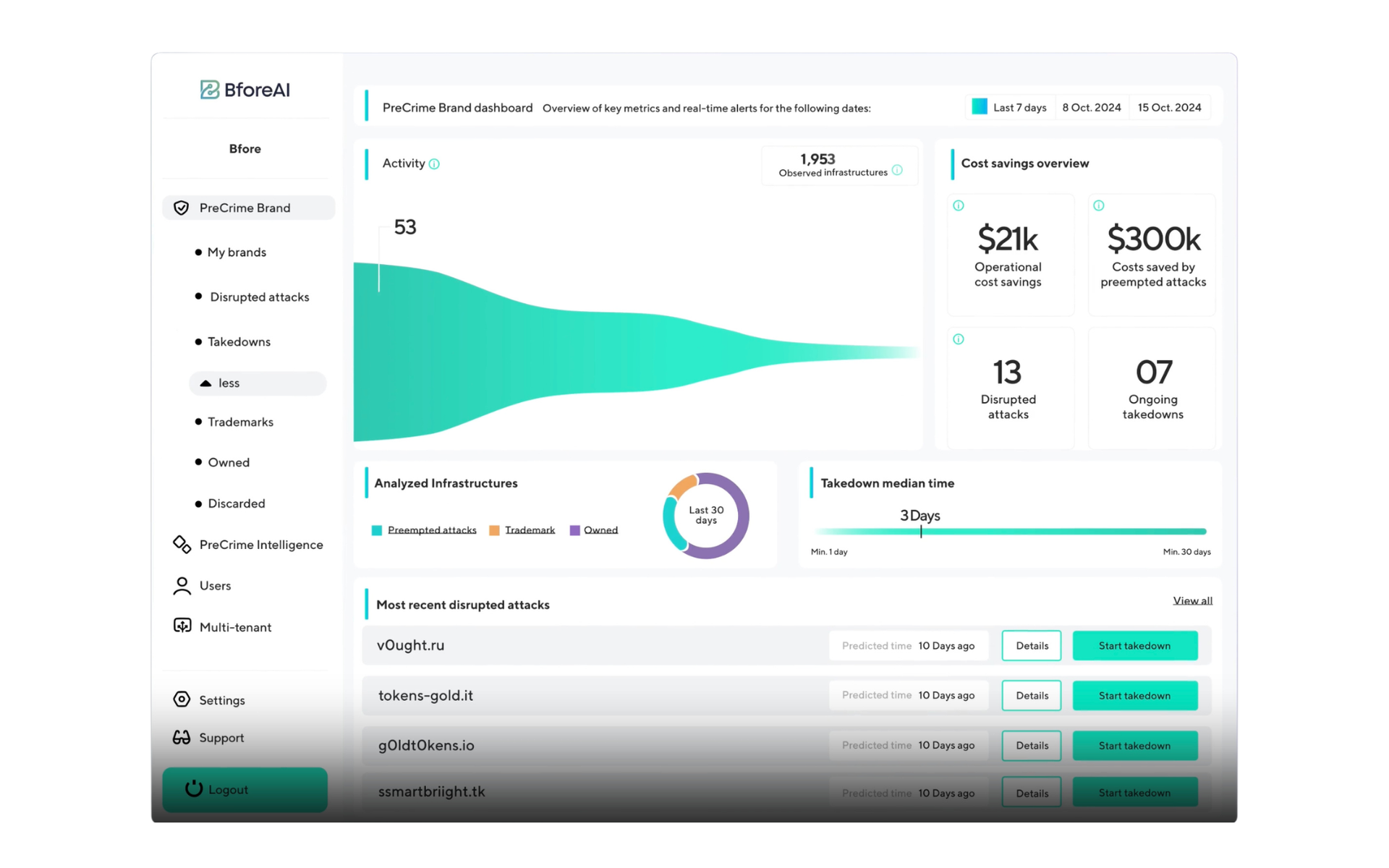
PreCrime's behavioural AI engine continuously analyzes internet-scale signals across three main categories. Registration patterns cover unusual naming conventions, bulk registrations, and registrar behaviours that correlate strongly with malicious campaigns. Hosting and infrastructure signals track how and where a domain is hosted, DNS configuration changes, and shared infrastructure links to known bad actors. Behavioural fingerprints capture the sequence of actions attackers typically take when standing up phishing or fraud infrastructure, long before any content is published for a human analyst or crawler to find.
BforeAI correlates these signals across a dataset built from millions of mapped malicious behaviours and tens of millions of suspicious infrastructures, giving the platform enough context to distinguish a legitimate new domain from one built to impersonate a brand, before it's ever used maliciously. That intelligence then feeds directly into automated takedown and disruption workflows, which is the piece that actually gives your SOC its time back. Instead of an analyst manually building a case file for every suspicious domain, PreCrime surfaces a pre-verified, high-confidence threat and can trigger the takedown process automatically.
The Data CISOs Care About: Coverage, Accuracy, and Speed
When you're deciding whether to bring a new platform into your stack, the numbers need to hold up. PreCrime's published performance includes 18 days of average lead time over conventional threat intelligence sources, up to 75 percent less phishing exposure by disrupting campaigns before activation, 96 percent coverage of malicious infrastructure targeting a given brand, a 93 percent automated takedown success rate, threat identification and disruption triggered in under 7 minutes, and a false positive rate below 0.05 percent.
That last figure matters more than it might first appear. A high detection rate with a high false positive rate just moves the manual workload from investigating live incidents to investigating false alarms, which is not a win for a CISO trying to reduce analyst burnout. A sub-0.05 percent false positive rate means your team can trust the alerts enough to let automated workflows run without a human double-checking every single one, which is precisely where the hours-back argument becomes real rather than theoretical.
From Alert to Automated Takedown: Reclaiming Your SOC's Time
Picture the same scenario from the opening of this article, but running through PreCrime instead of a manual queue. The platform identifies a newly registered domain exhibiting the behavioral fingerprint of an in-progress phishing setup, days or weeks before it would ever generate a customer complaint. It's already been checked against a dataset of confirmed malicious infrastructure, already scored with a false positive rate low enough to act on, and already routed into an automated takedown workflow, complete with the documentation your compliance team needs for reporting.
Your analyst's role shifts from manual investigator to exception handler: reviewing the small number of edge cases the system flags for human judgment, rather than personally building a case file for every one of the hundreds of impersonation attempts targeting your brand each month. For a security team already stretched across detection, response, vulnerability management, and everything else on a modern SOC's plate, that shift alone can be the difference between a threat intelligence program that scales and one that quietly falls behind the volume of attacks it's meant to be catching.
Full Spectrum Protection: Beyond Domains
Domain impersonation is just one slice of the exposure PreCrime is built to cover. The same behavioral detection model extends to executive and brand impersonation, including fraudulent domains and profiles built around your leadership team or trademarks; mobile app clones designed to mimic legitimate apps and steal data or payment details; social media fraud, including fake support accounts used to scam customers directly through channels they trust; and subdomain and third-party platform abuse, where attackers exploit trusted infrastructure to host malicious content under cover of a legitimate domain.
Because all of these threats tend to originate from the same kind of attacker preparation activity, a single predictive engine catches them earlier across the board rather than requiring a separate point solution, and a separate manual process, for each channel.
Predictive Intelligence and Regulatory Pressure: NIS2, DORA, and Board Reporting
For UK and EU organisations, the case for predictive threat intelligence isn't only operational, it's increasingly regulatory. NIS2 and DORA both raise the bar on proactive risk management, incident detection timelines, and the ability to demonstrate to a regulator or the board that your organisation identifies threats early rather than discovering them after the fact. A platform that can show measurable lead time on malicious infrastructure, backed by clear coverage and accuracy metrics, gives CISOs something far stronger to bring into a board or audit conversation than a description of a manual process and a spreadsheet of takedown requests.
Predictive detection also simplifies the evidence trail. Automated, timestamped detection and takedown records are inherently easier to present for compliance purposes than a patchwork of email threads, screenshots, and manually logged tickets, which matters as much during a regulatory review as it does during a live incident.
Why UK Organisations Are Turning to Cybergen for PreCrime
Cybergen is BforeAI's only authorized reseller in the United Kingdom, which means UK organizations get PreCrime with local procurement, local support, and a partner that already understands the UK regulatory landscape it needs to operate within. Cybergen was built as a next-generation threat intelligence and cybersecurity partner with a simple philosophy: no jargon, no fear tactics, and cybersecurity that organizations of any size, not just those with mature in-house security teams, can actually understand and act on.
That philosophy extends naturally to how PreCrime gets deployed. Cybergen's own portfolio spans 24x7x365 managed detection and response, penetration testing, threat intelligence, and governance and compliance consulting across ISO 27001, Cyber Essentials, NIS2, and DORA, which means PreCrime doesn't arrive as an isolated tool bolted onto your stack. It's implemented by a team that already thinks about detection, response, and compliance as one connected problem, and that can help translate PreCrime's predictive intelligence into the reporting your board and regulators expect to see.
Getting Started: Bringing PreCrime to Your Security Stack
If your team is currently spending hours a week on manual domain and impersonation takedowns, that time is recoverable, and the technology to recover it is already proven at scale. Cybergen can walk you through what PreCrime would surface against your specific brand footprint, show you the coverage and false positive numbers against your own domain estate, and map out how automated takedown slots into your existing SOC and SIEM workflows without disrupting what's already working.
Predictive cybersecurity isn't a future concept for CISOs to keep on a watch list. It's a deployable platform, backed by measurable results, that's already giving security teams weeks of lead time and hundreds of hours back every year. The only real question left is how much longer your team keeps doing manually what PreCrime is already built to automate.
Frequently Asked Questions
What is predictive cybersecurity, and how is it different from threat intelligence?
Predictive cybersecurity analyzes behavioral signals, such as domain registration patterns and hosting activity, to identify malicious infrastructure before it's used in an attack. Traditional threat intelligence typically catalogues indicators of compromise after a threat is already active, whereas predictive platforms like PreCrime aim to act during the attacker's preparation phase.
How much time can automated domain takedown actually save a security team?
The exact figure depends on your organisation's size and the volume of impersonation attempts it faces, but manual domain takedown workflows, verification, evidence gathering, registrar contact, follow-up, and documentation, typically consume several hours per incident. Automating detection and takedown for high-confidence threats lets analysts focus only on genuine exceptions, which for most mid-sized and enterprise security teams translates into hundreds of recovered hours per year.
How does PreCrime detect a domain before it's used maliciously?
PreCrime analyses registration patterns, hosting and infrastructure signals, and behavioural fingerprints associated with attacker preparation activity. By correlating these signals across a dataset of millions of previously mapped malicious behaviours, it can flag high-risk domains during setup, often around 18 days before the domain would be caught by conventional detection methods.
Is PreCrime relevant to NIS2 or DORA compliance?
Yes. Both frameworks emphasise proactive risk detection and the ability to demonstrate timely identification of threats. Predictive detection with clear, timestamped coverage and accuracy metrics gives CISOs stronger, more defensible evidence for board and regulatory reporting than manual, reactive takedown logs.
How do UK organisations get access to PreCrime?
Cybergen is BforeAI's only authorised reseller in the UK, providing local procurement, implementation support, and integration with existing security operations, including Cybergen's own managed detection and response and compliance services.
Does PreCrime only protect against phishing domains?
No. The same behavioural detection engine also covers executive and brand impersonation, mobile app clones, social media fraud, and subdomain or third-party platform abuse, giving security teams a single predictive engine across the full range of brand impersonation and digital risk.
Stay Ahead of the Next Attack
Speak to our specialist team today about how bfore.ai's predictive threat intelligence can stop attacks before they launch, not after they land. Get a personalised walkthrough of how PreCrime Cyber Threat Intelligence flags malicious domains, phishing infrastructure, and brand abuse days or weeks before they're weaponised.
Ready to strengthen your security posture? Contact us today for more information on protecting your business.
Let's get protecting your business
Thank you for contacting us.
We will get back to you as soon as possible.
By submitting this form, you acknowledge that the information you provide will be processed in accordance with our Privacy Policy.
Please try again later.
Cybergen News
Sign up to get industry insights, trends, and more in your inbox.
Contact Us
Thank you for subscribing. It's great to have you in our community.
Please try again later.
SHARE THIS
Latest Posts