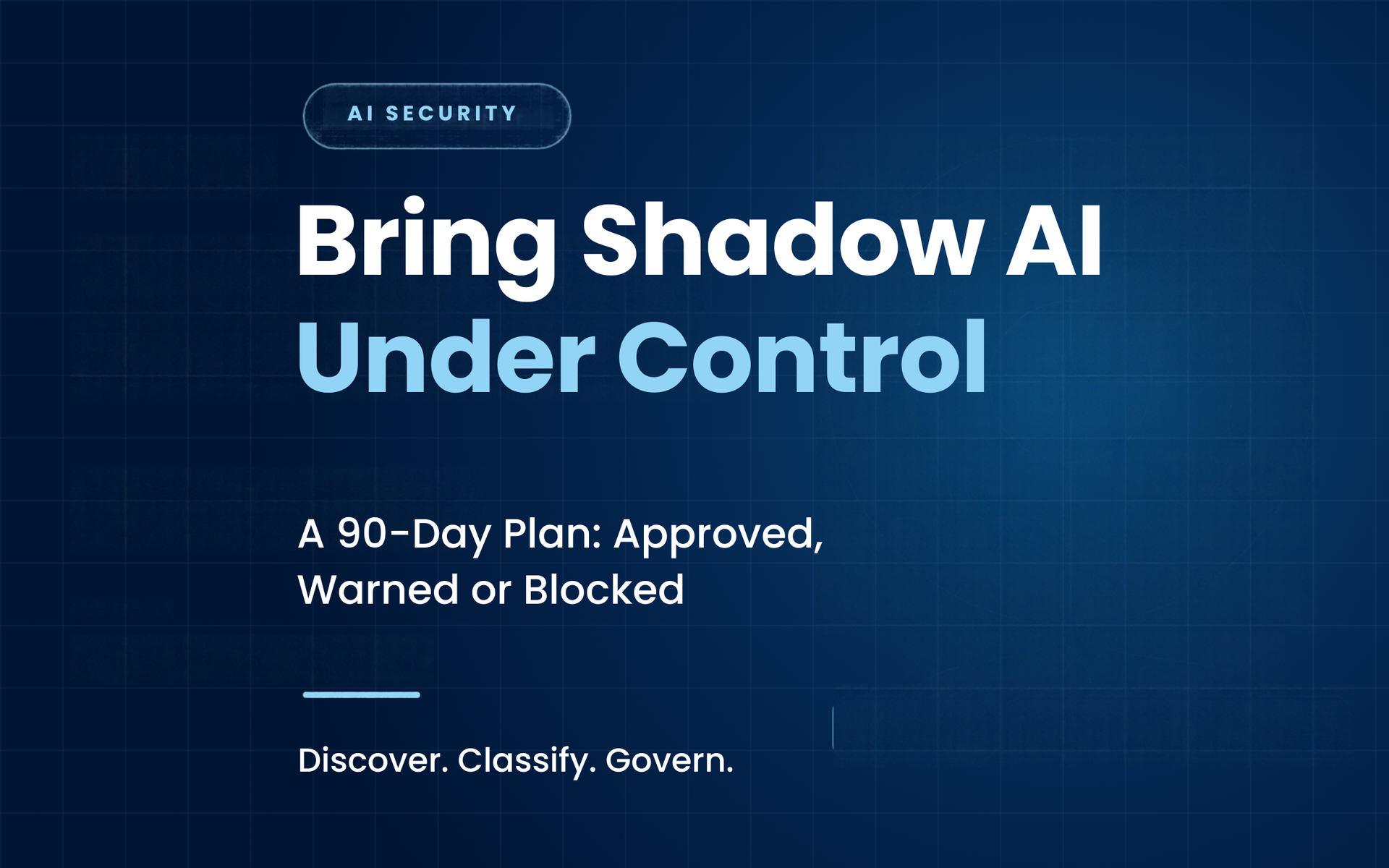
Shadow AI Is Already Inside Your Organisation: Here's How to Regain Control
June 3, 2026

AI Adoption Is Accelerating Faster Than Governance
Artificial intelligence has quickly become one of the most transformative technologies the modern workplace has ever experienced. Unlike previous technology shifts, which often took years to reach mainstream adoption, AI tools have been embraced by employees almost overnight. Platforms such as ChatGPT, Microsoft Copilot, Claude, Gemini and thousands of specialised AI applications are now being used across every business function imaginable. From drafting reports and analysing spreadsheets to writing software code and responding to customers, employees are increasingly turning to AI to work faster, improve productivity and reduce repetitive tasks.
For business leaders, this rapid adoption presents exciting opportunities. AI has the potential to increase efficiency, unlock innovation and create significant competitive advantages. However, for CISOs and security teams, it also introduces a new and rapidly expanding attack surface. The challenge is not that employees are using AI; the challenge is that many organisations have little visibility into how it is being used, what information is being shared and whether usage aligns with security, compliance and governance requirements.
What makes AI adoption particularly difficult to manage is its accessibility. Unlike traditional enterprise software, which typically requires procurement, deployment and IT approval, most AI tools can be accessed instantly through a web browser. An employee can discover a new AI application in the morning and begin using it with company data before lunch. Security teams are often completely unaware this activity is taking place. As a result, organisations find themselves in a situation where AI adoption is accelerating far faster than the governance frameworks designed to manage it.
Many CISOs are now discovering that their organisations have become AI-enabled by default rather than by design. Employees have already embraced AI because it helps them perform their jobs more effectively. The question facing security leaders is no longer whether AI is being used. The reality is that AI is already embedded into daily workflows across almost every department. The more important question is whether organisations have the visibility, controls and governance required to ensure that AI usage remains secure.
The scale of adoption is often far greater than organisations initially expect. Many businesses that conduct their first AI risk assessment discover dozens, sometimes hundreds, of AI applications being used across departments. Marketing teams may be using content-generation platforms, software developers may be leveraging coding assistants, HR teams may be experimenting with recruitment tools, while finance departments use AI for reporting and forecasting. Individually these tools can appear low risk. Collectively they create an ecosystem of unmanaged AI activity that introduces significant security, compliance and governance concerns.
What Is Shadow AI?
The term Shadow AI refers to the use of artificial intelligence applications, tools and services without formal approval, oversight or governance from an organisation's IT, security or compliance teams. It is the natural evolution of Shadow IT, a phenomenon that emerged when employees began adopting cloud services, file-sharing platforms and productivity applications without going through official procurement processes.
The difference today is that AI adoption is occurring at an unprecedented scale. Employees are not necessarily trying to bypass security policies. In most cases, they are simply seeking faster ways to complete their work. A marketing manager may use ChatGPT to create campaign content. A sales representative may ask an AI assistant to draft customer proposals. A software developer might rely on an AI coding assistant to accelerate development. A human resources professional could use AI to summarise interview notes or draft policies. Each use case appears relatively harmless in isolation, yet collectively they create significant visibility and governance challenges.
Consider a common scenario. A finance employee is preparing a board report and decides to upload financial data into an AI platform to generate an executive summary. The employee's intention is simply to save time. However, without realising it, they may have shared confidential financial information with a third-party AI provider. In another example, a legal team member may upload a sensitive contract into a generative AI platform to obtain a summary of key clauses.
Again, the objective is productivity, but the organisation may have no understanding of where that information is being processed, stored or retained.
Shadow AI is not limited to well-known platforms. Thousands of AI applications now exist for specialised functions including contract analysis, code generation, image creation, customer service, market research, financial modelling and business intelligence. Many of these tools offer free versions that employees can access immediately without involving IT or procurement teams. This ease of access is one of the primary reasons Shadow AI is growing so rapidly across organisations of all sizes.
The reality is that Shadow AI is often driven by positive intentions. Employees want to improve efficiency, meet deadlines and deliver better results. Unfortunately, good intentions do not eliminate risk. Without appropriate governance, organisations may find sensitive data flowing into AI systems beyond their control, creating potential exposure across cybersecurity, compliance, legal and operational domains.
The Hidden Risks Behind Uncontrolled AI Usage
One of the reasons Shadow AI has become such a significant concern for CISOs is that the risks are often invisible until an incident occurs. Unlike traditional cybersecurity threats, where organisations can monitor known attack vectors, Shadow AI activity frequently takes place through legitimate business workflows. Employees are using approved devices, approved networks and legitimate applications. The problem lies in what data is being shared and how it is being processed once it leaves the organisation's environment.
Sensitive data exposure is perhaps the most immediate concern. Many employees fail to appreciate that AI systems rely on information provided by users to generate responses. Depending on the platform and configuration, this information may be processed, stored or used in ways that introduce risk. Customer records, financial data, intellectual property, source code, legal agreements and strategic business plans can all find their way into AI applications through seemingly routine interactions.
Imagine a healthcare provider whose employees upload patient information into a generative AI tool to create clinical summaries. Or consider a financial services organisation where analysts use AI to process confidential investment information. In both cases, highly sensitive data could be leaving controlled environments without the knowledge of security teams. The potential consequences include regulatory investigations, financial penalties and reputational damage.
Compliance obligations add another layer of complexity. Regulations such as GDPR, the EU AI Act, DORA and NIS2 place increasing emphasis on accountability, transparency and data governance. Organisations are expected to understand how data is processed, where it resides and who has access to it. Shadow AI fundamentally undermines these requirements because organisations cannot govern activities they cannot see. If a regulator asks how AI is being used across the organisation, many businesses would struggle to provide a complete answer.
Intellectual property represents another major concern. For many organisations, their most valuable assets are not physical products but proprietary information, trade secrets and unique methodologies. AI tools are increasingly being used to analyse engineering designs, software code, research documents and strategic plans. Without proper controls, employees may inadvertently expose information that provides competitors with a significant advantage. Once proprietary information leaves the organisation, recovering control becomes considerably more difficult.
Perhaps most overlooked is the risk associated with inaccurate AI outputs. Generative AI systems are remarkably convincing, yet they are not always correct. Employees may assume that information generated by AI is accurate because it is presented confidently and professionally. This creates the risk of poor business decisions being made based on flawed information. Whether it is legal advice, financial analysis, technical guidance or regulatory interpretation, organisations that fail to establish validation processes may find themselves introducing new forms of operational risk.
There is also an emerging threat surrounding AI-powered social engineering. Cybercriminals are increasingly leveraging AI to create convincing phishing emails, fraudulent communications and impersonation campaigns. Employees who are already accustomed to interacting with AI tools may be more susceptible to trusting AI-generated content. This creates additional security concerns that extend beyond data exposure into broader cyber resilience and threat management strategies.
Why Existing Security Controls Are Not Enough
Many organisations assume that their existing cybersecurity investments will provide adequate protection against AI-related risks. Unfortunately, this assumption is increasingly proving to be incorrect. Traditional security controls were designed to address threats such as malware, phishing attacks, unauthorised access and data exfiltration. They were not designed to monitor how employees interact with AI platforms or understand the context of AI-generated workflows.
A secure web gateway, for example, may identify that an employee visited ChatGPT or another AI application. What it typically cannot determine is what information was entered into the platform, what files were uploaded or whether sensitive data was exposed during the interaction. Similarly, data loss prevention solutions often struggle to identify nuanced AI-related risks because they focus on predefined patterns rather than understanding user intent and behaviour.
This creates a significant visibility gap. Security teams may know that AI applications are being accessed, but they often lack the insight needed to assess risk effectively. They cannot easily determine whether employees are using AI responsibly or whether confidential information is being shared in ways that violate policy. As AI adoption continues to grow, these blind spots become increasingly difficult to manage.
The challenge becomes even greater when organisations attempt to block AI outright. Employees who see clear productivity benefits are unlikely to abandon AI simply because access has been restricted. Instead, they may seek alternative applications, personal devices or unsanctioned workarounds. The result is often reduced visibility rather than reduced risk.
Many organisations are finding that traditional approaches to governance simply do not work in an AI-driven environment. Security leaders need a deeper understanding of user behaviour, application usage and data movement. They need to know not just which AI applications are being accessed, but how they are being used and what risks those interactions create. Without this level of visibility, security teams are effectively attempting to manage a rapidly growing risk category while operating in the dark.
How Organisations Can Regain Visibility and Control
The first step towards addressing Shadow AI is recognising that AI adoption is already happening. Organisations that approach AI governance from a position of denial often find themselves falling further behind. Effective governance starts with visibility. Before organisations can manage risk, they must first understand the scope of AI usage taking place across their environment.
Modern AI monitoring solutions provide organisations with the ability to identify which AI applications are being used, who is using them, how frequently they are being accessed and what risks are associated with those interactions. This level of visibility often reveals surprising results. Many organisations discover that employees are using dozens of different AI platforms, many of which were previously unknown to security teams.
Once visibility is established, organisations can begin implementing policy-driven governance. The objective should not be to eliminate AI usage but to guide it. Employees need clear guidance regarding approved applications, acceptable use cases and prohibited behaviours. Policies should be practical, easy to understand and aligned with business objectives. Overly restrictive policies often encourage employees to seek workarounds, ultimately increasing risk rather than reducing it.
User education also plays a critical role. Most employees do not intentionally create risk. They simply lack awareness of the implications associated with sharing sensitive information through AI systems. Providing real-time coaching and contextual guidance helps users make better decisions while preserving productivity. Rather than acting as a barrier, governance becomes an enabler that allows employees to use AI responsibly.
Leading organisations are also establishing approved AI frameworks that provide employees with secure alternatives. By offering sanctioned AI tools that meet security and compliance requirements, organisations can encourage adoption within controlled environments. This approach balances innovation and governance, ensuring employees can benefit from AI while reducing organisational exposure.
What Modern AI Governance Should Look Like
The future of AI governance will not be defined by restriction. It will be defined by visibility, control and enablement. Organisations that attempt to ban AI entirely are unlikely to succeed. The productivity benefits are simply too compelling, and employees will continue seeking ways to incorporate AI into their workflows.
Modern AI governance begins with real-time visibility. Security teams need to understand AI usage across the organisation as it happens. They need insight into which applications are being accessed, what data is being shared and where risks are emerging. Visibility transforms AI from an unknown threat into a manageable business process.
Risk-based enforcement represents another critical component. Not every AI interaction carries the same level of risk. An employee using AI to improve grammar in an internal document presents a different risk profile than an employee uploading customer databases into a public AI platform. Modern governance frameworks prioritise risk based on context, allowing security teams to focus on activities that pose genuine business concerns.
Compliance reporting is becoming increasingly important as regulators focus more closely on AI adoption. Boards, auditors and regulators want evidence that organisations understand how AI is being used and that appropriate controls are in place. Effective governance programmes provide measurable insights into AI adoption, policy adherence and risk reduction efforts.
Most importantly, successful organisations view AI governance as a business enabler. The objective is not to stop employees using AI. The objective is to ensure they can do so safely. When organisations provide visibility, guidance and approved pathways for AI usage, employees gain confidence, productivity improves and risks become manageable.
Shadow AI Is Already Here. The Time to Act Is Now
Shadow AI is no longer a future concern. It is already embedded within most organisations, often at a scale far greater than leadership teams realise.
Employees are using AI applications every day to improve efficiency, automate tasks and solve business problems. In many cases, they are doing so with the best of intentions. However, without visibility and governance, these activities can introduce significant cybersecurity, compliance and operational risks.
For CISOs, the priority should be clear. Organisations cannot secure what they cannot see. Before effective governance can be established, security teams need visibility into AI usage across the organisation. Once that visibility exists, organisations can implement policies, educate users and enable AI adoption in a way that balances innovation with security.
The organisations that thrive in the age of AI will not be those that resist change. They will be those that embrace AI confidently while maintaining control over how it is used. Secure AI adoption is no longer simply a technology challenge; it is a business imperative.
Cybergen helps organisations uncover Shadow AI activity, understand AI-related risks and implement intelligence-led governance frameworks that provide visibility without restricting innovation. Through our FREE AI Risk Assessment, organisations can gain a clear understanding of AI usage across their environment, identify areas of exposure and establish the foundations for secure AI adoption.
The first step towards regaining control is understanding what is already happening. The question is not whether Shadow AI exists within your organisation. The question is how much of it you can currently see.
Ready to strengthen your security posture? Contact us today for more information on protecting your business.
Let's get protecting your business
Thank you for contacting us.
We will get back to you as soon as possible.
By submitting this form, you acknowledge that the information you provide will be processed in accordance with our Privacy Policy.
Please try again later.
Cybergen News
Sign up to get industry insights, trends, and more in your inbox.
Contact Us
Thank you for subscribing. It's great to have you in our community.
Please try again later.
SHARE THIS
Latest Posts