Cybersecurity in 2026: Why Strong Controls Still Fail, and How Threat-Led Security Closes the Gap
February 1, 2026

Introduction: The Cybersecurity Gap No One Wants to Admit
Cybersecurity spending is rising.
Regulation is tightening.
Boards are asking better questions.
And yet, breaches continue to escalate.
Despite decades of investment, many organisations are still failing at the fundamentals of cybersecurity, not because they lack tools, but because they lack clarity, prioritisation, and real-world context.
Nowhere is this more visible than in financial services, where regulators continue to uncover the same weaknesses year after year: inconsistent access controls, weak monitoring, over-reliance on perimeter defences, and limited visibility into third-party cyber risk.
The uncomfortable truth is this:
Most organisations are busy managing cyber activity — not cyber risk.
This article explores:
- Why cybersecurity controls still fail despite heavy investment
- Where organisations are most exposed today
- Why traditional security models struggle against modern threats
- How a threat-led, intelligence-driven approach finally closes the gap
1. Cybersecurity Has a Visibility Problem, Not a Technology Problem
Ask most organisations about their cybersecurity posture and you’ll hear the same answers:
- “We have firewalls”
- “We run vulnerability scans”
- “We’ve rolled out MFA”
- “We’re ISO aligned”
- “We pass audits”
All of these are necessary.
None of them are sufficient.
The Core Issue: Controls Without Context
Traditional cybersecurity focuses on control deployment, not exposure reduction.
A vulnerability scan may tell you:
- What is missing a patch
- What is misconfigured
- What is technically vulnerable
But it cannot tell you:
- Whether an attacker is actively exploiting it
- Whether it can be chained into a real compromise
- Whether it actually matters to your business
This creates a dangerous illusion of security, dashboards full of data, but no clear view of risk.
2. Cyber Risk Is Not Evenly Distributed — But Most Defences Are
One of the biggest failures in cybersecurity strategy is treating all vulnerabilities, alerts, and assets as equal.
They are not.
Real-World Attackers Don’t Target Everything
Threat actors focus on:
- Externally exposed systems
- Credential-rich environments
- Weak identity controls
- Poorly monitored infrastructure
- Trusted third parties
Yet many organisations still spread security efforts evenly across environments, drowning teams in alerts while missing the few risks that actually matter.
This is why breaches often feel “sudden”, even though attackers were present weeks or months earlier.
3. Why Detection Still Lags Behind Attackers
Prevention alone is no longer realistic.
Modern attackers assume:
- At least one control will fail
- Credentials will be reused or phished
- Alerts will be missed
- Logs won’t be reviewed in real time
The Detection Gap
Many organisations struggle with:
- Incomplete logging
- Delayed alerting
- No 24×7 monitoring
- Poor signal-to-noise ratio
- Lack of skilled analysts
This creates long dwell times, where attackers:
- Test credentials quietly
- Move laterally undetected
- Escalate privileges
- Stage data exfiltration
- Prepare ransomware deployment
By the time an alert fires, the damage is already done.
4. Managed Detection and Response (MDR): From Monitoring to Outcomes
This is why Managed Detection and Response (MDR) has become a cornerstone of modern cybersecurity.
But not all MDR is created equal.
What MDR Should Actually Deliver
True MDR is not:
- A ticket factory
- A tool reseller
- A dashboard with alerts
Effective MDR provides:

- 24×7×365 monitoring
- Human-led threat hunting
- Real incident investigation
- Actionable response guidance
- Clear business-level reporting
Most importantly, it answers one question executives care about:
“Are we being targeted right now, and what should we do about it?”
5. Threat Intelligence: The Missing Layer in Most Cybersecurity Programmes
Cybersecurity without threat intelligence is reactive by design.
You are always responding after something happens.
What Threat Intelligence Changes
Threat intelligence introduces:
- Adversary context
- Attack intent
- Infrastructure tracking
- Early warning signals
- Prioritised risk
Instead of asking “What vulnerabilities do we have?”
You ask, “Which of these vulnerabilities matter right now?”
This shift transforms how organisations:
- Prioritise remediation
- Tune detections
- Allocate SOC effort
- Brief leadership
- Justify investment
Threat intelligence turns cybersecurity from a technical exercise into a decision-support function.
6. Continuous Threat Exposure Management (CTEM): From Lists to Clarity
Most organisations already have long lists of vulnerabilities.
The problem isn’t lack of data, it’s lack of prioritisation.
Why CTEM Matters
Continuous Threat Exposure Management (CTEM) reframes vulnerability management around exposure, not volume.
CTEM focuses on:
- External attack surface
- Exploitability in the wild
- Business criticality
- Identity and access weaknesses
- Chained attack paths
Instead of fixing everything slowly, CTEM ensures you:

- Fix the right things first
- Reduce attacker opportunity
- Align remediation with real threats
This is how organisations move from compliance-driven security to risk-driven security.

7. Third-Party Cyber Risk: The Blind Spot That Keeps Getting Exploited
Modern organisations are ecosystems.
Your security posture is only as strong as:
- Your suppliers
- Your service providers
- Your cloud platforms
- Your outsourced IT
Why Third-Party Risk Is So Dangerous
Attackers love third parties because:
- They are trusted
- They often have weaker controls
- They bypass perimeter defences
- They enable lateral movement
Yet many organisations still rely on:
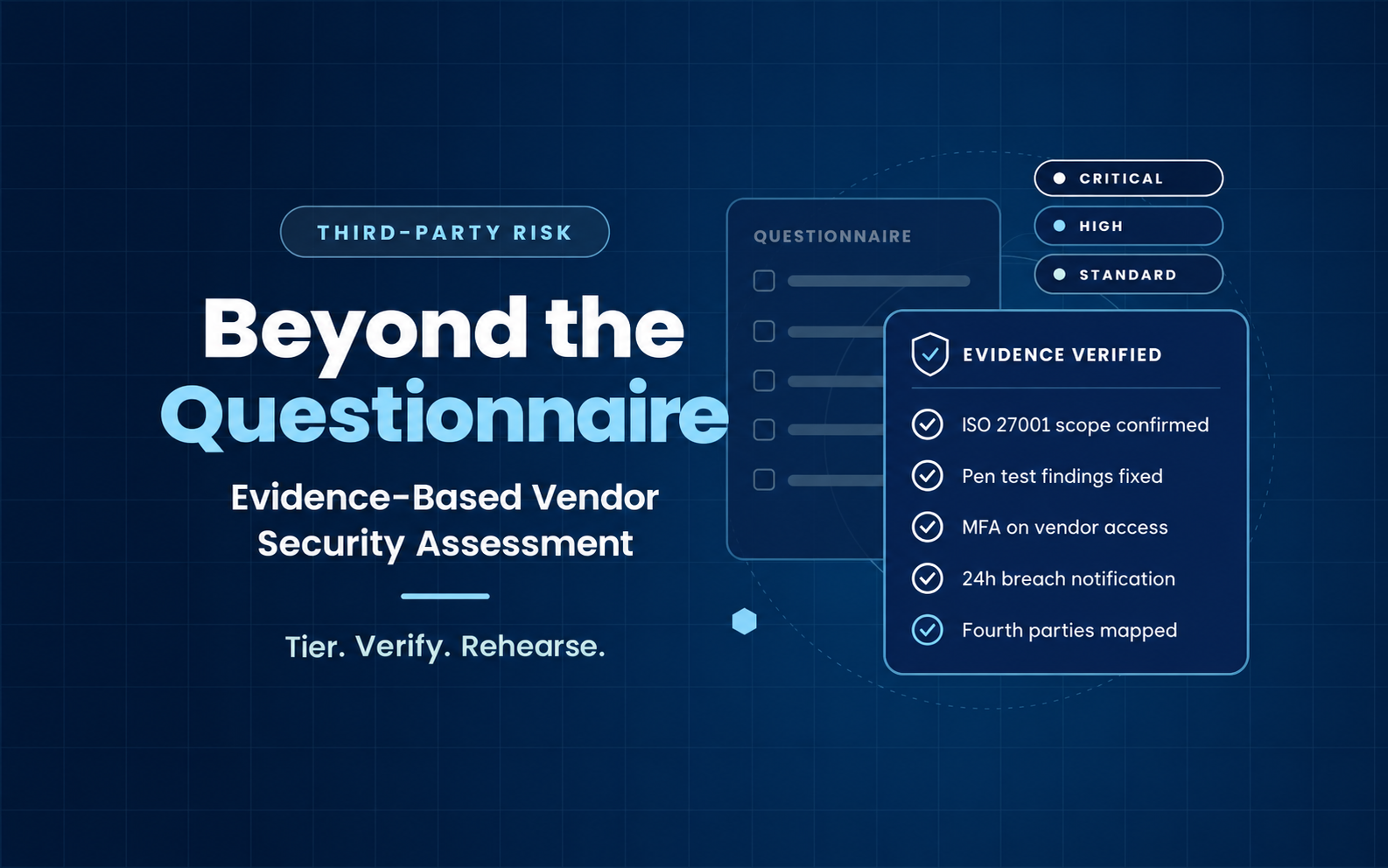
- Annual questionnaires
- Self-attestation
- Paper-based risk assessments
This provides little protection against real-world attacks.
Effective third-party cyber risk management requires:
- Continuous monitoring
- Identity assurance
- Threat intelligence correlation
- Contractual security enforcement
8. Cyber Resilience: Beyond Prevention and Recovery
Cyber resilience is not just about stopping attacks.
It’s about:
- Detecting early
- Responding effectively
- Recovering quickly
- Learning continuously
What Resilient Organisations Do Differently
Resilient organisations:
- Assume compromise is possible
- Test response regularly
- Maintain clear escalation paths
- Align cyber risk with business risk
- Communicate clearly under pressure
They don’t panic during incidents, because they’ve already rehearsed them.
9. Why Boards Still Struggle With Cybersecurity Decisions
Cybersecurity often fails at the executive level because it is presented poorly.
Boards are shown:

- Technical metrics
- Tool performance
- Vulnerability counts
What they actually need is:
- Risk exposure
- Likelihood of impact
- Business consequence
- Clear options
Threat-led cybersecurity bridges this gap by translating technical activity into decision-ready insight.
10. The Shift to Intelligence-Led Cybersecurity
The most effective organisations are making a clear shift:
From:
- Tool-led security
- Compliance-driven controls
- Reactive incident response
To:

- Threat-led security
- Intelligence-driven prioritisation
- Outcome-focused protection
This model recognises a simple reality:
You cannot defend everything, but you can defend what matters most.
Conclusion: Cybersecurity That Reduces Risk, Not Just Noise
Cybersecurity in 2026 is no longer about who has the most tools.
It’s about:
- Who understands their real exposure
- Who detects threats earliest
- Who responds with confidence
- Who aligns security with business outcomes
Organisations that continue to rely on static controls, periodic assessments, and generic dashboards will remain exposed, regardless of spend.
Those that adopt threat intelligence, MDR, and CTEM as a unified strategy will move faster, see clearer, and reduce risk where it actually counts.
How Cybergen® Supports Modern Cybersecurity
Cybergen® delivers intelligence-led cybersecurity services designed to reduce real-world risk:
- Managed Detection & Response (MDR)
- Continuous Threat Exposure Management (CTEM)
- Cyber Threat Intelligence (CTI)
- Incident Readiness & Response
- vCISO & Cyber Risk Advisory
Built around clarity, prioritisation, and measurable outcomes, not noise.
Ready to strengthen your security posture? Contact us today for more information on protecting your business.
Let's get protecting your business
Thank you for contacting us.
We will get back to you as soon as possible.
By submitting this form, you acknowledge that the information you provide will be processed in accordance with our Privacy Policy.
Please try again later.
Cybergen News
Sign up to get industry insights, trends, and more in your inbox.
Contact Us
Thank you for subscribing. It's great to have you in our community.
Please try again later.
SHARE THIS
Latest Posts